ReadPaper Blog
WorldDirector: Building Controllable World Simulators with Persistent Dynamic Memory
WorldDirector addresses a core weakness in video world models: dynamic objects often stop evolving, lose identity, or reappear incorrectly when they leave the camera view. The paper proposes a controllable framework that separates 3D semantic motion planning from latent video synthesis, using an LLM-orchestrated trajectory system, causal chunks, appearance binding, and spatial-aware conditioning to preserve object permanence during long-horizon generation.
Source: WorldDirector: Building Controllable World Simulators with Persistent Dynamic Memory

Research question
The paper asks how a video world model can maintain persistent dynamic memory when objects are no longer visible. Existing video generation systems can often produce plausible frames, but the authors argue that true world simulation requires dynamic entities to keep moving according to physical logic even outside the camera view. WorldDirector is introduced to solve this problem by preserving both independent object motion and strict appearance consistency across long-horizon videos. The motivating example is unrestricted viewpoint exploration, where the camera may rotate or move away while entities such as a sports car or a person continue their trajectories. The central claim is that object permanence in video synthesis cannot be left to pixel-level generation alone; it needs an explicit mechanism for tracking semantic state over time.
Why old methods fall short
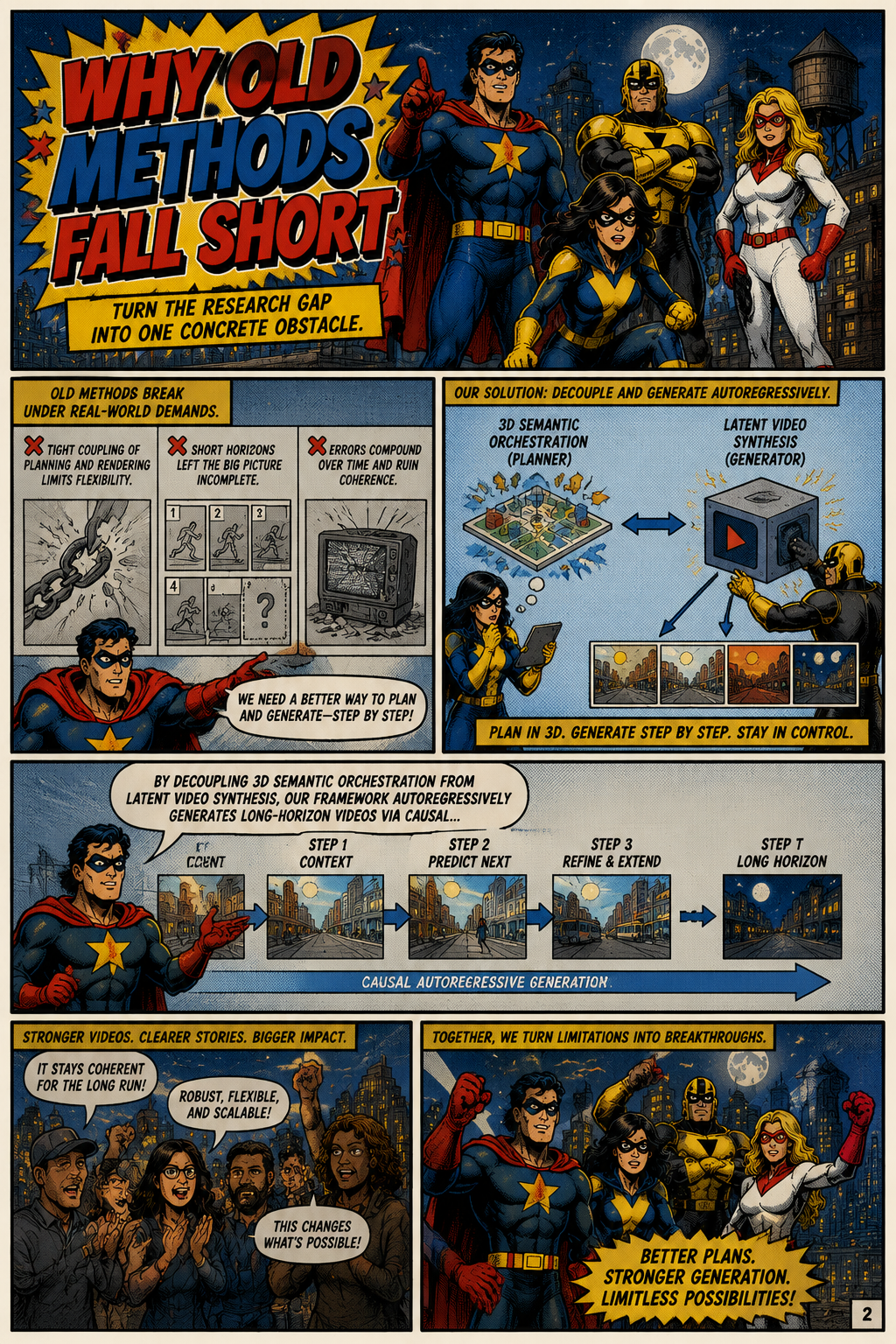
The paper identifies a gap between static scene consistency and dynamic object memory. Prior methods have made progress on preserving static environments through memory retrieval or contextual conditioning, but dynamic entities create a harder problem because their positions and states must evolve while they are unseen. The authors contrast monitor-based systems, which explicitly track out-of-sight entities but scale poorly with multiple active objects, with approaches that rely on internal generative priors to infer hidden motion. According to the paper, implicit extrapolation can fail during prolonged occlusion or complex interactions, producing frozen states, trajectory collapse, or identity errors when objects re-enter the frame. This diagnosis motivates WorldDirector’s separation of physical or semantic orchestration from visual rendering.
Core idea
WorldDirector’s core mechanism is to decouple 3D semantic orchestration from latent video synthesis. An LLM acts as a central orchestrator that translates user instructions into 3D bounding-box trajectories for dynamic objects and camera movements, so motion planning is represented explicitly before frames are generated. These 3D plans are projected into 2D bounding-box sequences that condition video synthesis, giving the generator concrete spatial signals rather than asking it to infer unseen dynamics from pixels alone. The framework generates long-horizon videos autoregressively through causal chunks, allowing each segment to inherit and advance the world state. This design gives users control over multiple entities while enforcing the paper’s two stated requirements: independent motion and consistent reappearance.

Evidence check
The paper’s evidence is presented through experiments showing that WorldDirector can synthesize complex extended events with persistent dynamic object memory and controllable viewpoint changes. The excerpt emphasizes scenarios where the camera leaves the relevant objects out of view and later returns, requiring the system to update their positions rather than freeze them at the last observed frame. The method uses orchestrated trajectories as control signals and introduces Appearance Binding to inject RGB dynamic-object features from context as visual anchors, which is intended to preserve identity and fine details after re-entry. It also uses spatial-aware cross-attention to route entity-specific text prompts to the corresponding regions, supporting granular state control. The reported result is not merely smoother video generation, but stricter alignment between planned object dynamics, camera motion, and visual identity across causal chunks.

One thing to remember
The main implication of WorldDirector is that controllable world simulation requires an explicit memory structure for dynamic entities, not just better frame prediction. By placing semantic motion planning outside the latent video generator, the framework treats object permanence as a first-class modeling problem: objects persist, move, and reappear according to planned trajectories even when the camera has stopped observing them. This makes the approach relevant to interactive environment simulation, where users may freely explore a scene while expecting hidden agents and objects to continue evolving. The paper also suggests a broader architectural lesson for video world models: separating what happens in the world from how it is rendered can improve controllability, physical logic, and appearance stability. Its limitations are not detailed in the provided excerpt, but the stated contribution is a framework for long-horizon, viewpoint-flexible video generation with persistent dynamic object memory.