ReadPaper Blog
Wan-Streamer v0.2: Higher Resolution, Same Latency
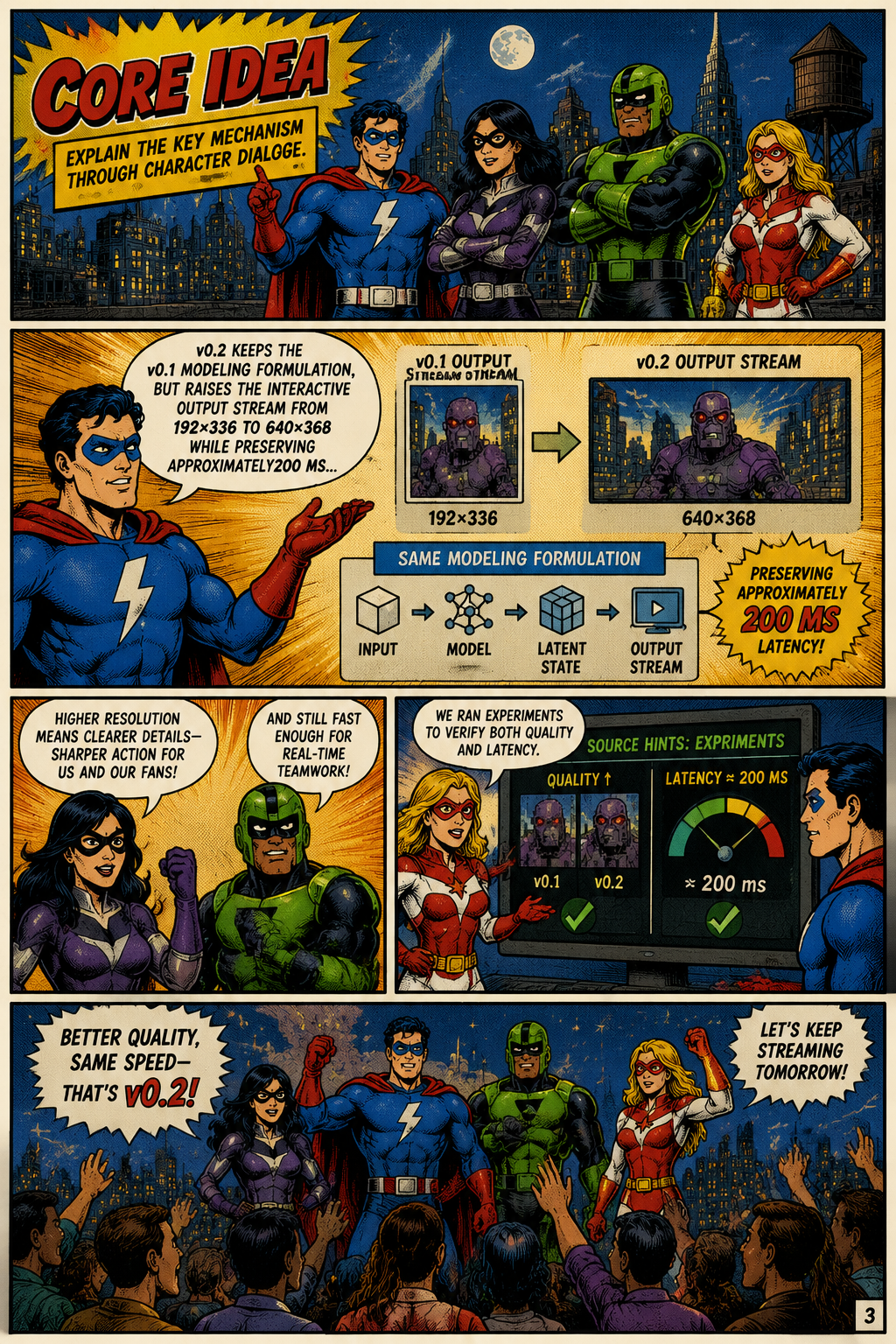
Wan-Streamer v0.2 is a latency-preserving upgrade to Alibaba Group's native-streaming audio-visual interaction model, raising real-time output from 192×336 to 640×368 at 25 FPS while keeping approximately 200 ms model-side signal-to-signal latency. The paper addresses the problem that low-resolution close-up agents cannot reliably convey posture, gaze, hands, nearby objects, or local scene layout during interactive conversation, and it solves this by keeping the v0.1 causal modeling formulation while changing the serving topology. Its main implication is that higher-fidelity, scene-grounded digital humans can be served in real time by concentrating visual generation cost in a multi-GPU Ulysses-style context-parallel performer while preserving a compact single-GPU thinker path.
Source: Wan-Streamer v0.2: Higher Resolution, Same Latency
Research question
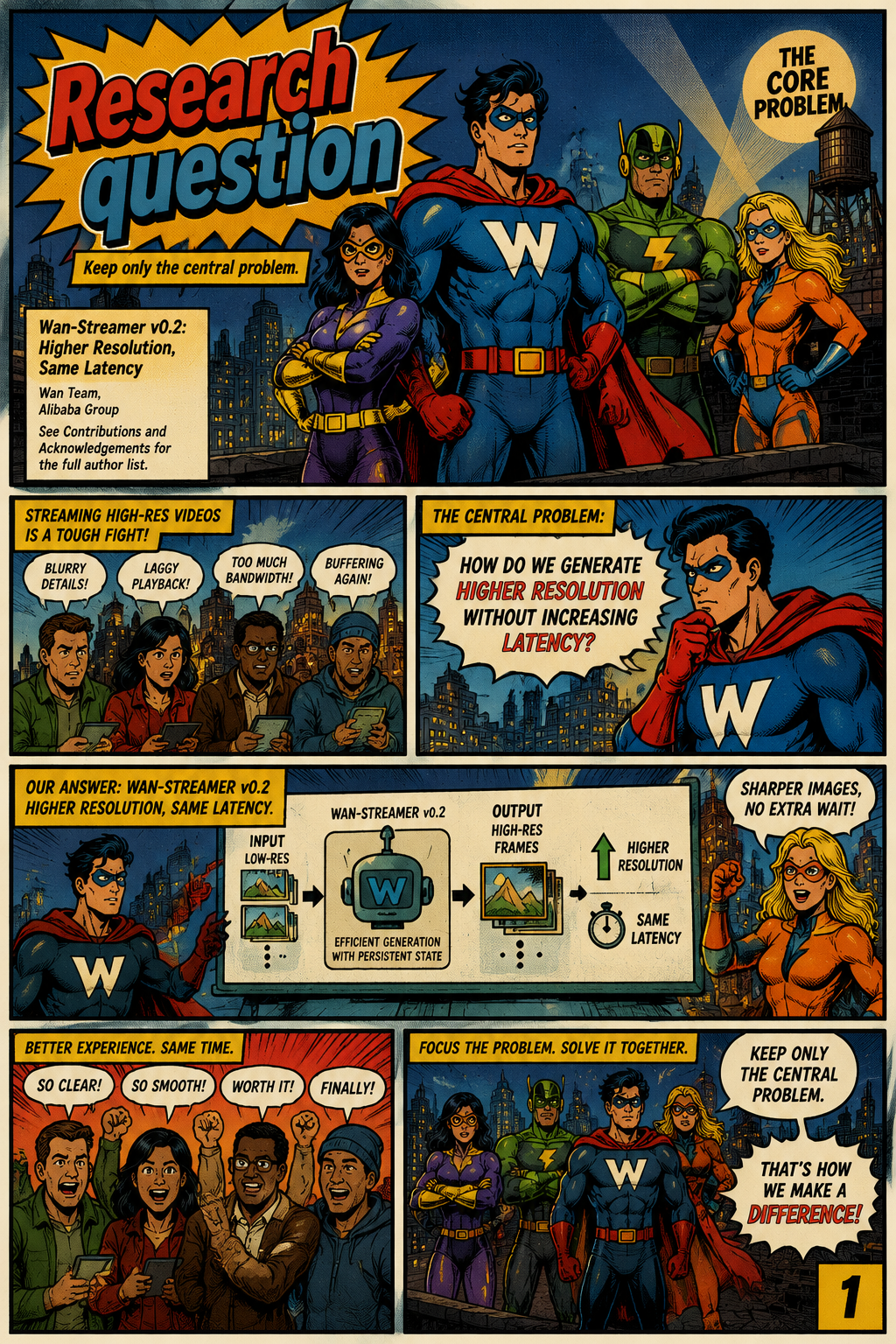
The central question in Wan-Streamer v0.2 is whether an end-to-end audio-visual interaction model can become visually richer without becoming perceptibly slower. Wan-Streamer v0.1 already modeled user text, audio, video, agent text, speech, and video on one shared causal timeline, but its 192×336 output constrained the usable visual range. The v0.2 paper targets a specific upgrade: 640×368 video at 25 FPS while preserving approximately 200 ms model-side signal-to-signal latency. This matters because real-time interaction is governed by streaming causality, where each 160 ms unit must absorb current user observations, update state, generate synchronized audio-video latents, decode the previous unit, and emit a response. The paper frames higher resolution not as an offline rendering improvement, but as a requirement for legible real-time embodied interaction.
Why old methods fall short
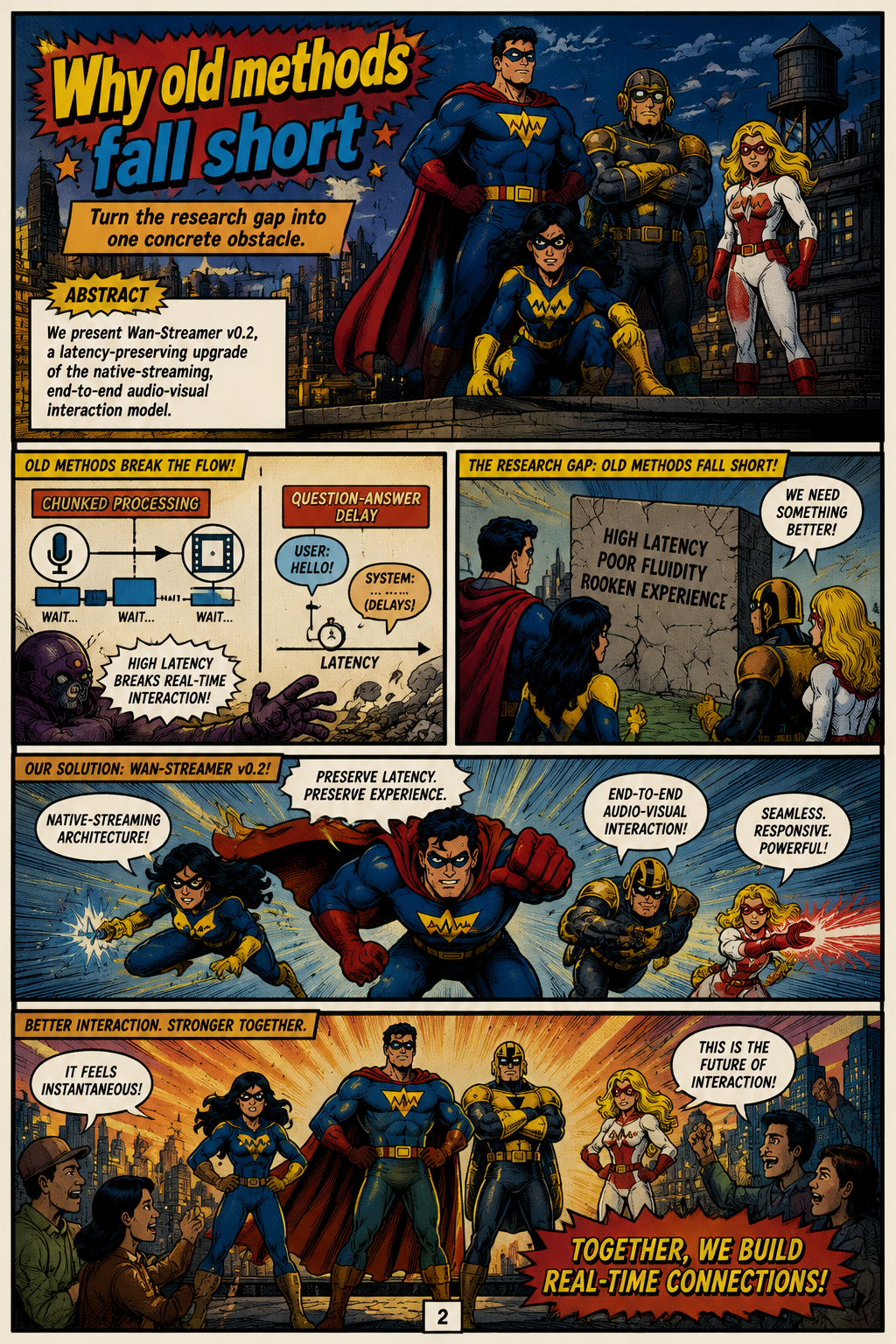
The motivation comes from a gap between conversational timing and visual grounding in prior systems. Cascaded ASR-LLM-TTS pipelines can support speech, but the paper argues that natural full-duplex dialogue should not be reduced to alternating turns, especially when visible listening behavior and synchronized video response are part of the interaction. Omni-modal perception models, video generation systems, causal rollout methods, and real-time avatar systems each cover parts of the problem, but Wan-Streamer's claim is that the interaction loop needs a unified causal state. In v0.1, that formulation closed the audio-visual loop, yet the low-resolution stream favored close-up video-call framing and compressed wider scenes too heavily. The paper identifies this as a practical obstacle: posture, gaze, hands, local objects, and scene layout must remain readable if an agent is to appear grounded in its surroundings during conversation.
Core idea
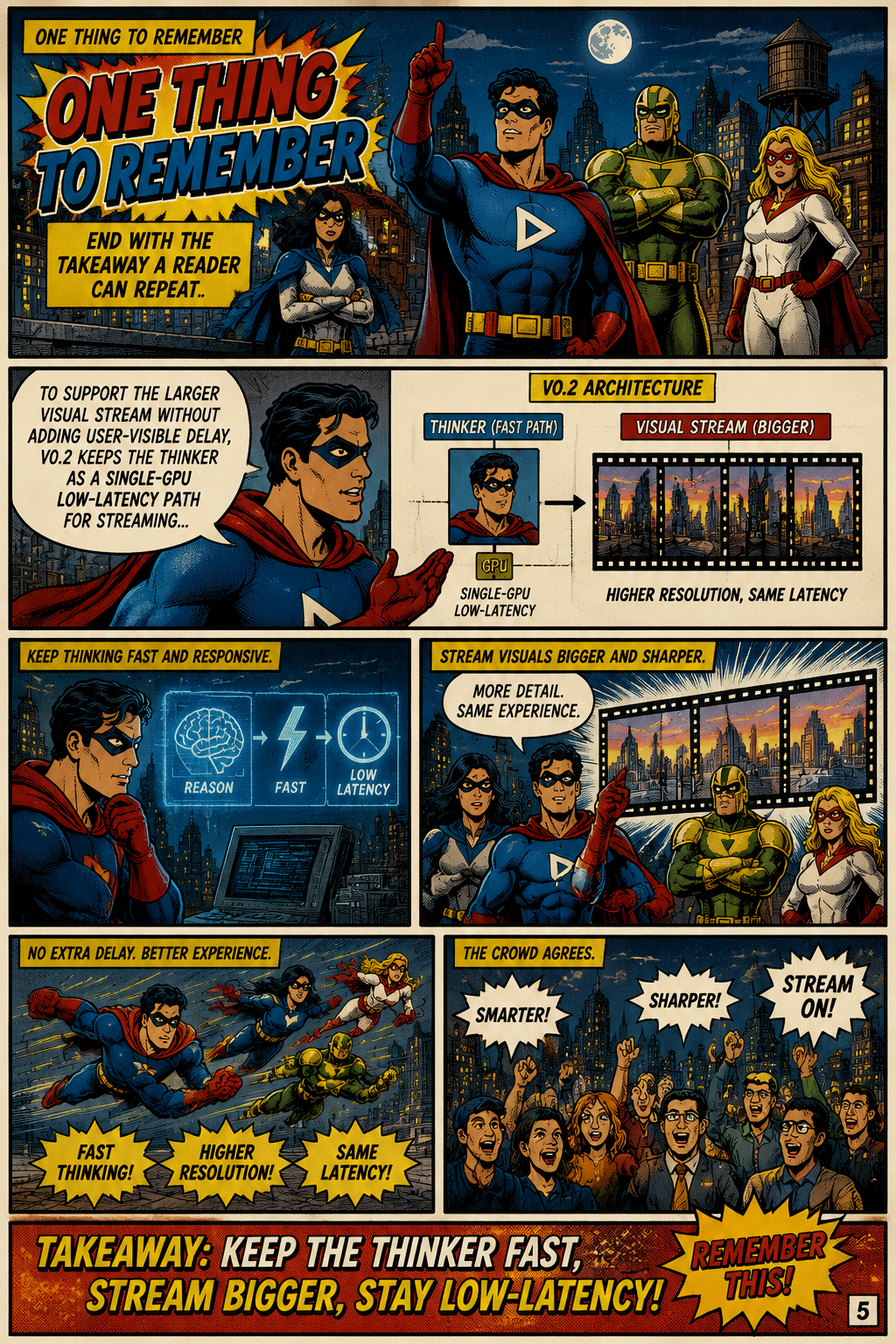
The core technical move in v0.2 is to keep the native-streaming model formulation fixed while changing the deployment strategy around the more expensive visual stream. The thinker remains a single-GPU low-latency path responsible for streaming perception, language and state update, K/V cache construction, and final causal decoding. The performer becomes a multi-GPU Ulysses-style context-parallel group that handles the costly next-unit latent generation for 640×368 video. Each performer rank writes incoming K/V into a pre-sharded local cache, splits the long high-resolution latent video sequence across ranks for denoising, and gathers results through Ulysses communication. Audio latents remain unsharded because their sequence is much shorter, and the language/state computation reaches the performer only as K/V conditioning rather than as a separate sequence to communicate.
Evidence check
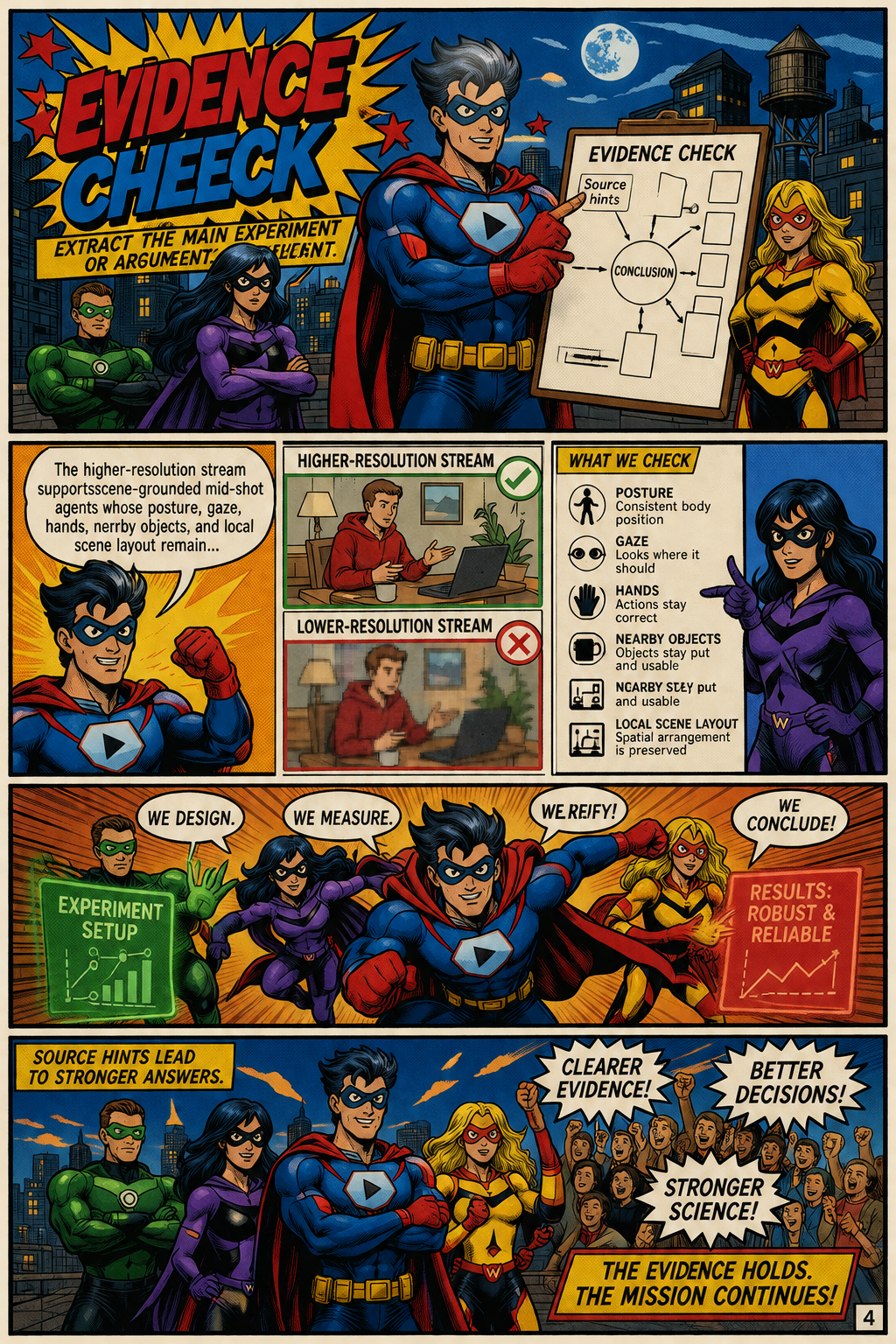
The evidence in the paper is primarily a latency and runtime protocol comparison against the v0.1 response boundary. Model-side signal-to-signal latency begins when a 160 ms user streaming unit is available to the thinker and ends when the corresponding audio-video response unit has been decoded for emission. Under the v0.2 serving path, the paper reports that the model still runs at approximately 200 ms model-side latency while producing 640×368 video at 25 FPS. With the same 350 ms bidirectional network budget used for v0.1, the total remote interaction latency remains approximately 550 ms, allowing the comparison to isolate model-side serving changes. The qualitative significance of the higher-resolution output is that close-up interactions gain fidelity while mid-shot agents can preserve readable body and scene context during real-time exchange.
One thing to remember
The main takeaway is that Wan-Streamer v0.2 treats resolution scaling as a serving-topology problem rather than a change to the interaction model. By preserving the single causal timeline for text, audio, and video, the system keeps perception, response timing, speech, visible listening behavior, and synchronized video response inside one interaction state. By moving only the high-cost latent video generation path into a Ulysses-style context-parallel performer, the added computation is concentrated where parallelism is most useful. The compact thinker-performer boundary, based on performer-compatible K/V slices and returned latents, prevents language/state processing from becoming a multi-GPU communication burden. The paper's broader implication is that real-time digital humans can move beyond tight face-centric framing toward situated, scene-grounded interaction without sacrificing the latency budget that makes conversation feel responsive.