ReadPaper Blog
UniClawBench: A Universal Benchmark for Proactive Agents on Real-World Tasks
UniClawBench addresses the problem that many agent benchmarks test isolated, sandboxed, single-turn tasks rather than proactive agents operating in dynamic real-world environments. The paper introduces a capability-driven benchmark with 400 bilingual tasks, live Docker-based execution, step-by-step checkpoints, and a three-role closed-loop evaluation strategy. Its results show that agent framework design can affect performance more than the base model choice, with long-context reasoning and multimodal understanding remaining major bottlenecks.
Source: UniClawBench: A Universal Benchmark for Proactive Agents on Real-World Tasks
Why Real Agents Fail
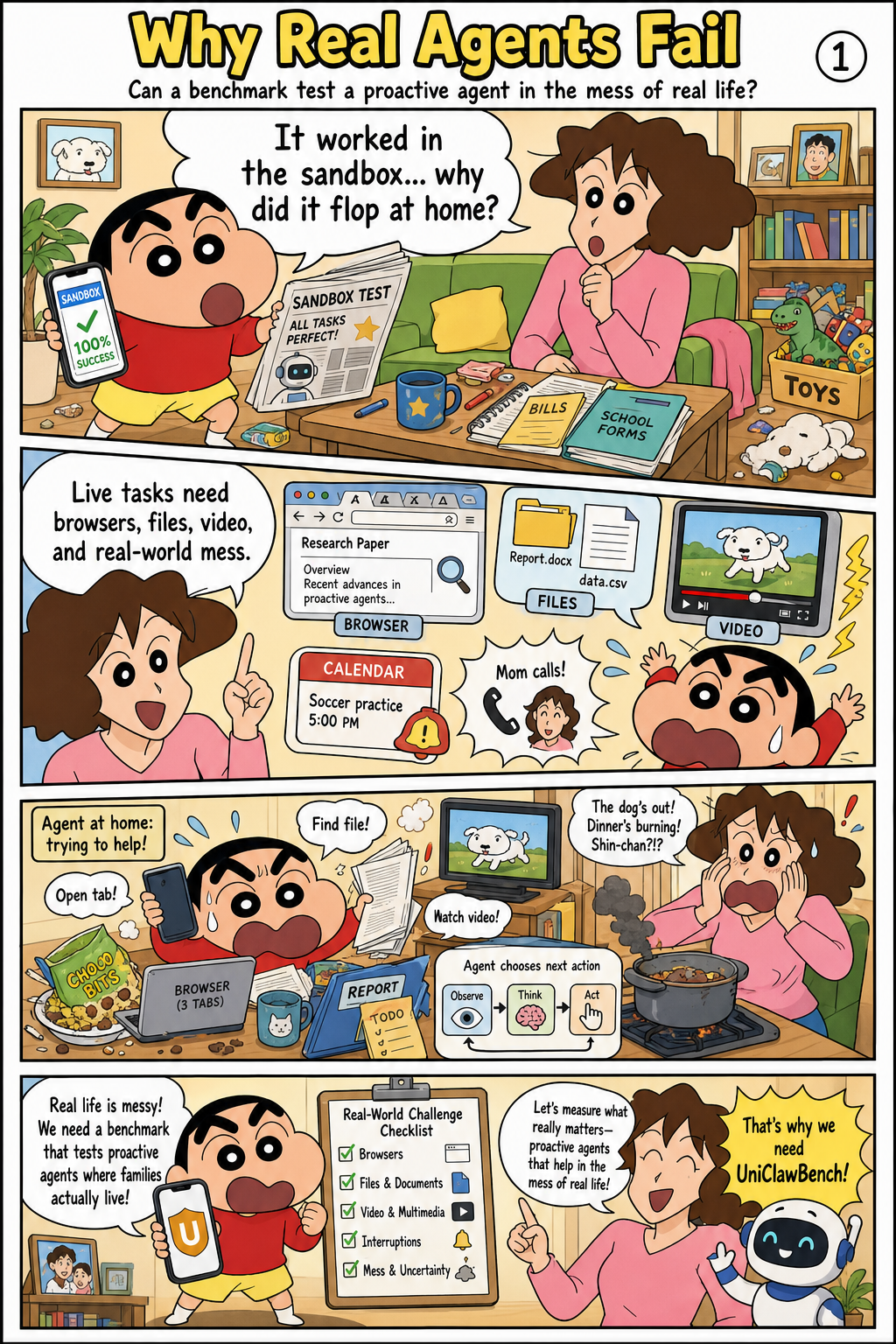
UniClawBench is motivated by the gap between impressive demonstrations of proactive agents and the difficulty of measuring whether those agents can actually complete everyday tasks with real tools. The paper argues that modern agents increasingly control browsers, terminals, files, GUI applications, and multimodal inputs, so benchmark environments must reflect that operational complexity. Existing evaluations often make agents look capable in controlled settings while failing to expose breakdowns caused by changing web pages, multi-step execution, or tool coordination. The authors frame proactive agents as digital coworkers that must pursue user goals across platforms rather than merely answer prompts. This makes evaluation a question of sustained task completion, not just one-shot response quality.
What Was Missing
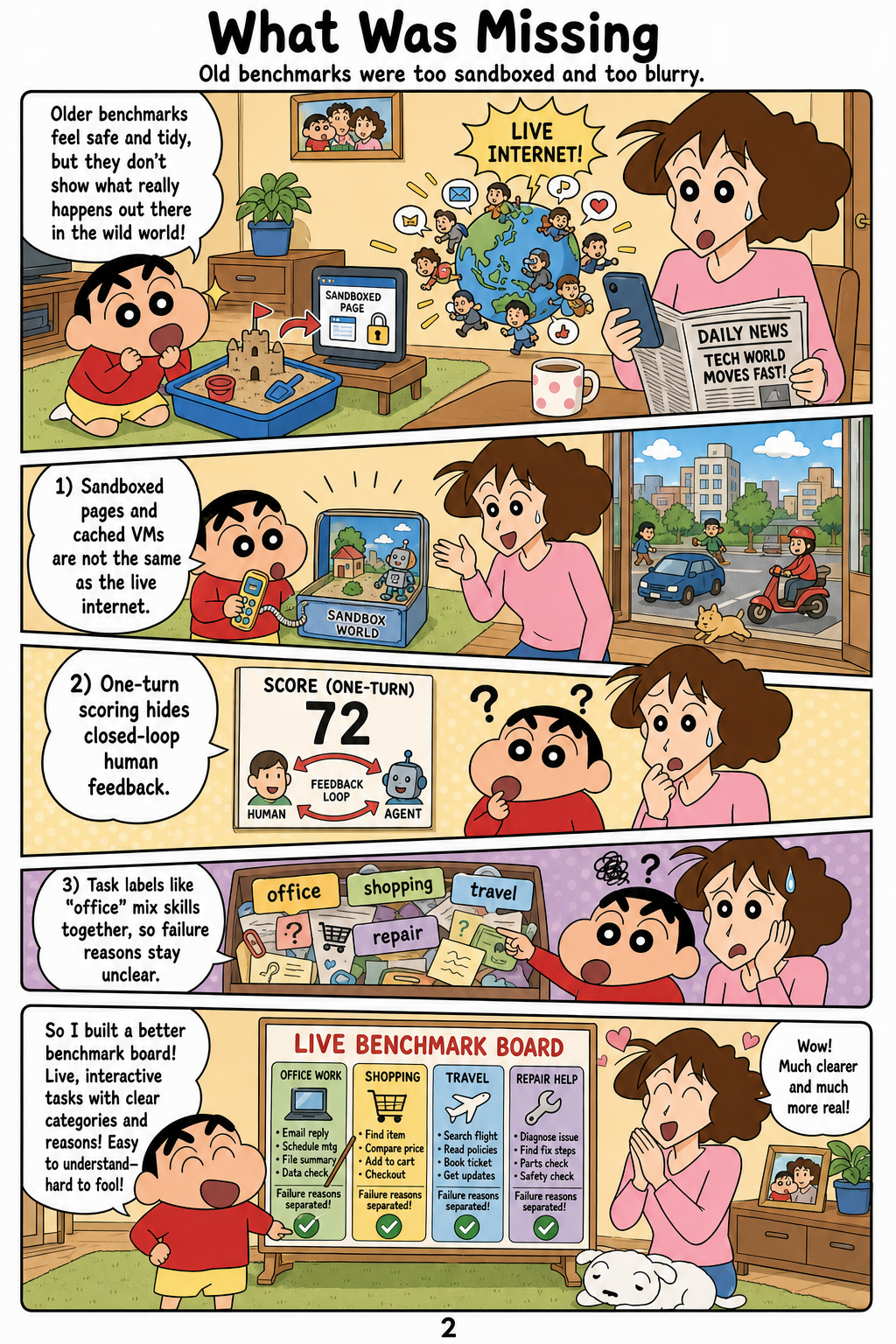
The paper identifies three structural weaknesses in prior agent benchmarks: sandboxed environments, single-turn evaluation, and scenario-based task labels that blur distinct capabilities. Benchmarks such as web mirrors or cached virtual-machine pages can stabilize evaluation, but the authors argue that this stability comes at the cost of real-world fidelity. Single-turn scoring also misses the closed-loop nature of user-agent collaboration, where a user may review partial work and provide corrective feedback. The paper further argues that categories such as office or research tasks do not reveal whether failure comes from visual perception, long-context reasoning, exploration, tool use, or cross-platform coordination. UniClawBench is designed to make those failure sources more diagnosable.
UniClawBench's Trick
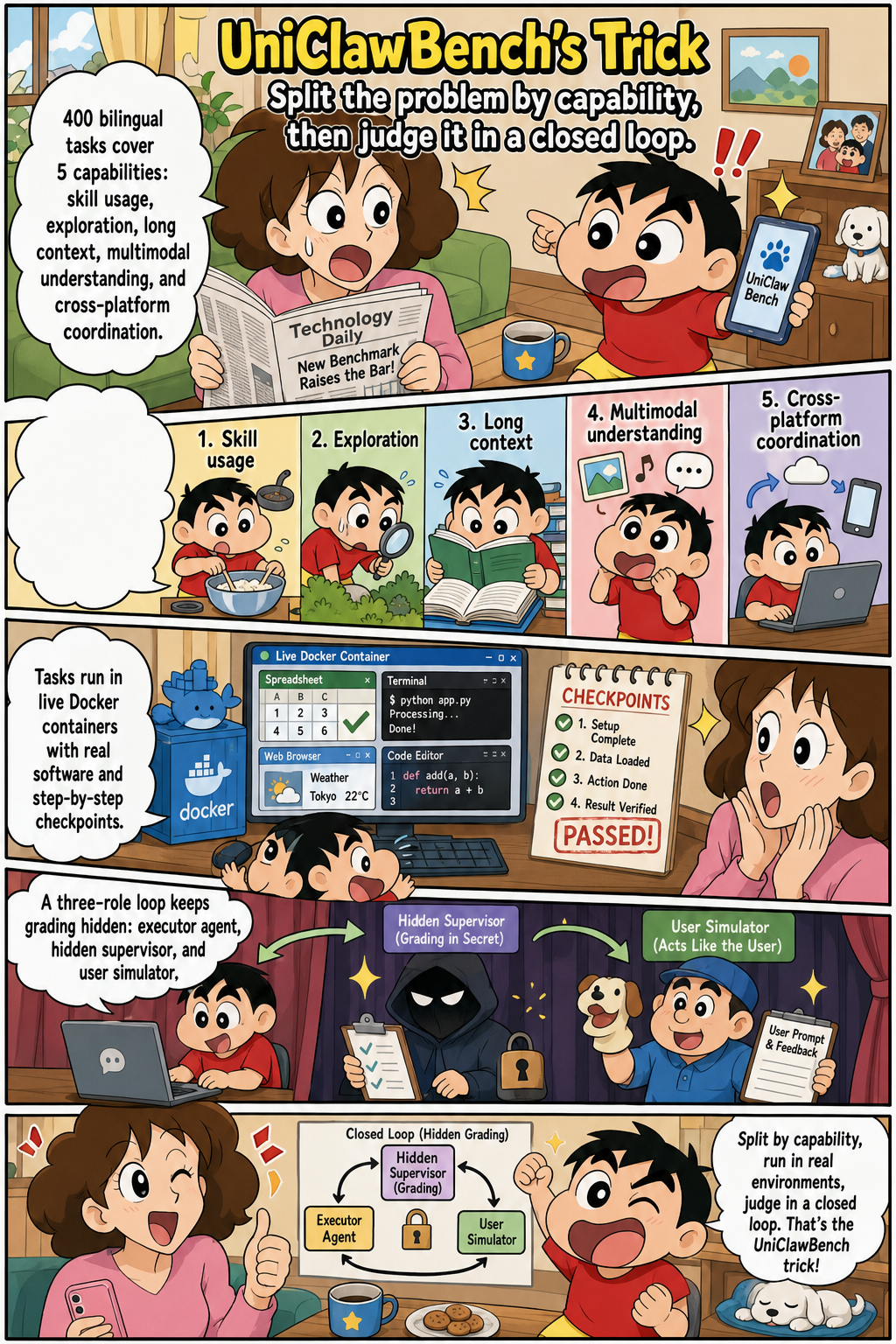
UniClawBench builds its evaluation around five foundational capabilities: Skill Usage, Exploration, Long-Context Reasoning, Multimodal Understanding, and Cross-Platform Coordination. The benchmark contains 400 manually designed bilingual tasks in English and Chinese, executed in Docker containers with live browsers, local file systems, software tools, and realistic artifacts. Instead of relying on pre-recorded static answers, the paper proposes fine-grained step-by-step completion checkpoints that let evaluation track intermediate evidence and execution progress. Its three-role closed-loop strategy separates an executor agent, a hidden supervisor agent, and a user simulator agent. This design lets the system provide multi-turn feedback while keeping hidden references, rubrics, and grading criteria isolated from the agent being evaluated.
What They Found
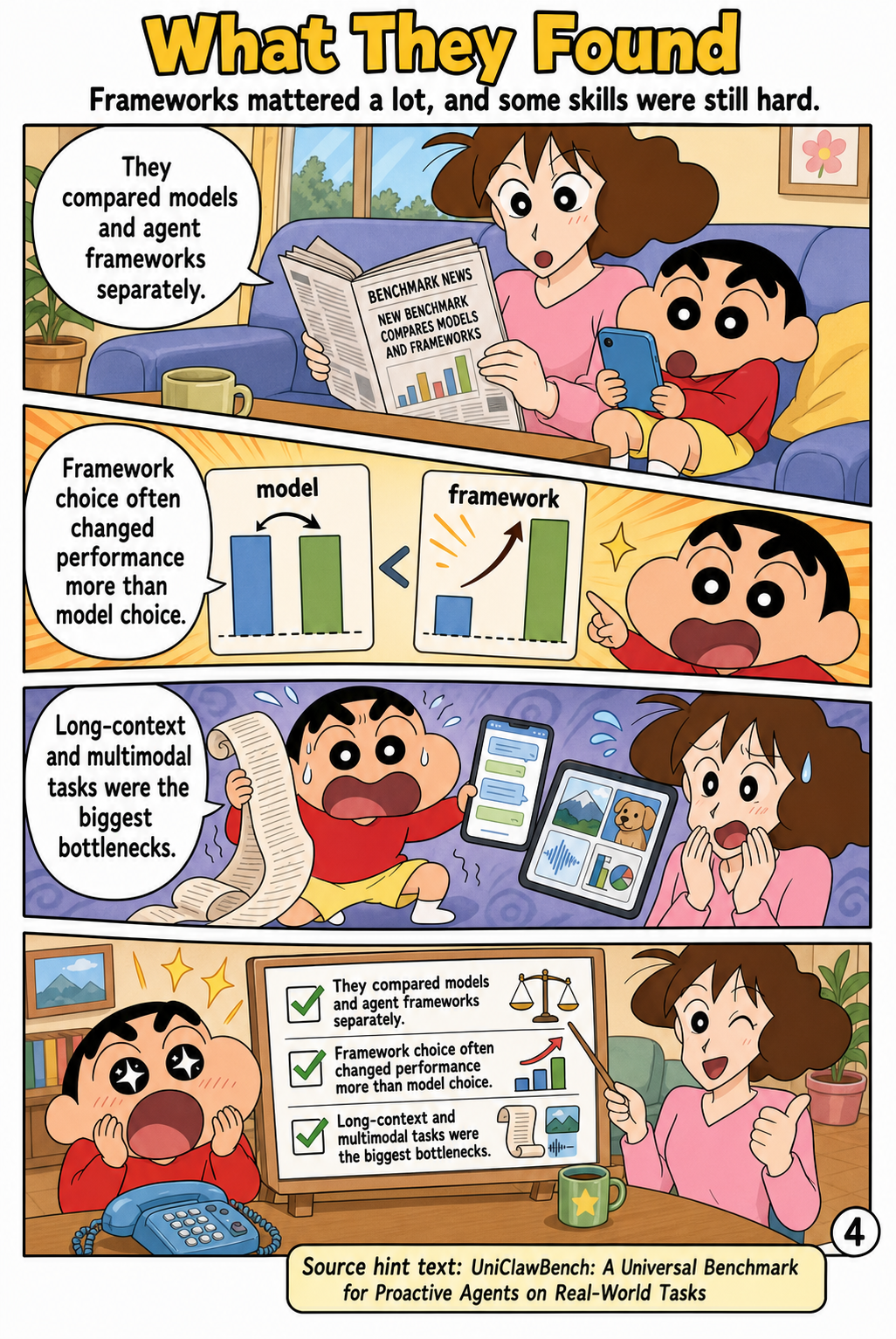
The experiments compare both base-model capability and agent-framework design by evaluating state-of-the-art models under OpenClaw and then testing representative models across OpenClaw, EDICT, and Nanobot. This two-part setup is intended to disentangle whether performance differences arise from the underlying language or multimodal model, or from the orchestration framework around it. The paper reports that framework choice consistently has a stronger effect on capability performance than model choice in the UniClawBench setting. The capability-level analysis also identifies Long-Context Reasoning and Multimodal Understanding as major bottlenecks for current proactive agents. These findings imply that better prompting or stronger base models alone may not solve real-world agent reliability without improvements in memory, tool orchestration, perception, and execution control.
Why It Matters
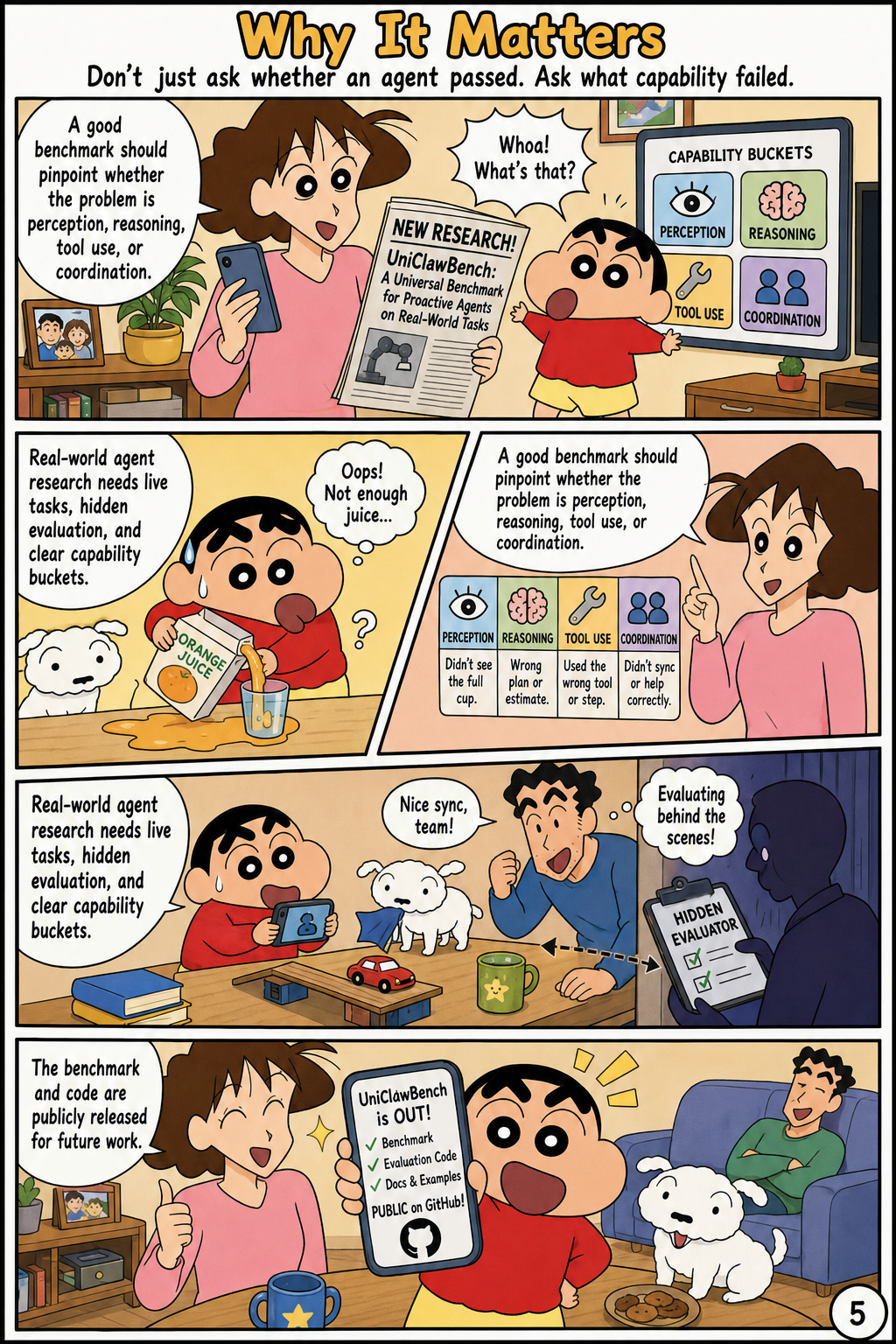
The broader contribution of UniClawBench is a diagnostic view of proactive-agent evaluation: the benchmark asks not only whether an agent passes, but which capability dimension explains its success or failure. By using live environments, hidden rubrics, stepwise checkpoints, and information-separated feedback, the paper targets the instability and leakage risks that arise when benchmarks move beyond static tasks. The capability taxonomy gives researchers a way to compare systems on specific weaknesses such as multimodal grounding, long-context evidence tracking, active exploration, task-specific skill operation, and cross-platform coordination. The public release of the benchmark and code is positioned as infrastructure for studying both model-level progress and framework-level design. The paper’s implication is that robust real-world agents will require evaluation methods that are interactive, capability-specific, and resistant to shortcutting the grading process.