ReadPaper Blog
Trust Region On-Policy Distillation
The paper studies why On-Policy Distillation for large language models becomes unstable when a student model learns from teacher supervision on its own generated tokens. It proposes Trust Region On-Policy Distillation, or TrOPD, a credit-assignment approach designed to make token-level supervision reliable under teacher–student distribution mismatch, with implications for efficient LLM post-training, agent learning, multi-task improvement, and model compression.
Source: Trust Region On-Policy Distillation
The Distillation Problem
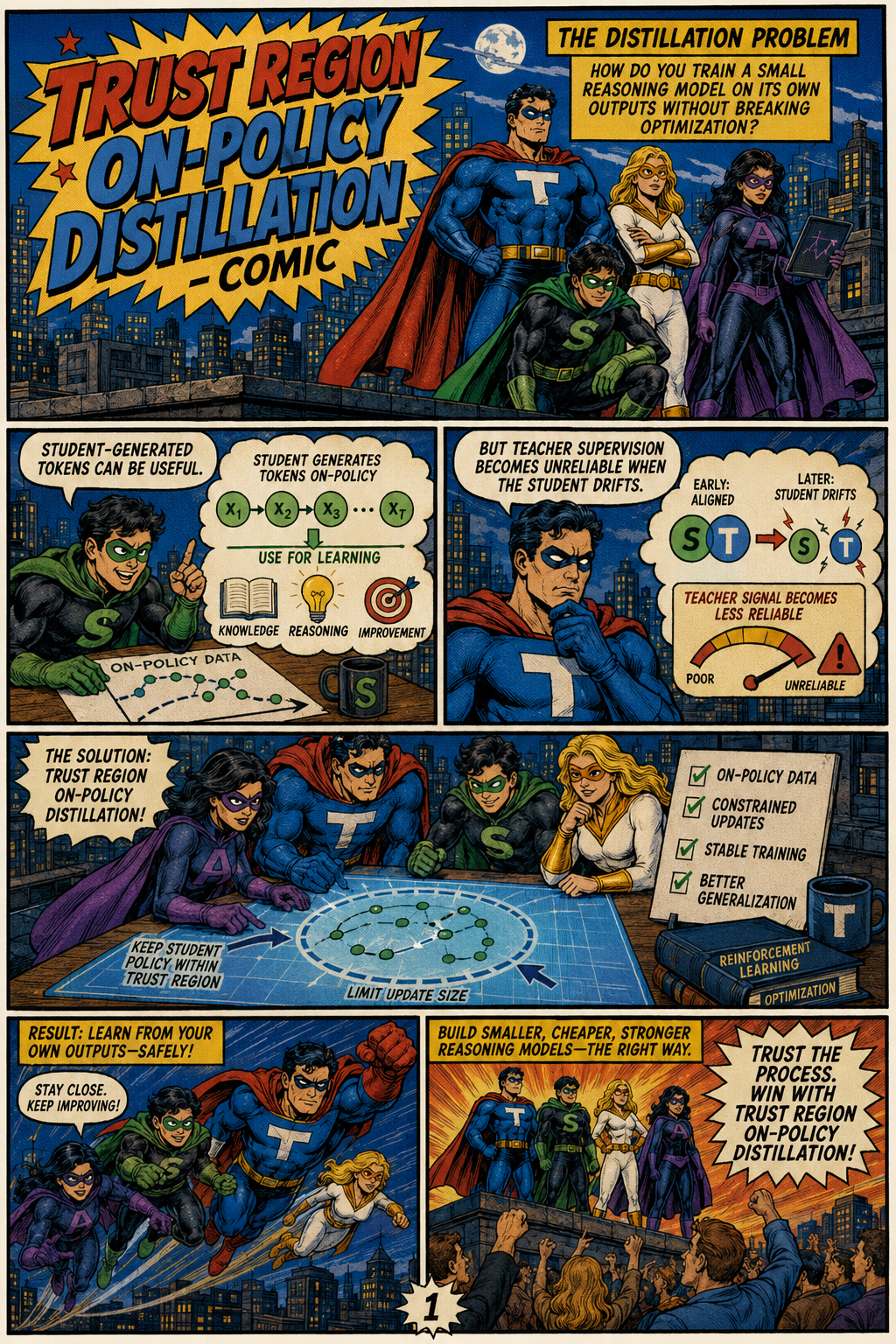
Trust Region On-Policy Distillation addresses a central problem in efficient post-training of large language models: how to use student-generated trajectories without letting unstable teacher supervision damage optimization. The paper frames On-Policy Distillation as valuable because the student is trained on the kinds of tokens it actually produces, which can make post-training more aligned with deployment behavior. The key difficulty is that the teacher and student distributions can differ substantially, so teacher labels or preferences assigned to student-generated tokens may no longer provide dependable learning signals. Xingrun Xing, Haoqing Wang, Boyan Gao, Ziheng Li, and Yehui Tang identify this mismatch as a source of unreliable policy gradients and even optimization failure. The proposed TrOPD method is motivated by the need for reliable on-policy token-level supervision rather than by simply adding more teacher feedback. This matters because stable OPD would make LLM post-training more practical for agent learning, multi-task enhancement, and model compression.
Why OPD Breaks
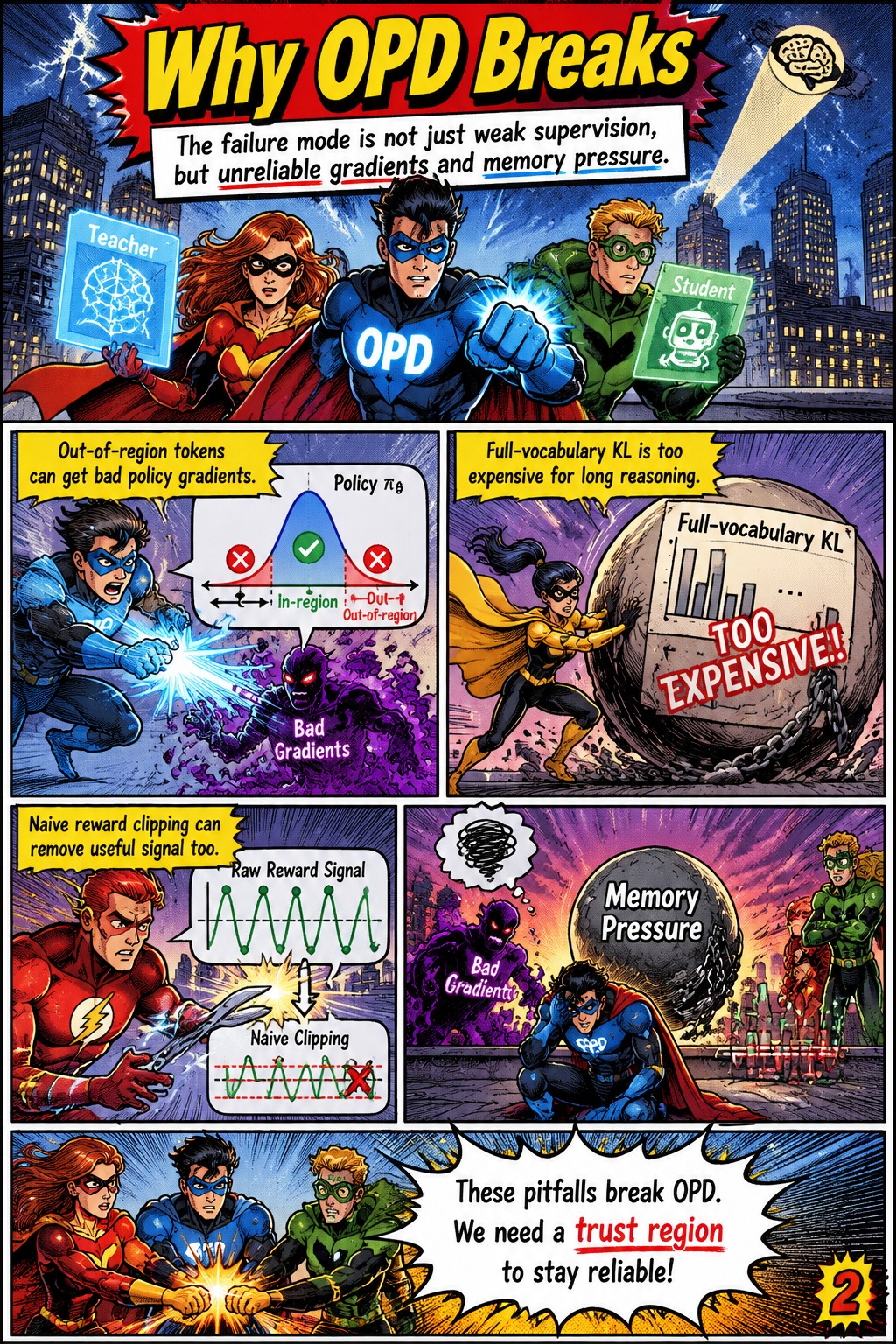
The paper’s diagnosis is that OPD can break when credit assignment treats all student-generated tokens as equally trustworthy targets for teacher supervision. In standard on-policy learning, the student explores its own distribution, but that same exploration can move tokens into regions where the teacher’s supervision no longer supports reliable policy-gradient updates. The abstract emphasizes that the failure is not merely weaker supervision but supervision that can become misleading enough to produce optimization failure. This makes the teacher–student distribution gap a structural problem for token-level distillation. The paper therefore treats reliability as a property that must be estimated or controlled during training, rather than assumed from the teacher’s overall competence. Its method section is positioned around credit assignment strategies because the core issue is deciding which token-level signals should influence the student and how strongly.
TrOPD's Core Idea
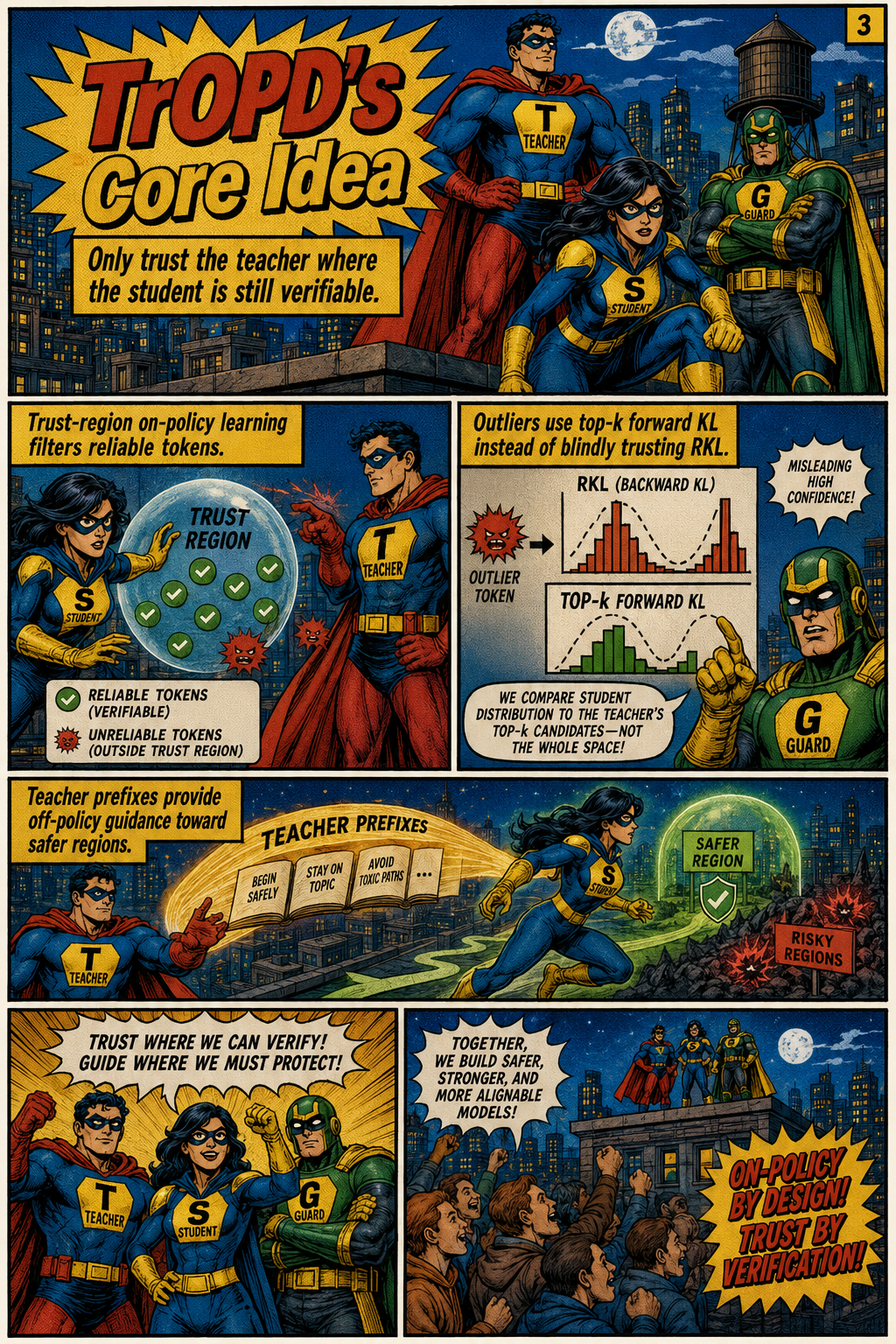
TrOPD’s core contribution is to introduce a trust-region view of On-Policy Distillation for LLM post-training. Instead of applying teacher supervision uniformly across all student-generated tokens, the method seeks reliable on-policy token-level supervision through credit assignment. The trust-region framing implies that updates should be concentrated where the teacher’s guidance remains meaningful for the student’s current distribution. This directly addresses the paper’s stated mismatch problem: when the student distribution drifts far from the teacher’s expected region, the method must prevent unreliable gradients from dominating training. By tying the method to token-level supervision, TrOPD targets the fine-grained decisions that determine whether a generated sequence improves or destabilizes the student. The approach is therefore presented as a principled modification of OPD rather than a separate post-training paradigm.
What The Results Say
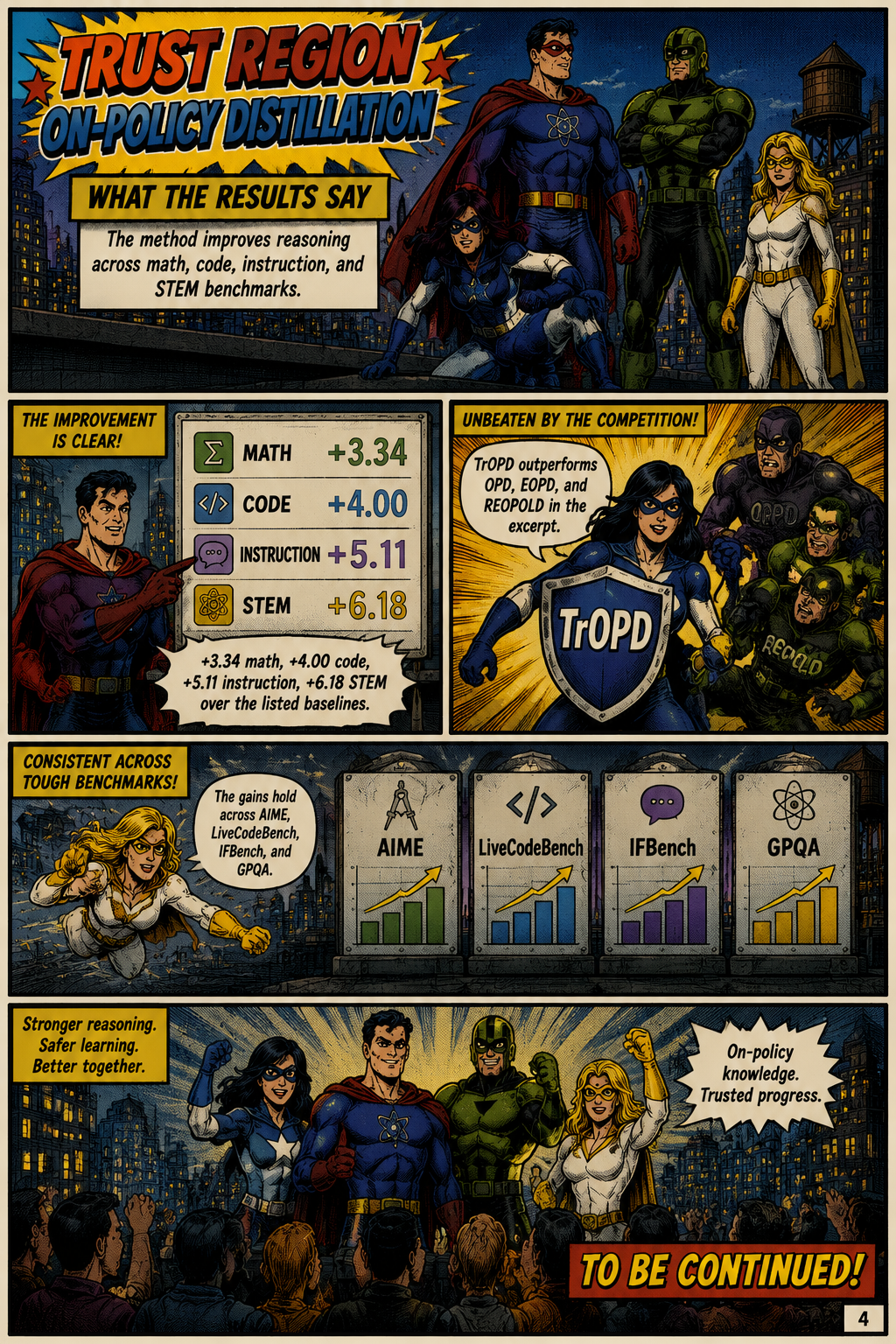
The paper evaluates TrOPD in an experimental section designed to test whether trust-region credit assignment improves the reliability of On-Policy Distillation. Although the provided abstract does not specify datasets, model scales, or numerical results, it states that OPD is a fundamental technique with broad applications, so the experimental motivation is to establish whether the proposed method can serve those applications more robustly. The results section is framed around the practical consequence of the method: preventing unreliable teacher supervision on student-generated tokens from causing failed or unstable optimization. The comparison target implied by the paper is conventional OPD, where substantial teacher–student distribution differences can corrupt policy-gradient learning. Evidence in the paper is therefore organized around the claim that TrOPD makes on-policy token-level supervision more dependable. The results matter because reliability, rather than raw teacher quality alone, determines whether distillation can be used safely in efficient LLM post-training.
The Takeaway
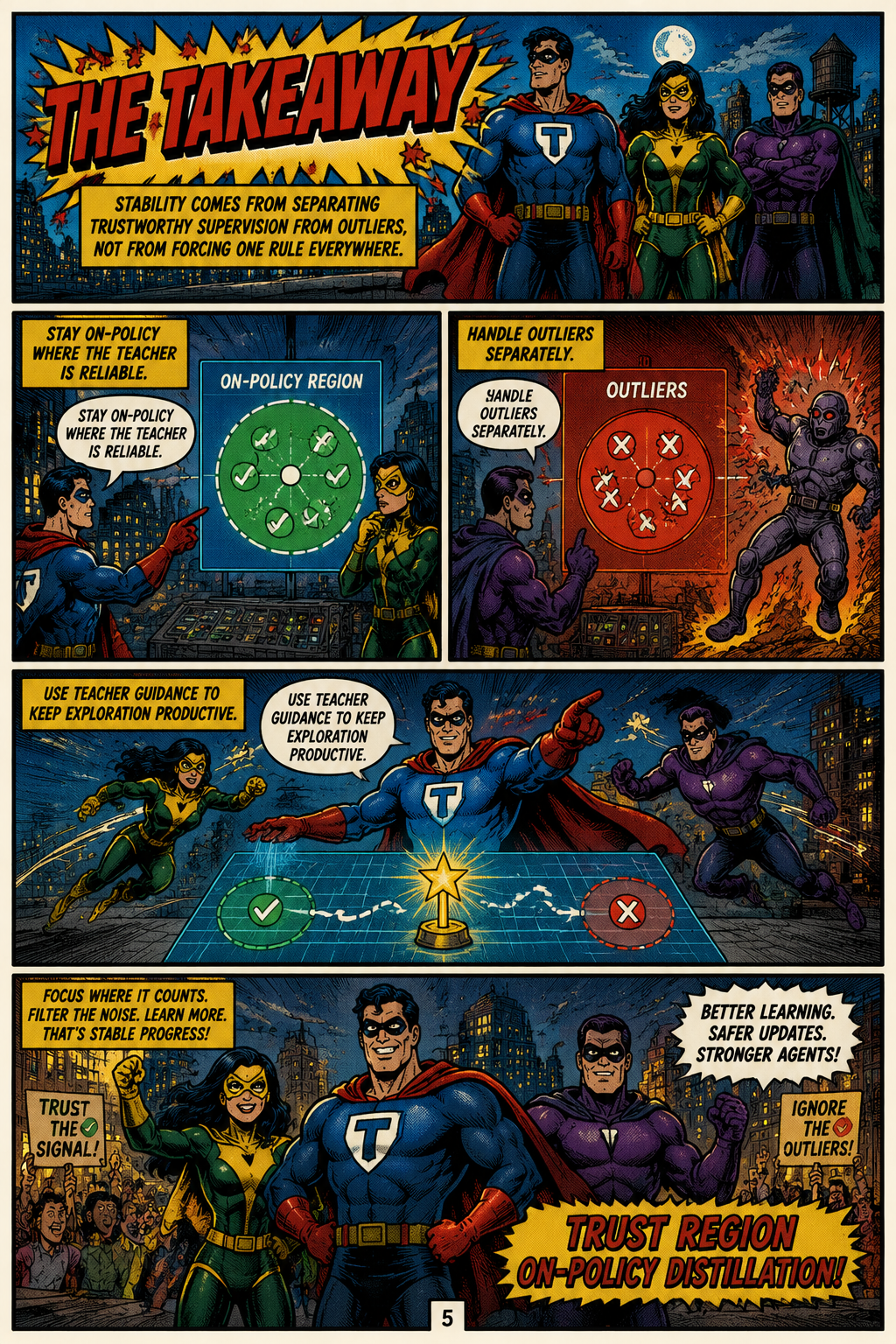
The paper’s broader implication is that stable distillation requires separating trustworthy token-level supervision from supervision that lies outside the student’s reliable learning region. TrOPD argues that On-Policy Distillation should not blindly trust every teacher signal attached to student-generated text, because the usefulness of that signal depends on the relation between teacher and student distributions. This perspective shifts post-training design from simple imitation toward controlled credit assignment under distribution mismatch. For agent learning, multi-task enhancement, and model compression, the method suggests a way to preserve the efficiency benefits of OPD while reducing the risk of optimization collapse. The limitations and discussion sections are likely important because trust-region rules introduce design choices about how reliability is measured and how broadly the approach transfers across LLM settings. The conclusion of the paper is that Trust Region On-Policy Distillation provides a more reliable foundation for on-policy LLM distillation by making token-level supervision selective rather than unconditional.