ReadPaper Blog
TIDE: Proactive Multi-Problem Discovery via Template-Guided Iteration
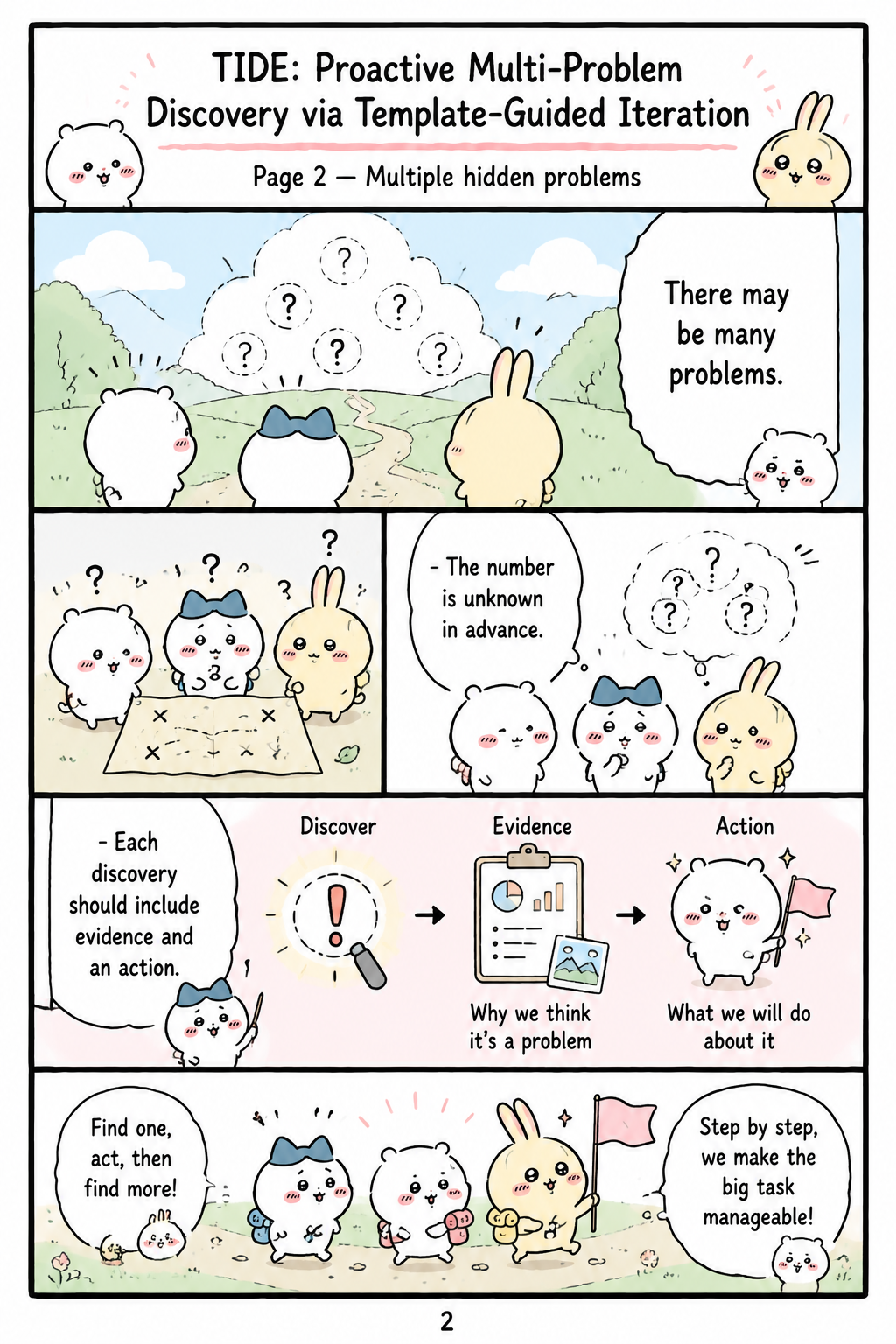
The paper introduces TIDE, a framework for proactive LLM agents that discover multiple hidden problems in a user’s broader context rather than waiting for explicit requests. TIDE combines iterative discovery with reusable thought templates so agents can uncover coexisting issues, ground each one in supporting evidence, and propose concrete actions. The result matters because the paper shows this multi-step formulation improves coverage, identification, and resolution in personal workspaces and software repositories compared with single-shot and parallel multi-agent baselines.
Source: TIDE: Proactive Multi-Problem Discovery via Template-Guided Iteration

Why reactive agents miss the real mess
The paper argues that today’s LLM agents are still largely reactive, even when they can read documents, use tools, or operate over code. This reactive setup assumes the user already knows what is wrong and can ask for the right task, such as summarizing a file, scheduling a meeting, or fixing a failing test. TIDE targets the harder setting in which important issues are present in the available context but are not stated as user requests. The motivating examples in the paper include unresolved workspace bottlenecks such as unrecorded approvals, conflicting report versions, stale meetings, buried deadlines, and other problems that can remain hidden despite being visible across documents, emails, calendars, or repositories. The paper’s central claim is that proactive assistance should be framed as discovering multiple hidden problems from context, not merely anticipating a single user intent.
The task is bigger than one answer
The paper formalizes hidden-problem discovery as a set prediction task over a collection of artifacts D, such as workspace documents or source-code functions. Within that context, there is a latent set of hidden problems P⋆ whose size is unknown in advance, and the agent must produce a predicted set P̂ that approximates it. Each predicted problem is defined as a triple consisting of a natural-language problem description b, a supporting subset of evidence artifacts D̂, and a concrete action a that proposes a resolution. This formulation makes quality depend on both coverage across the latent problem set and fidelity within each prediction. The paper emphasizes that simply asking an LLM to list all problems in one pass tends to miss less salient issues and to generate generic or speculative claims when it lacks a reusable model of what evidence patterns indicate real problems.
TIDE’s first trick: don’t do it all at once
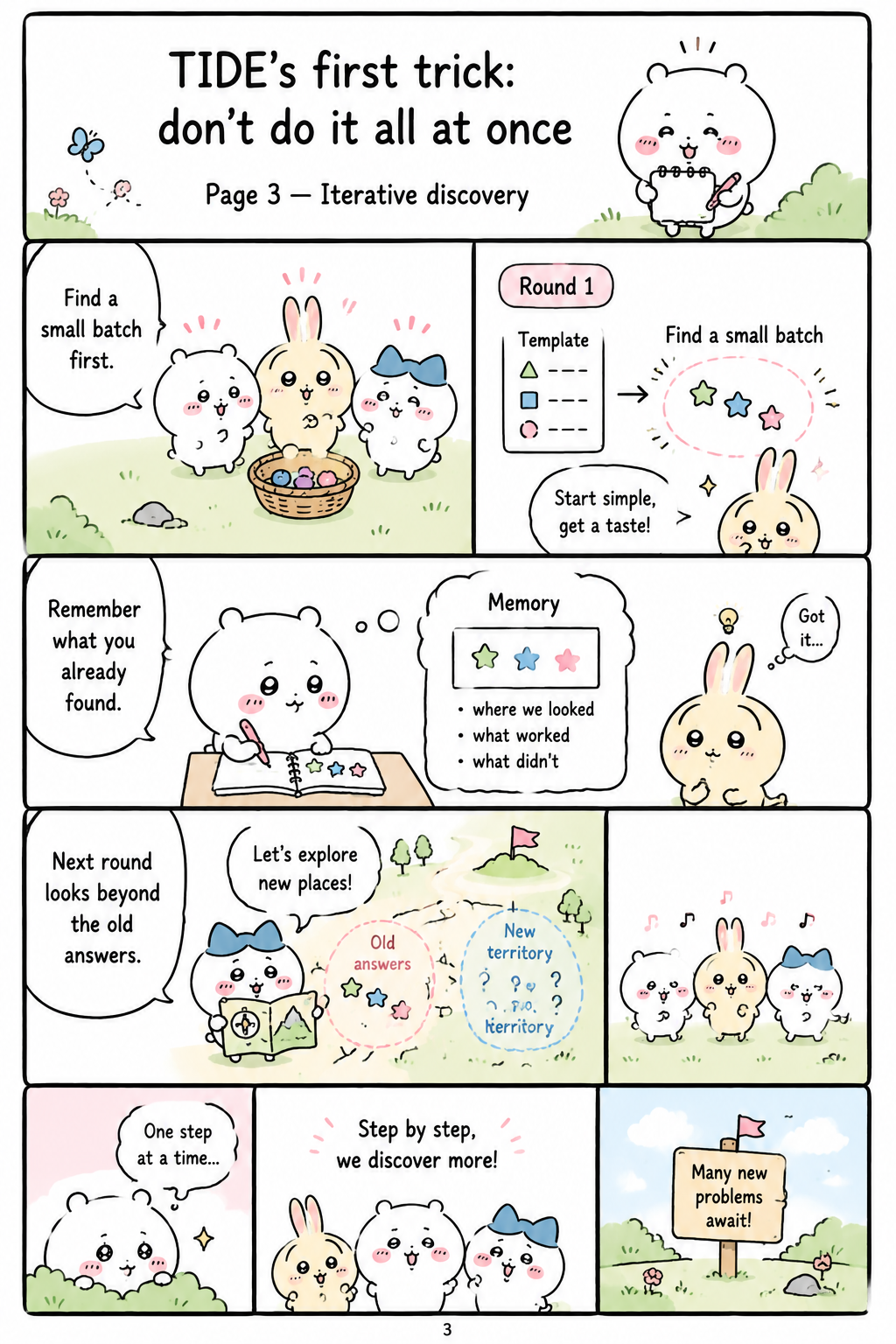
TIDE’s first mechanism is iterative discovery, which replaces one-shot enumeration with multiple rounds of small-batch prediction. In each round, the agent conditions on the full document collection D, the template library T, and the cumulative prediction state P̂ from earlier rounds, then proposes up to k new candidate triples. The update rule accumulates newly discovered candidates into the current state, and the process stops after a fixed number of rounds or when no new predictions are returned. The paper’s rationale is that single-pass prediction anchors on the most obvious cases, while conditioning on already found problems pushes later rounds toward uncovered regions of the context. This mechanism is designed to improve broad coverage when many problems coexist and their number is not known beforehand.
TIDE’s second trick: use thought templates
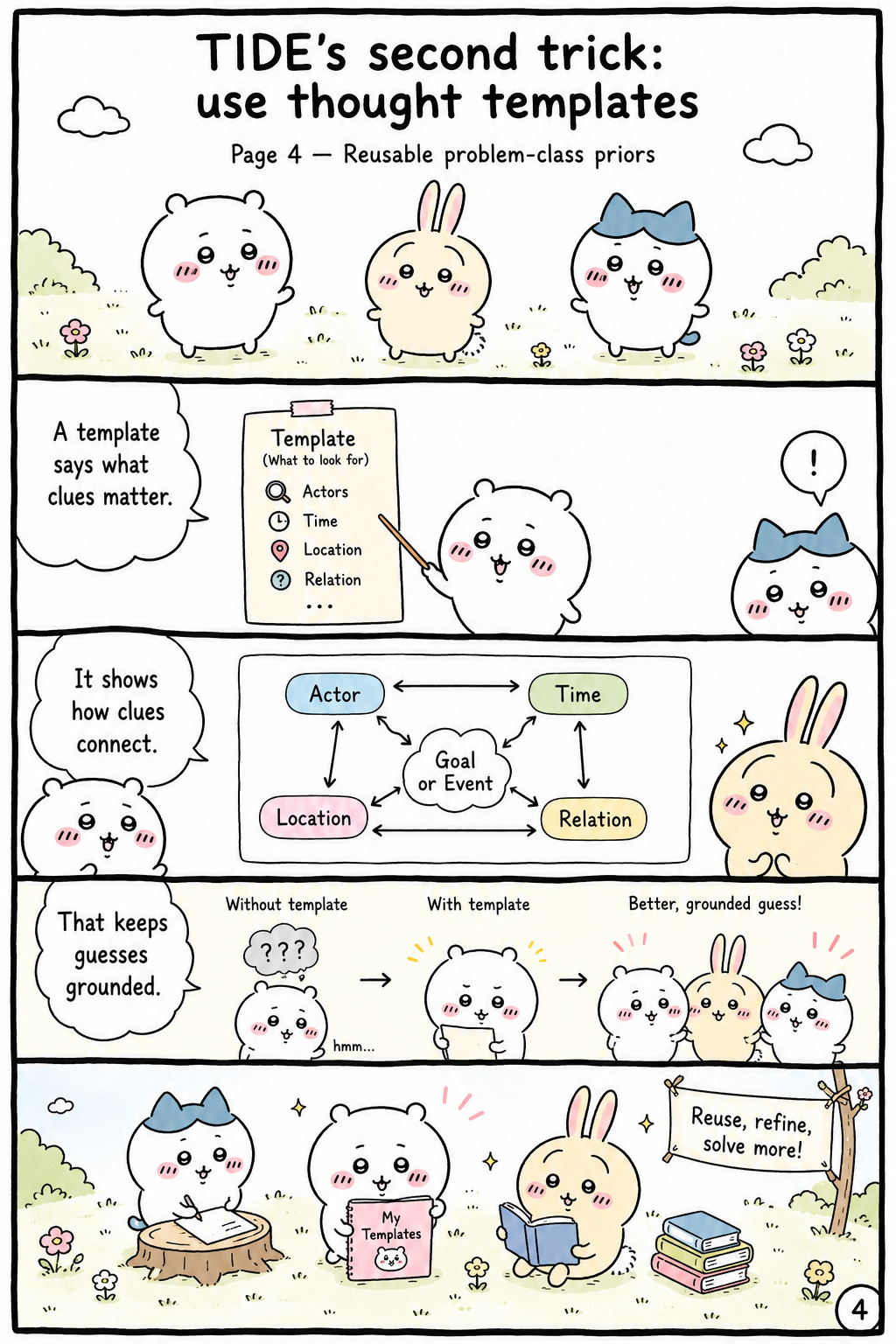
TIDE’s second mechanism is the use of thought templates, which the paper defines as reusable schemas distilled from previously solved cases. Each template contains a name for a recurring problem class, a pattern describing the structural form of that class, and an evidence flow specifying which contextual signals to attend to and how to connect them. The paper describes constructing templates from training cases that include a document collection, a discovered problem, and a reference resolution, with an LLM abstracting away instance-specific details into a reusable schema. At inference time, the template set is supplied as a library of discovery priors, so predictions can be anchored in recognizable problem classes rather than inferred from scratch. The paper gives a workspace example, “Conflicting Source-of-Truth Blocks Sign-off Under Deadline,” whose evidence flow links a deliverable, conflicting copies across channels, a material discrepancy, a time-bounded review, and the owner who can resolve it.
What TIDE returns, and why it matters
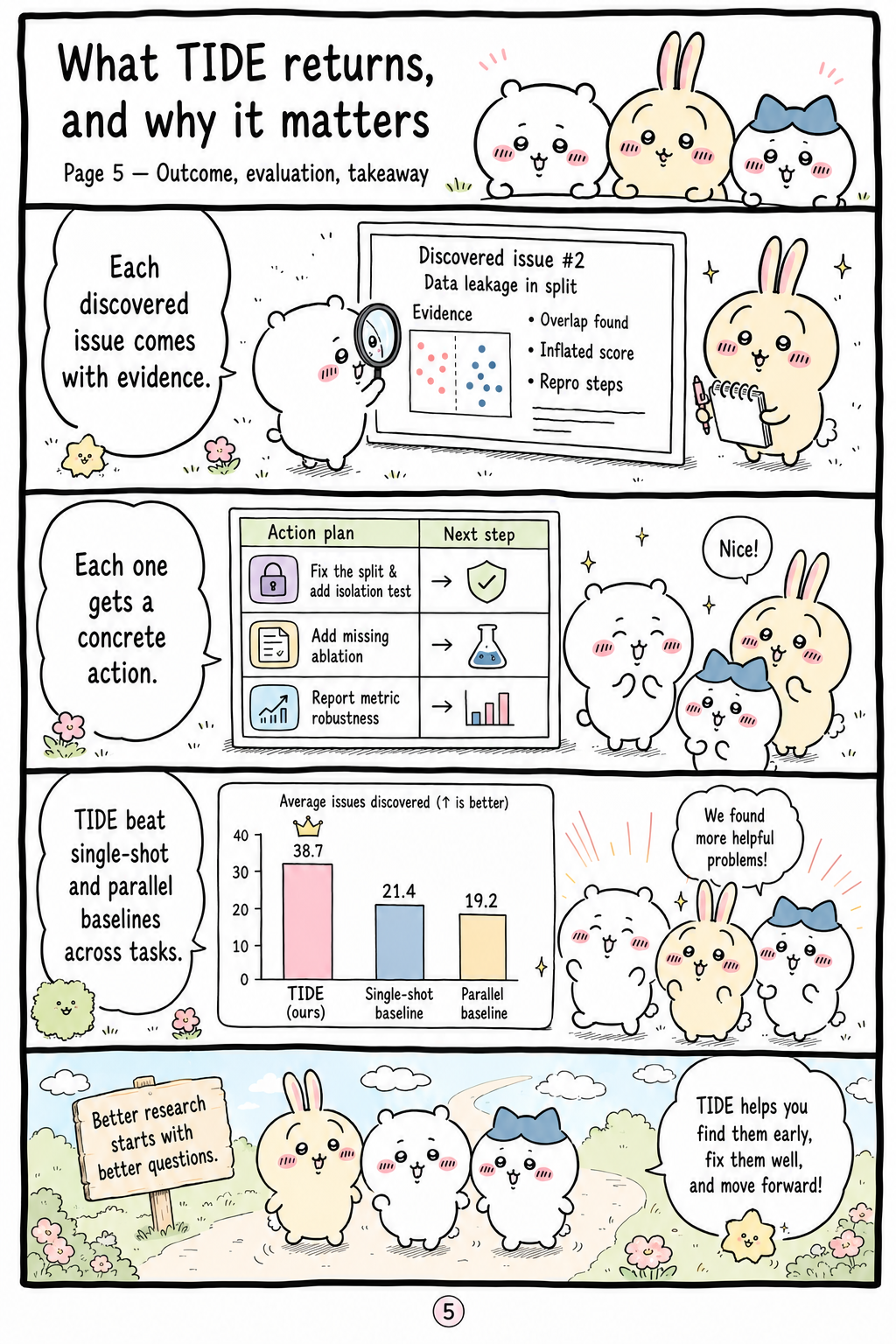
The paper instantiates TIDE in two realistic domains: personal workspaces, where agents discover unresolved bottlenecks across user artifacts, and software repositories, where agents identify hidden bugs in source code and generate patches. Its outputs are designed to be actionable because each discovered issue includes identification, supporting evidence, and a proposed resolution rather than a vague alert. Across both settings and four LLM backbones, the paper reports that TIDE outperforms single-shot and parallel multi-agent baselines on task coverage, identification, and resolution. The analysis further states that iterative discovery and thought templates provide largely complementary gains, while templates transfer across model backbones. The broader implication is that proactive agents should be built as context-wide, multi-step discovery systems that surface what users may not have thought to ask and connect each finding to evidence and action.