ReadPaper Blog
SkillOpt-Lite: Better and Faster Agent Self-evolution via One Line of Vibe
SkillOpt-Lite studies the minimal viable pipeline for skill optimization in autonomous agents, asking which components are truly necessary for agents to improve their own skills efficiently. The paper frames agent self-evolution as Zeroth-Order optimization, connects recent skill-optimization practice to classical ideas such as central difference and trust regions, and argues that interpretable skill trajectories can make optimization both simpler and more diagnosable.
Source: SkillOpt-Lite: Better and Faster Agent Self-evolution via One Line of Vibe
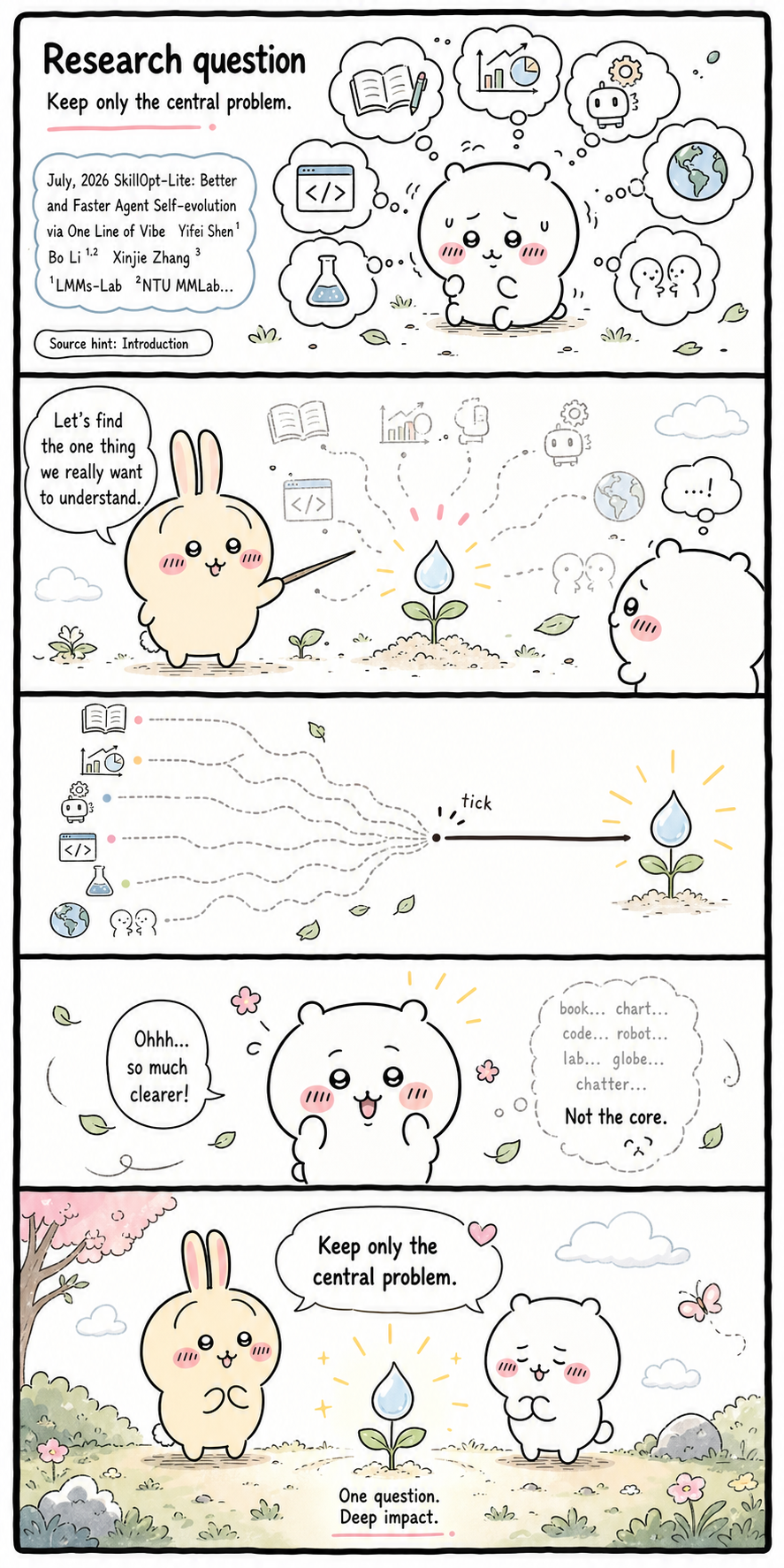
Research question
SkillOpt-Lite addresses a central problem in autonomous-agent research: skill optimization methods have become influential, but many rely on complex pipelines whose individual components are not clearly justified. The paper asks what a minimal viable pipeline for agent self-evolution should contain when every part must be supported by theory or empirical necessity. Its motivation is practical as well as conceptual, because faster and simpler optimization would make agent improvement easier to reproduce, inspect, and maintain. The authors position SkillOpt-Lite as a lean alternative that seeks better agent self-evolution without adding unnecessary machinery. The core contribution is not merely another optimization recipe, but a framework for deciding which pieces of the skill-learning process are essential.
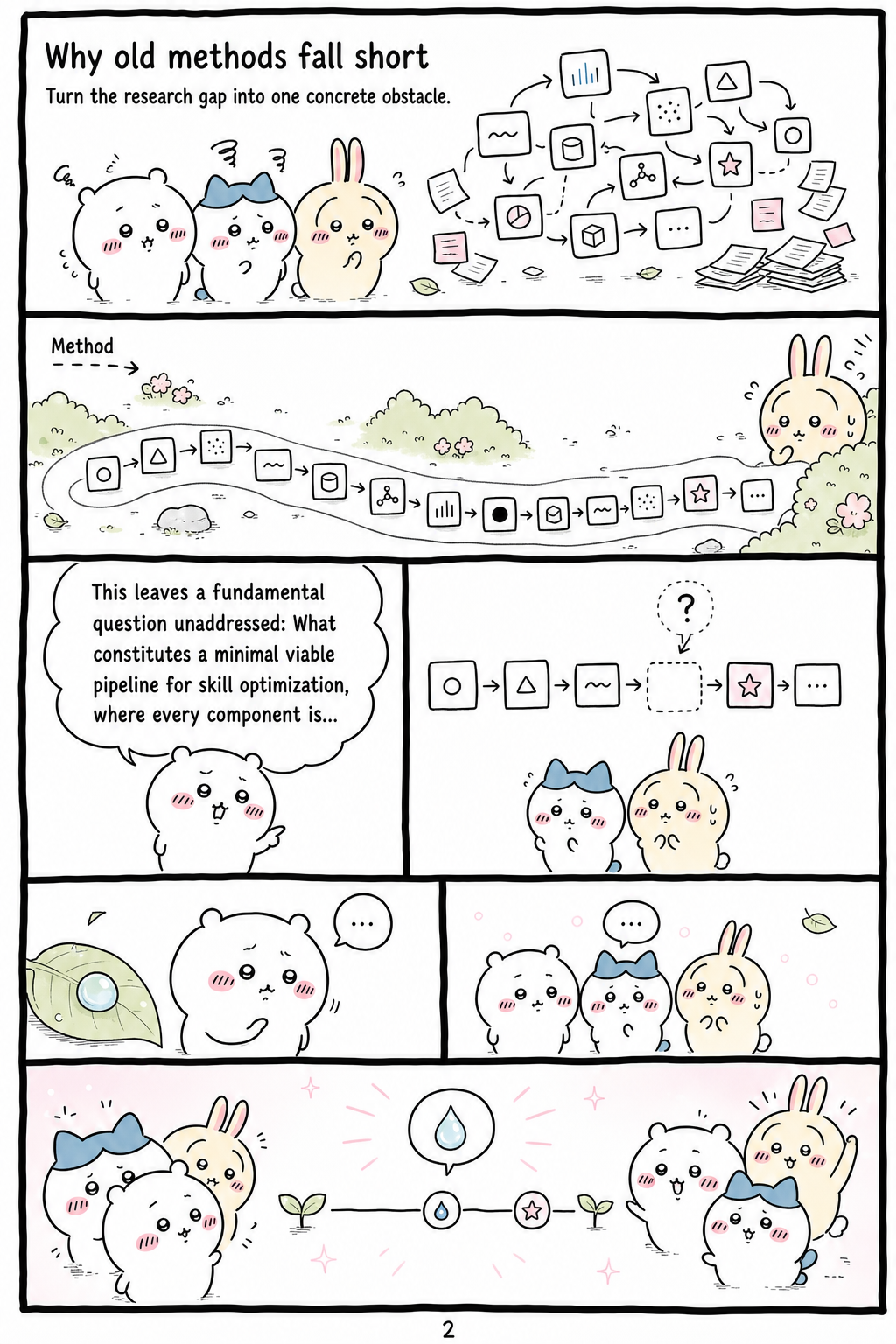
Why old methods fall short
The paper argues that older or more elaborate skill-optimization pipelines fall short because they often accumulate mechanisms without clarifying why each one is needed. This creates a gap between observed agent improvement and a principled account of convergence, generalization, and debugging. SkillOpt-Lite treats this gap as the main obstacle: if a pipeline cannot explain which component drives progress, then it is difficult to simplify, compare, or trust. The authors therefore focus on the question of minimality, asking how much structure an autonomous agent actually needs in order to evolve useful skills. By making component justification explicit, the paper reframes skill optimization as a problem of disciplined pipeline design rather than incremental engineering complexity.
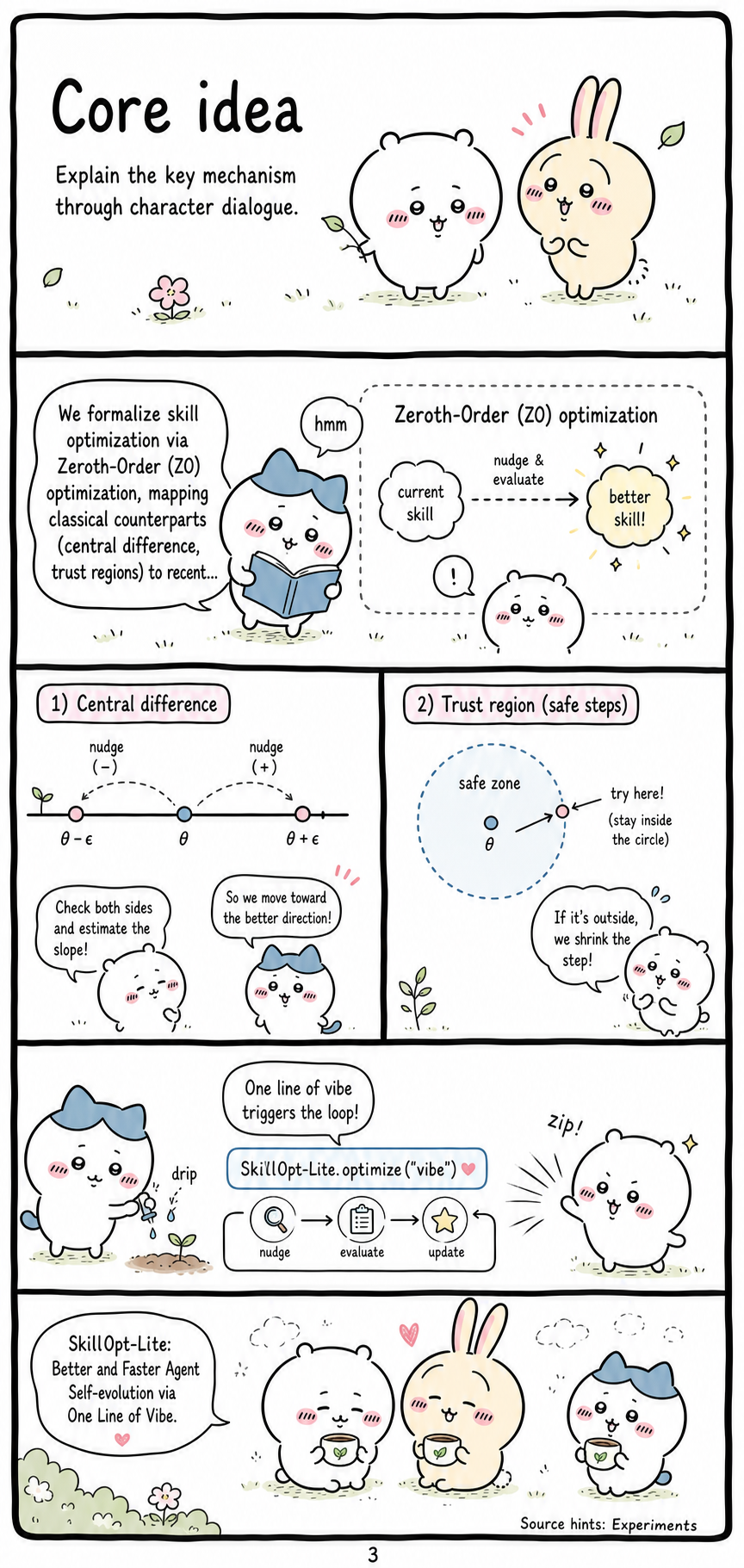
Core idea
The technical core of SkillOpt-Lite is its formalization of skill optimization through Zeroth-Order optimization. In classical Zeroth-Order methods, an optimizer estimates improvement without direct gradient access, often through numerical perturbations and comparisons of resulting function values. The paper maps this perspective onto autonomous agents by relating skill updates to ideas such as central difference and trust regions, thereby giving recent agent-optimization practice a more recognizable optimization-theoretic vocabulary. This framing matters because agent skills are not ordinary numeric parameters; they are operational behaviors that produce trajectories, files, traces, and outcomes. SkillOpt-Lite uses that distinction to argue that agent self-evolution can borrow rigor from Zeroth-Order optimization while still exploiting the semantic structure of agent behavior.
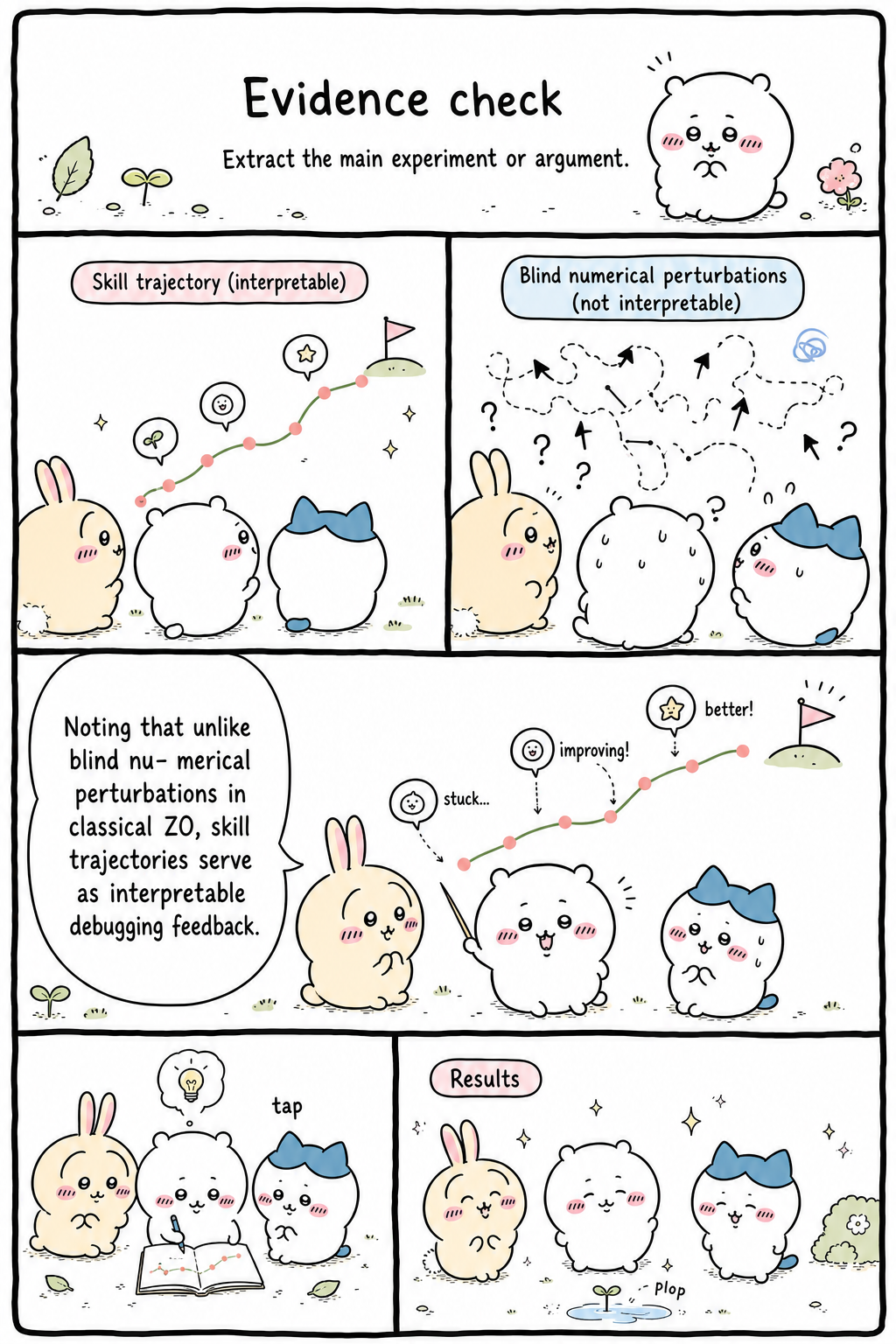
Evidence check
A key evidence-oriented claim in the paper is that skill trajectories provide interpretable debugging feedback, unlike blind numerical perturbations in classical Zeroth-Order optimization. This observation changes how optimization signals are understood: an agent’s failed or successful trajectory can reveal what the skill attempted, where it broke down, and how the next update might be targeted. The paper’s experiments and results sections are presented as the empirical setting for evaluating whether this lighter pipeline can improve agent self-evolution while remaining faster and simpler. From the provided abstract, the important result is the claimed combination of better and faster optimization under a reduced design. The implication is that interpretability is not only a diagnostic convenience but also part of the optimization substrate for autonomous agents.
One thing to remember
The paper’s final takeaway is that a minimal agent self-evolution pipeline can be grounded in three principles for convergence and generalization. These principles are described as drawing on Claude Code philosophy and PAC learning, with file-system-based trajectory information identified as one important ingredient. The use of PAC learning signals that the authors care not only about local improvement on observed tasks, but also about whether learned skills generalize beyond the immediate optimization traces. The reference to file-system-based trajectories suggests a concrete mechanism for preserving and inspecting the evidence produced during agent work. SkillOpt-Lite therefore presents agent skill optimization as a compact loop where interpretable trajectories, Zeroth-Order reasoning, and generalization principles jointly justify a simpler path to self-improving autonomous agents.