ReadPaper Blog
Self-Guided Test-Time Training for Long-Context LLMs
The paper addresses a core weakness of long-context LLMs: larger context windows let models ingest more tokens, but do not ensure they can identify and use the evidence needed to answer a question. It proposes Self-Guided Test-Time Training (S-TTT), a method that asks the model to select question-relevant evidence spans from the test context, adapts the model only on those spans with a standard language-modeling objective, and then answers using the full context. The result matters because S-TTT improves long-context reasoning on LongBench-v2 and LongBench-Pro while avoiding the cost and noise of training on the entire context.
Source: Self-Guided Test-Time Training for Long-Context LLMs
Long Context, Short Attention
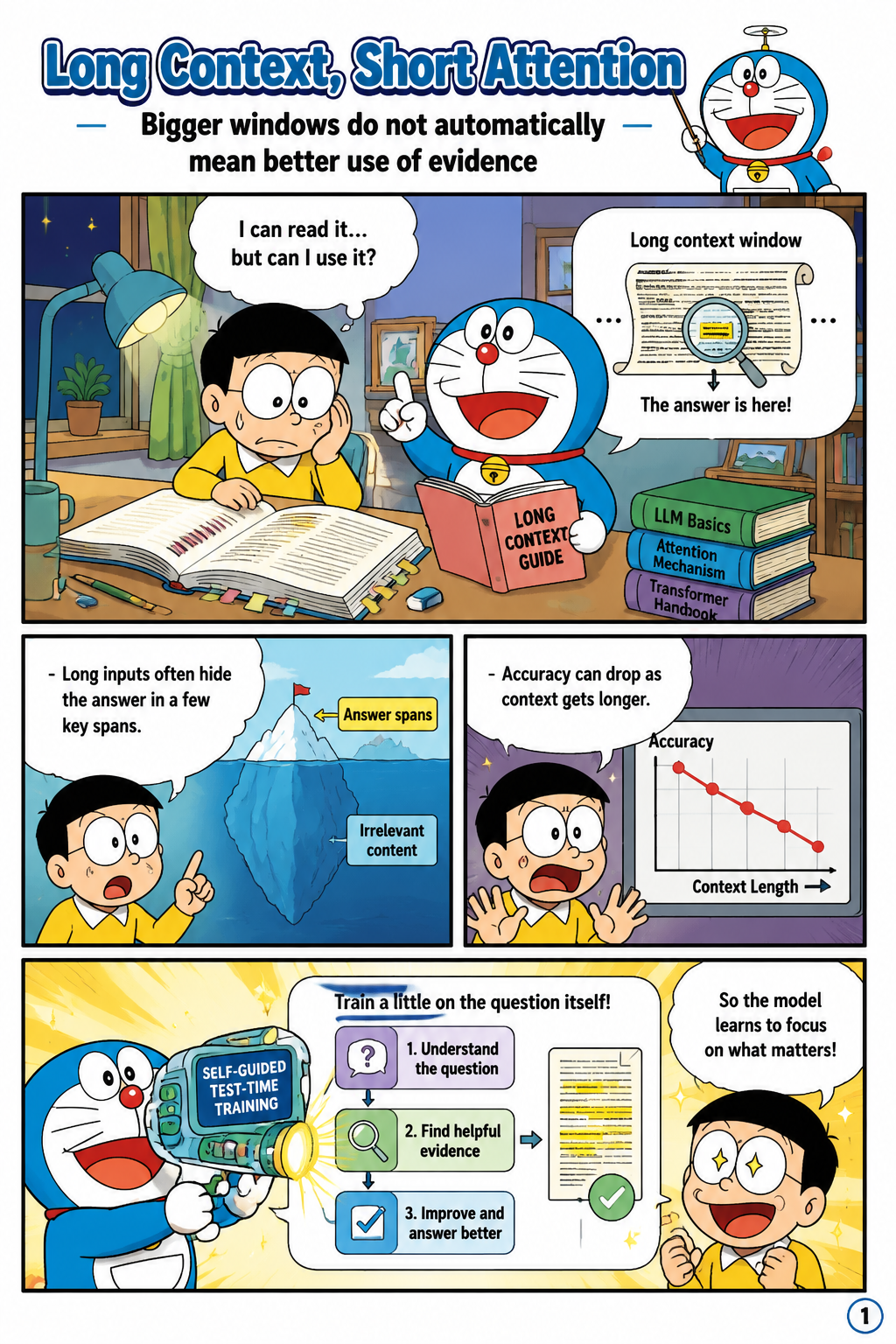
The paper begins from the observation that long-context capability is not the same as long-context utilization. Modern LLMs can accept hundreds of thousands of tokens, but the authors argue that accuracy often degrades as inputs grow because the model must keep a small amount of relevant evidence accessible among many distractors. This reframes the bottleneck in long-context reasoning: the limiting factor is not merely whether the prompt fits, but whether the model can identify and exploit the spans that support the specific question. The authors situate this problem in tasks where the answer is hidden in a few key passages inside a much longer input. Their motivation is therefore to improve evidence use at inference time without changing the base model architecture or relying on broader context windows alone.
TTT Has A Trap
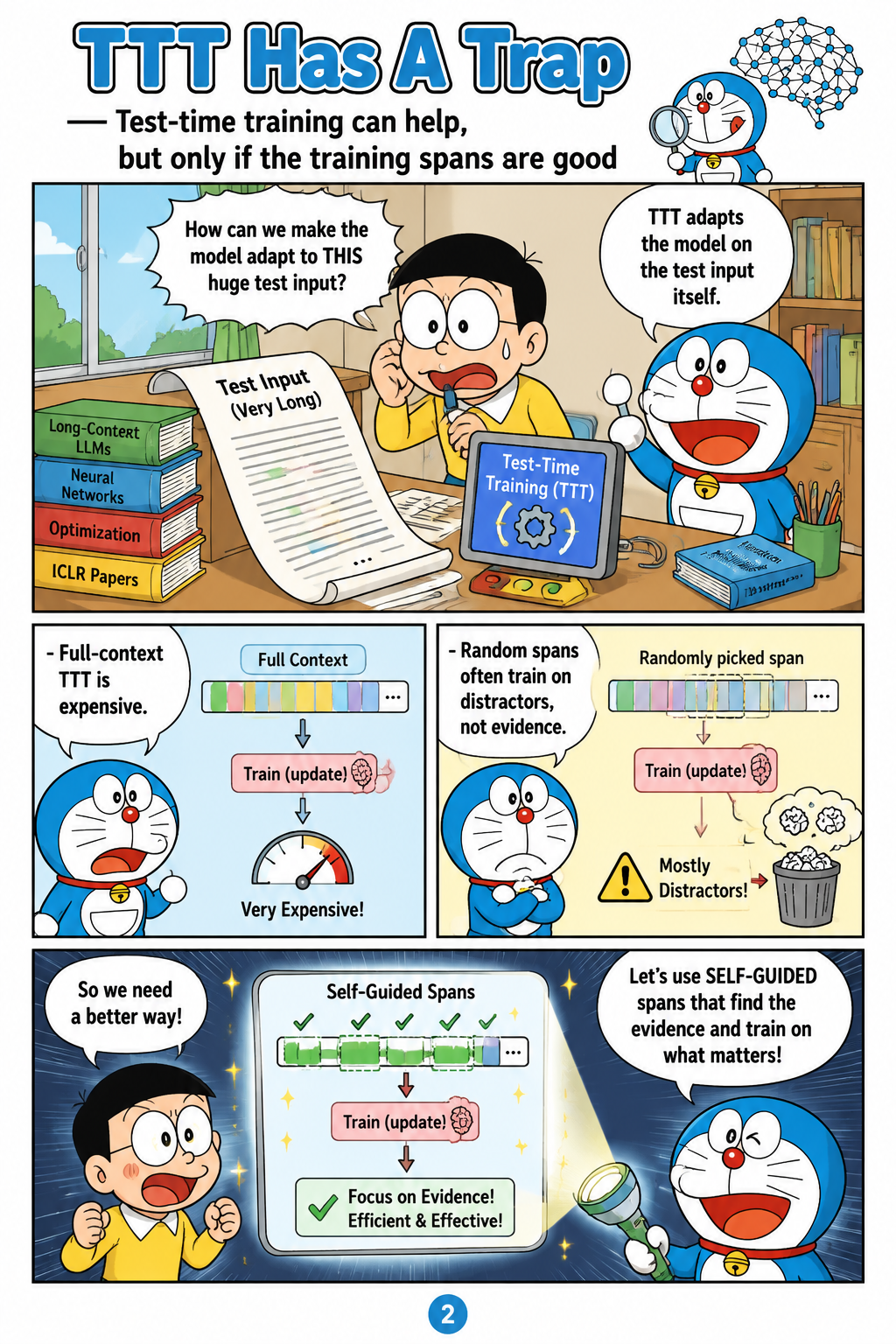
The paper treats test-time training as a promising but fragile tool for long-context reasoning. In TTT, the model is adapted on the test input itself before producing the answer, allowing instance-specific information from the context to influence the model’s parameters. The authors argue that long-context TTT raises a crucial data-selection problem because training on the full context is computationally expensive and dominated by irrelevant material. Randomly sampled spans reduce the cost, but they often miss the evidence and instead adapt the model to distractors. This leads to the paper’s central claim that training-token quality, rather than the adaptation mechanism alone, is the key bottleneck for effective long-context TTT.
The Diagnostic Shock
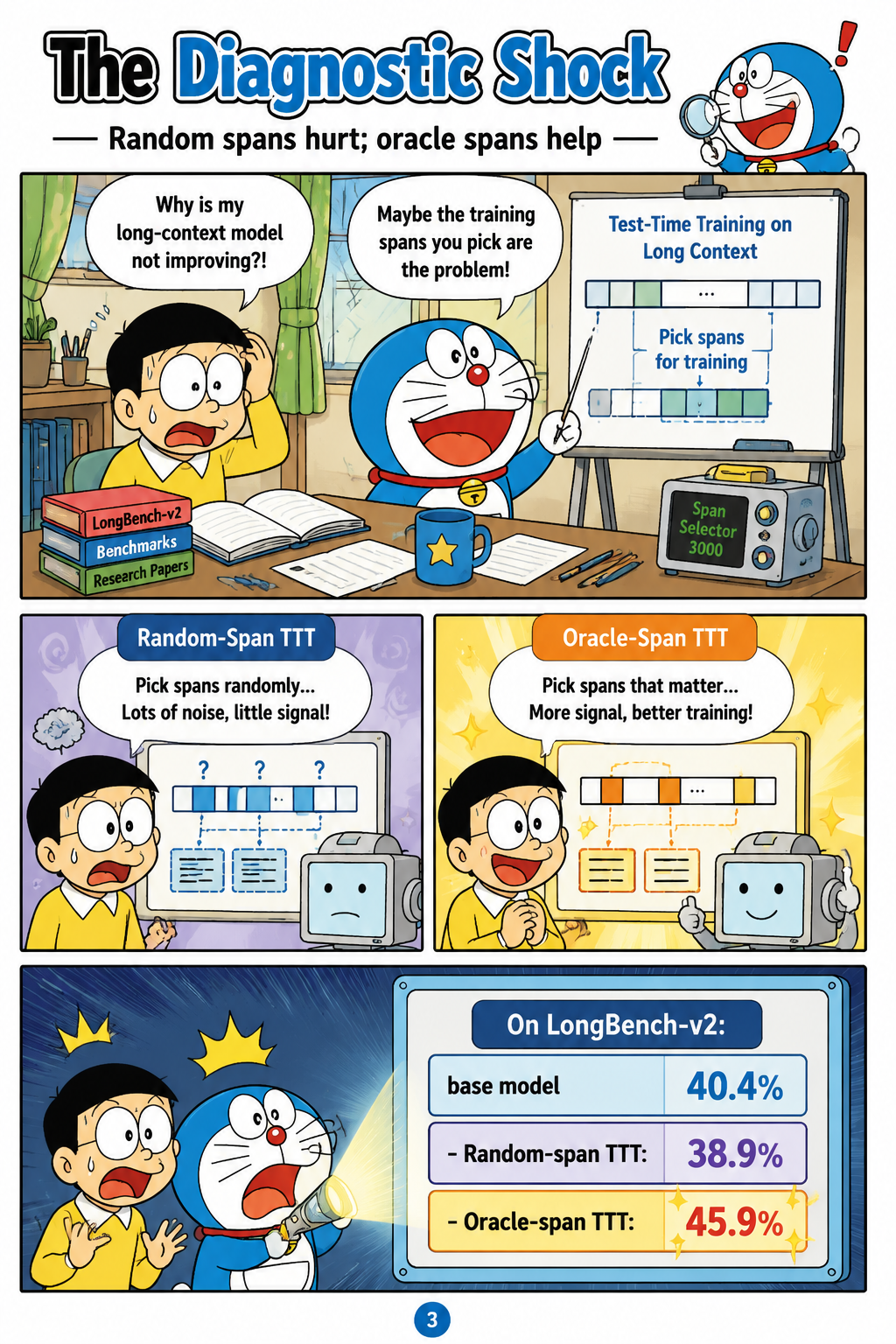
The paper supports this claim with a diagnostic experiment on LongBench-v2 using Qwen3-4B-Thinking-2507. The base model reaches 40.4% accuracy without test-time adaptation, while random-span TTT lowers accuracy to 38.9%, showing that adaptation can actively hurt when the training tokens are noisy. In contrast, TTT on answer-aware oracle spans annotated by GPT-5.5 raises accuracy to 45.9%, demonstrating that high-quality evidence spans make the same general adaptation idea much more useful. This result isolates the signal-to-noise ratio of the selected training tokens as a decisive factor. The experiment motivates the paper’s method by showing that the main opportunity is to approximate oracle-like evidence selection without access to the answer.
Self-Guided TTT
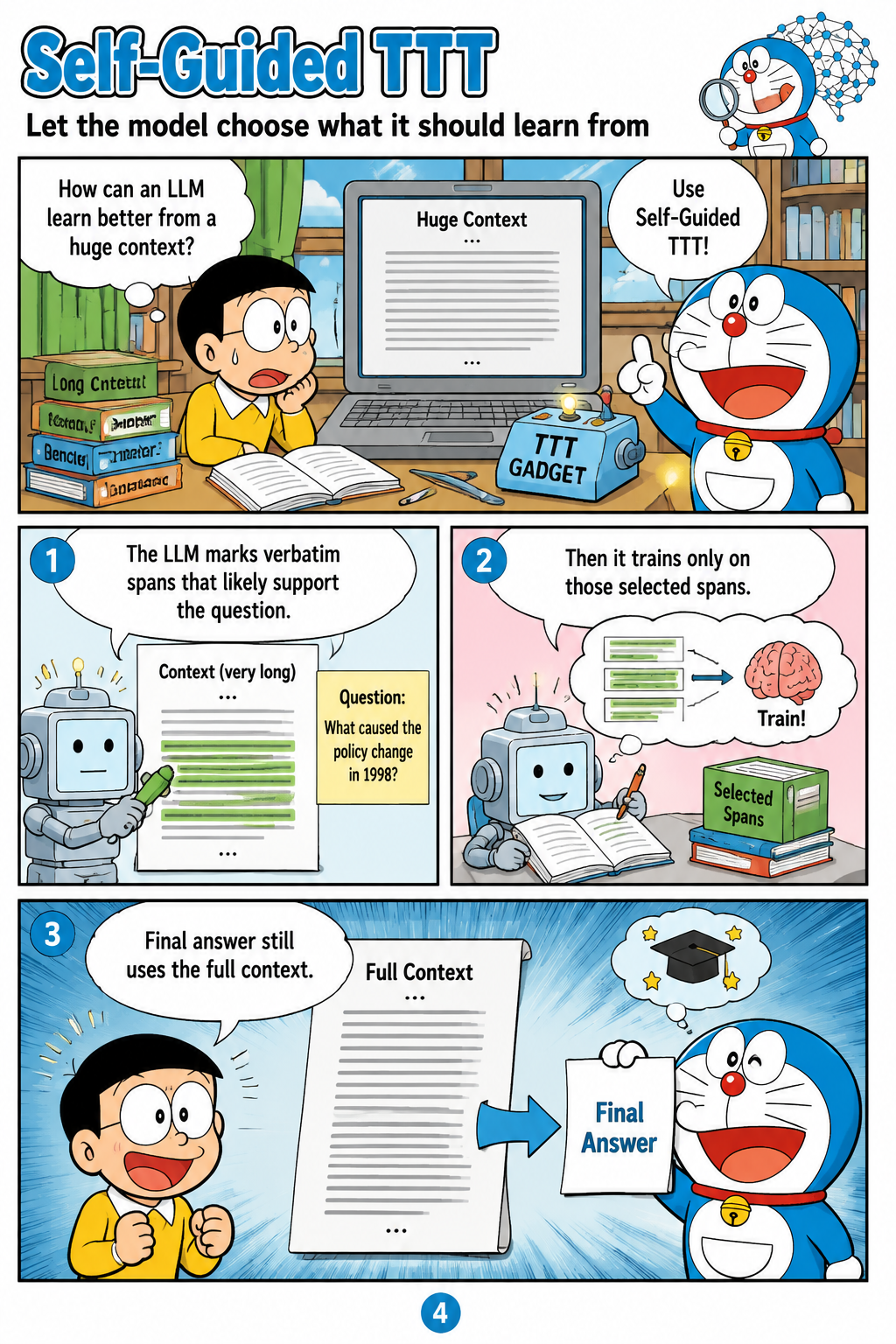
The proposed method, Self-Guided Test-Time Training, uses the LLM itself as a test-time data selector before adaptation. Given a question and a long context, the model is prompted to mark verbatim spans that are likely to support the answer, rather than training on the entire input or on uniformly sampled chunks. The method then applies the standard next-token-prediction objective only to the selected spans, keeping the training objective, model architecture, and final decoding procedure unchanged. After this span-focused adaptation, the model generates the final answer from the full context, so the method does not discard the broader input at inference. The design makes S-TTT a lightweight intervention focused specifically on improving which tokens shape the instance-specific parameter update.
What It Delivers
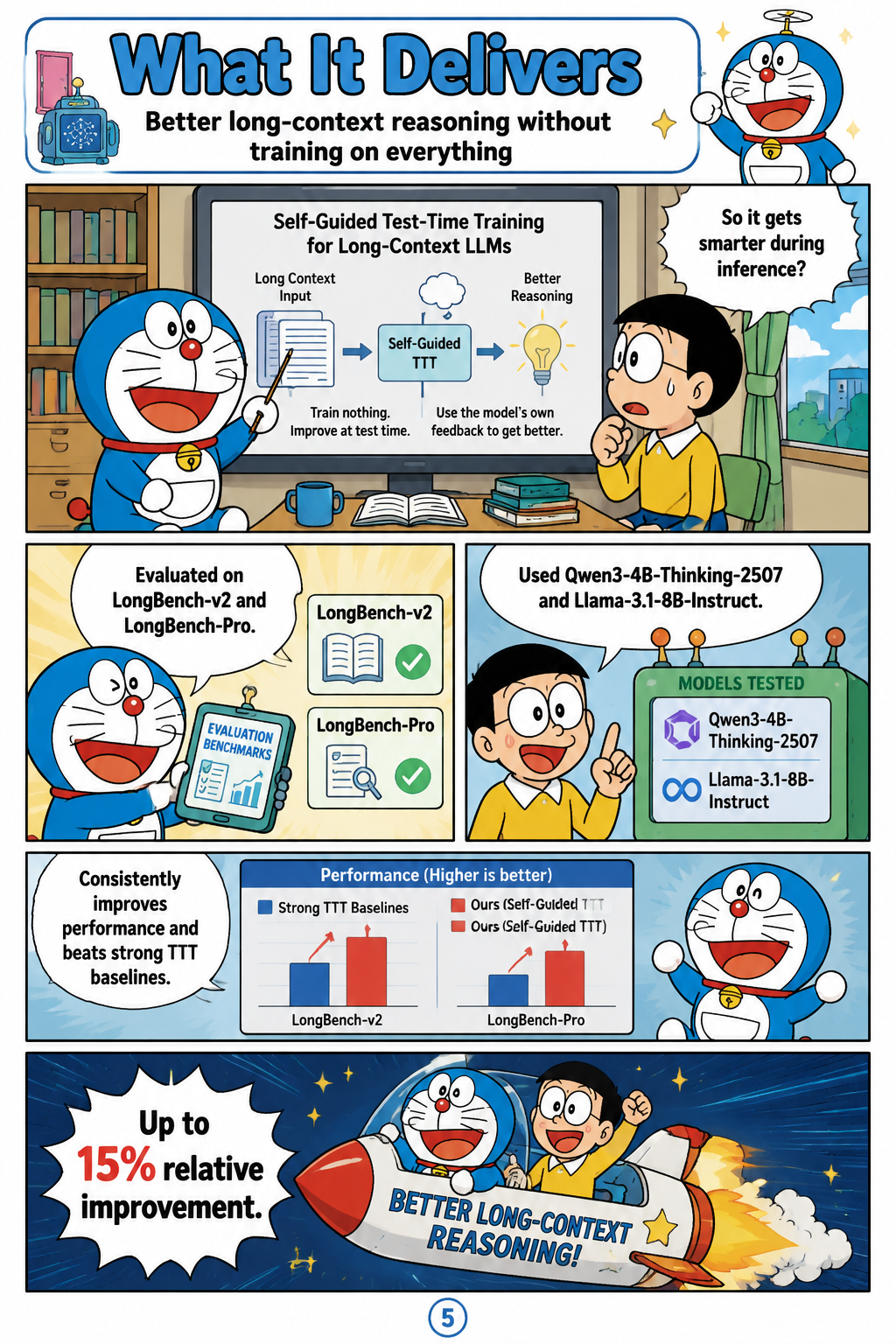
The paper evaluates S-TTT on two challenging long-context reasoning benchmarks, LongBench-v2 and LongBench-Pro. The experiments use Qwen3-4B-Thinking-2507 and Llama-3.1-8B-Instruct, allowing the authors to test whether the method generalizes across different model families. The reported results show that S-TTT consistently improves long-context performance and outperforms strong TTT baselines, with gains reaching up to a 15% relative improvement. The implication is that long-context reasoning can be improved by optimizing test-time training data selection rather than expanding context length, changing the architecture, or training on every available token. The paper also suggests a broader lesson for inference-time adaptation: in long inputs, choosing the right evidence to learn from can matter more than simply doing more adaptation.