ReadPaper Blog
Scaling Mixture-of-Experts Video Pretraining for Embodied Intelligence
The paper introduces LingBot-Video, a DiT-based video pretraining paradigm designed to make video foundation models more useful for embodied intelligence rather than only content creation. It addresses the mismatch between visually impressive video generation and the needs of robot control by combining sparse Mixture-of-Experts computation, robot-augmented video data, and reward signals for physical rationality and task completion. The result matters because it frames video models as scalable world models that can better support planning, policy learning, and embodied reasoning.
Source: Scaling Mixture-of-Experts Video Pretraining for Embodied Intelligence
Research question
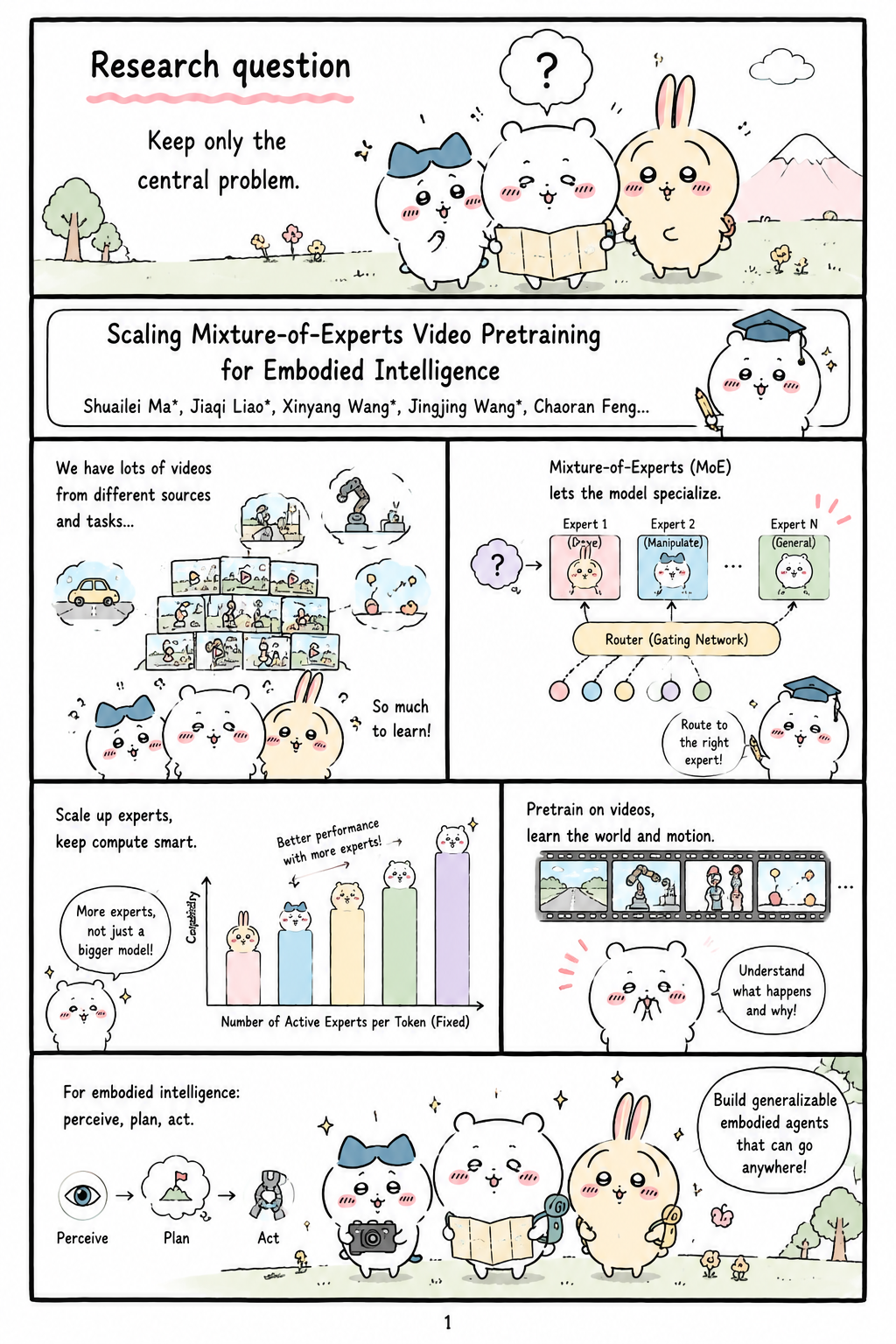
The central problem in the paper is that modern video generative models are increasingly plausible as predictive world models, but they are not yet optimized for embodied intelligence. Diffusion-based and autoregressive video models can synthesize temporally coherent, photorealistic sequences conditioned on text, images, or other controls, which makes them attractive for robotics, autonomous driving, and interactive environments. The authors argue that this promise exposes a gap between passive video generation and active embodied reasoning, where a model must respect intervention, contact, and long-horizon dynamics. LingBot-Video is proposed as a video foundation model that targets this gap directly rather than treating robot-relevant behavior as a byproduct of internet-scale visual learning. The paper’s motivation is therefore not simply better videos, but better pretrained dynamics representations for physical actuation and robot control.
Why old methods fall short
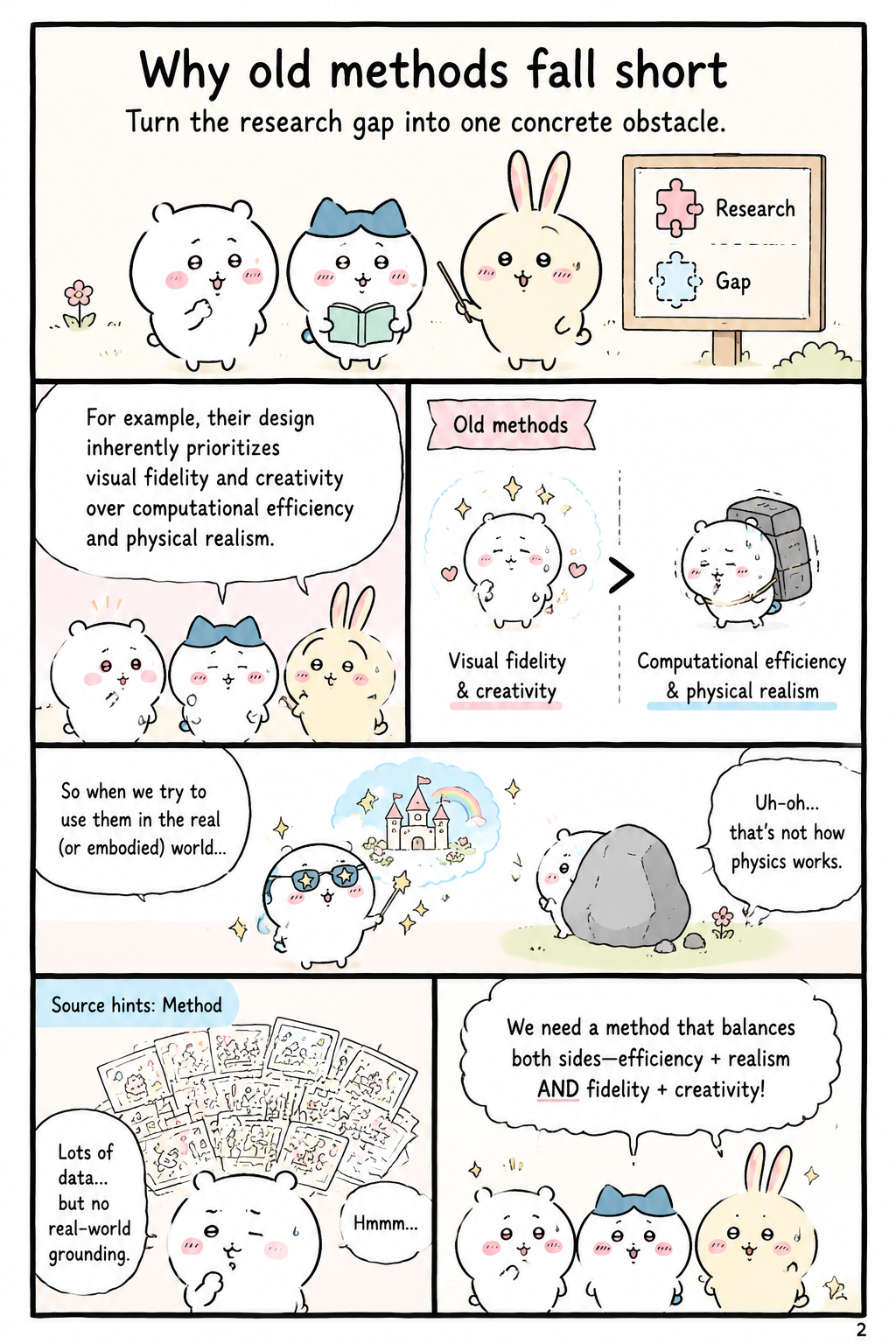
The paper identifies three reasons existing video models fall short for embodied use: architecture, data, and training objectives. Architecturally, many diffusion video transformers rely on dense computation, activating the same large parameter set across tokens and timesteps, which makes inference expensive as models scale. Data-wise, internet videos provide broad visual diversity but often lack robot embodiment priors, precise manipulation dynamics, navigation behavior, and egocentric interaction signals. Training-wise, common alignment criteria emphasize aesthetics, prompt following, and motion consistency, while leaving physical feasibility, task completion, contact stability, rigid-body dynamics, and long-horizon state consistency weakly enforced. The authors present these shortcomings as a coupled bottleneck: a model can look realistic yet still be inefficient, poorly grounded in action, and unreliable as a physical simulator.
Core idea
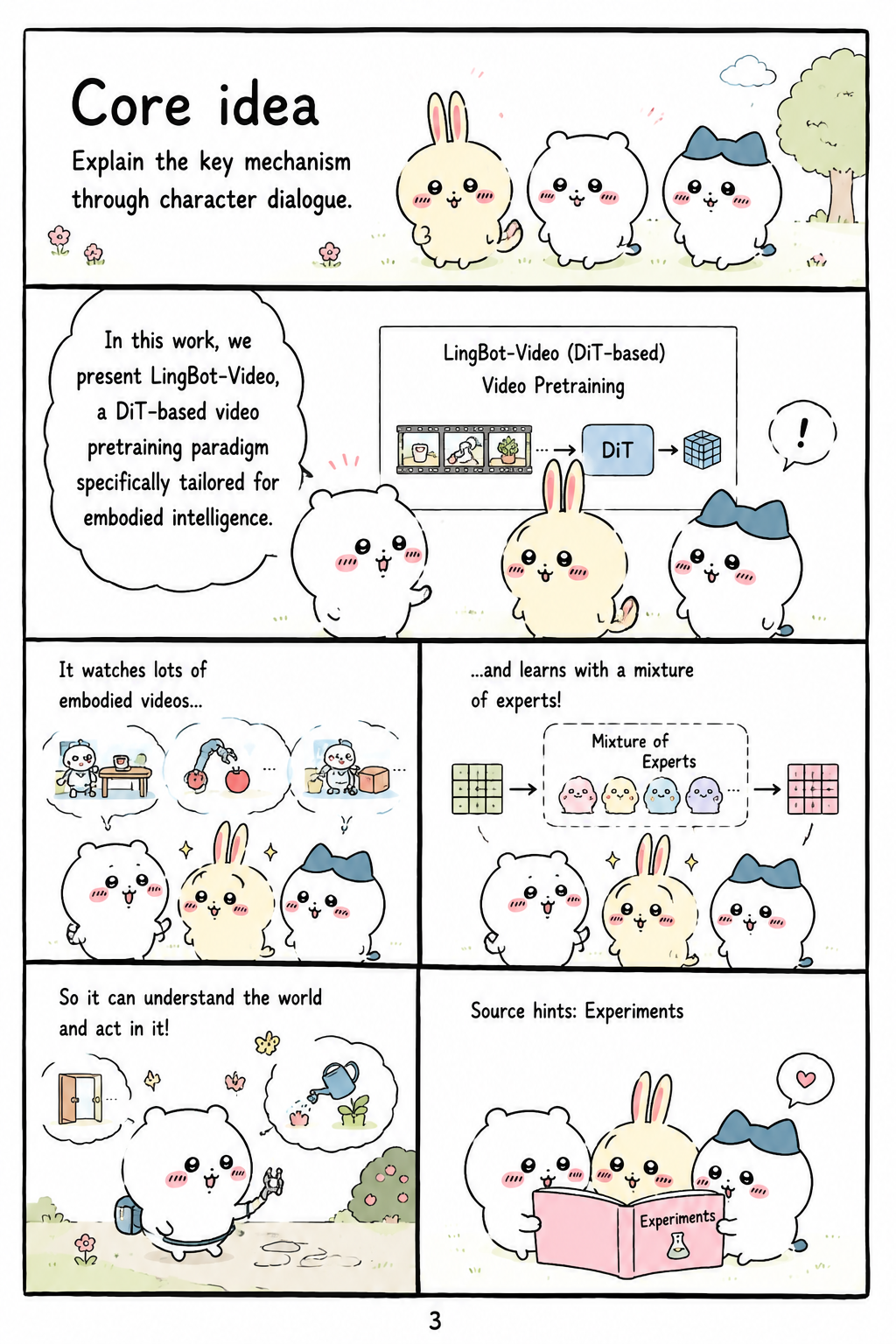
LingBot-Video’s core idea is to redesign video pretraining around embodied intelligence using a DiT-based framework with sparse conditional computation. Instead of a fully dense video transformer, the model adopts a Mixture-of-Experts architecture so that different experts can be conditionally activated, improving the trade-off between modeling capacity and inference efficiency. This matters for spatiotemporal prediction because embodied environments require rich capacity for complex dynamics, but robot-oriented deployment also benefits from computational efficiency. The paper also treats pretraining data as part of the method, constructing a data profiling engine that augments standard internet video with robot-oriented footage. By including manipulation, navigation, and egocentric perspectives, the pretraining corpus is intended to give the base model stronger priors about actions, objects, viewpoints, and world dynamics.
Evidence check
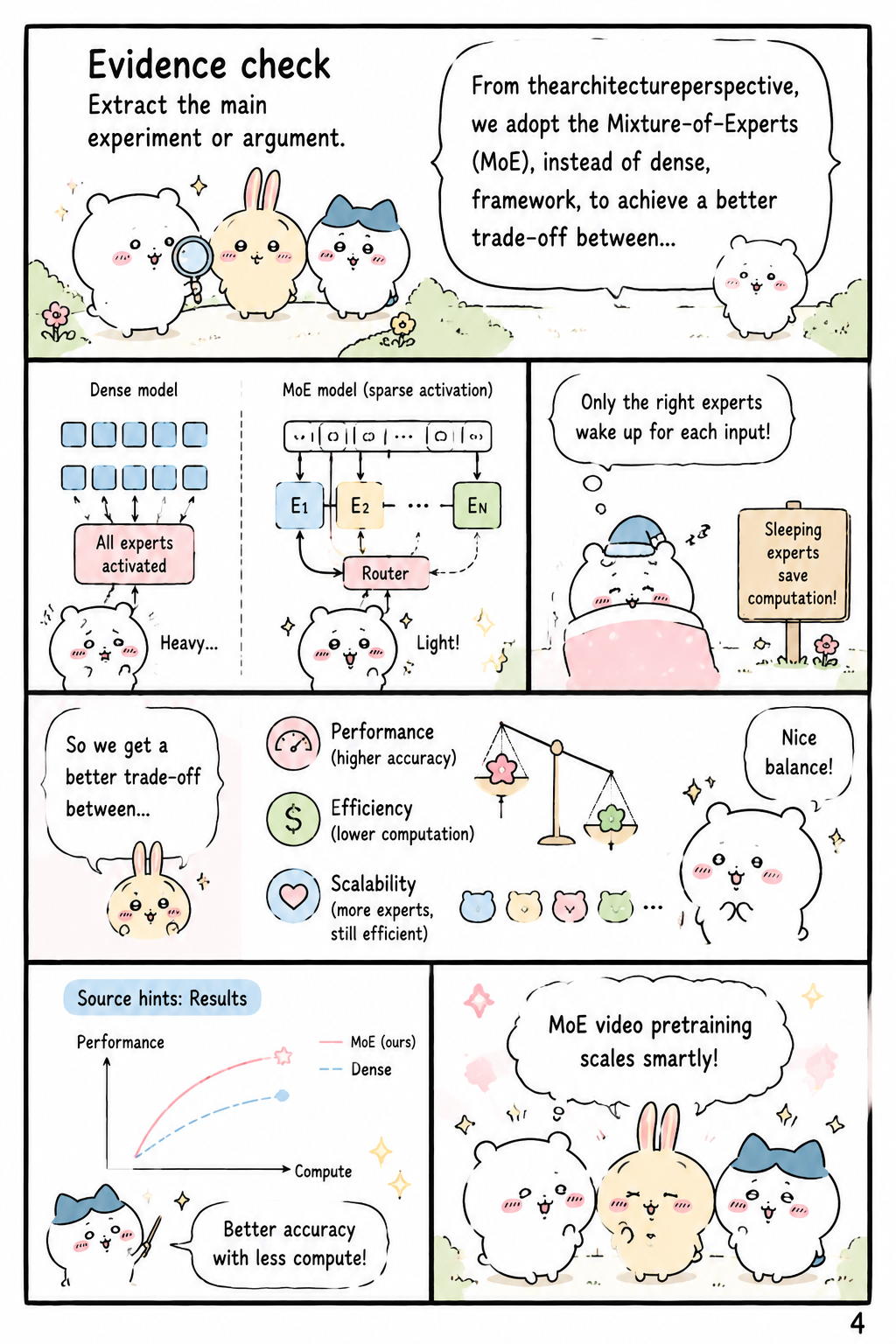
The evidence described in the paper centers on comprehensive evaluations of LingBot-Video as a video foundation model, with attention to both performance and efficiency. The authors claim that the MoE design enables scaling from scratch while maintaining a better balance between capacity and inference cost than dense alternatives. Their evaluation framing goes beyond visual fidelity by asking whether generated sequences align with embodied requirements such as physical rationality and task-oriented success. The multi-dimensional reward system is a key part of this evidence pipeline, because it explicitly extends alignment beyond aesthetics, prompt-following, and generic motion consistency. Within the available description, the paper’s strongest empirical claim is that combining MoE architecture, robot-augmented data, and embodied reward alignment validates LingBot-Video as a foundation model suited to physical reasoning tasks.
One thing to remember
The main takeaway is that the paper treats video pretraining for robots as a distinct problem from video generation for human viewing. LingBot-Video contributes an open-source large-scale MoE video foundation model intended to bridge digital creativity and physical actuation. Its data strategy emphasizes that internet-scale video diversity is useful but insufficient unless supplemented with manipulation, navigation, and egocentric robot-oriented footage. Its training strategy emphasizes that physical rationality and task completion should be explicit alignment targets, not hoped-for side effects of visual realism. The paper also implies an important limitation of the broader field: without architectures, corpora, and rewards designed for embodied constraints, visually strong video models may remain weak world models for robot decision-making.