ReadPaper Blog
SCAIL-2: Unifying Controlled Character Animation with End-to-End In-Context Conditioning
SCAIL-2 addresses controlled character animation by replacing fragile intermediate conditions such as pose skeletons and masked backgrounds with direct end-to-end conditioning on the driving video. The paper introduces a unified framework, a synthetic MotionPair-60K training pipeline, in-context mask conditioning, mode-specific RoPE, and Bias-Aware DPO to improve motion transfer across animation, replacement, multi-character, complex-interaction, and non-human driving scenarios.
Source: SCAIL-2: Unifying Controlled Character Animation with End-to-End In-Context Conditioning
Mission Briefing: Why Old Forms Fail
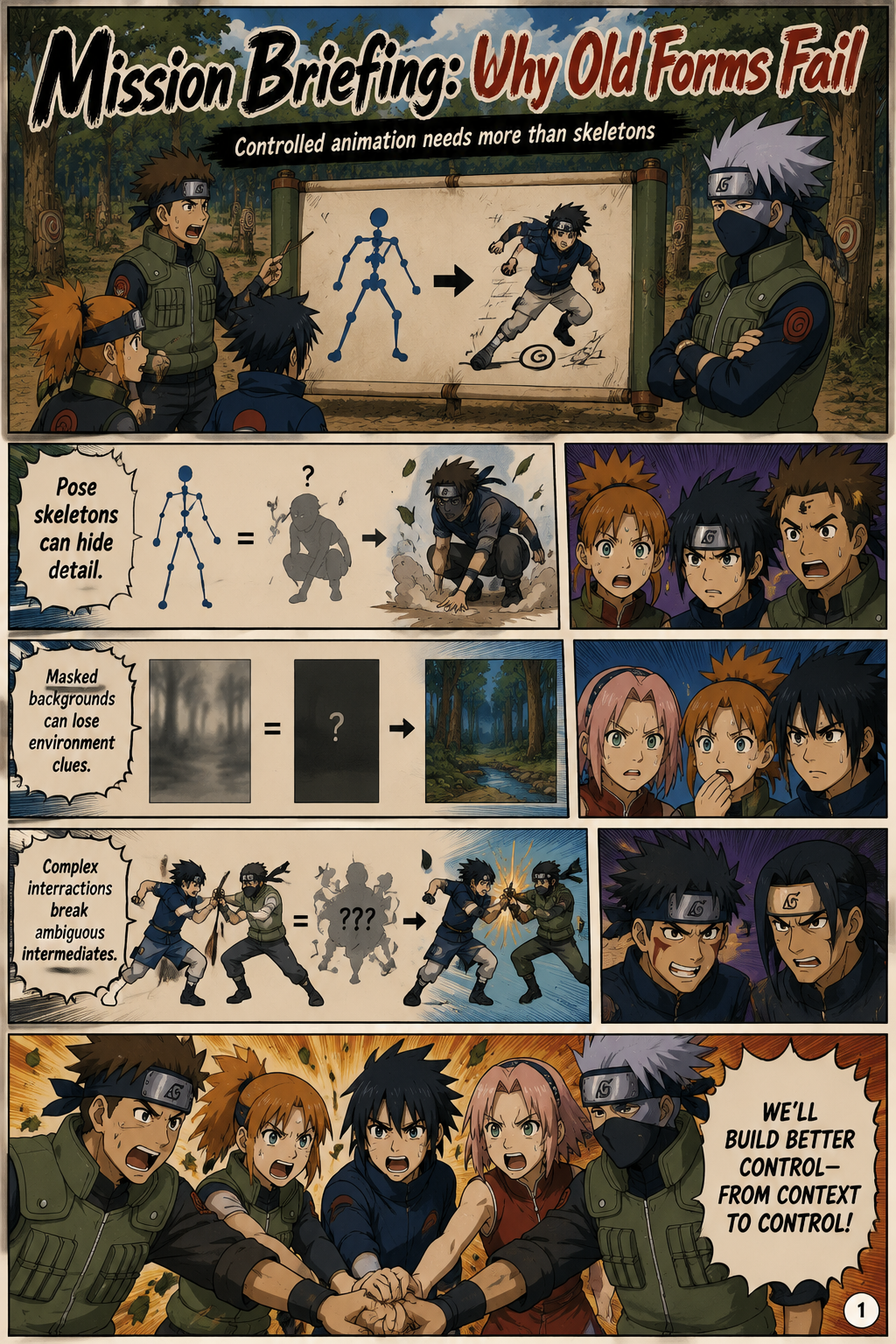
The paper starts from a central weakness in controlled character animation: many video diffusion methods compress the driving sequence into intermediate signals that discard information needed for realistic motion transfer. Pose skeletons extracted by off-the-shelf estimators can become ambiguous when bodies overlap, when depth ordering matters, or when interactions involve objects and occlusions. Self-supervised motion bottlenecks can also lose spatial detail that is important for multi-character interaction and environment-aware synthesis. In character replacement, masked backgrounds and cropped environment cues are described as suboptimal because changing a character may also change the surrounding objects or contact relationships. SCAIL-2 therefore frames skeleton maps, masks, and other hand-designed intermediates as a bottleneck that limits universal character animation, especially for animals, unusual body shapes, and complex interactions.
The Core Trick: Go End-to-End
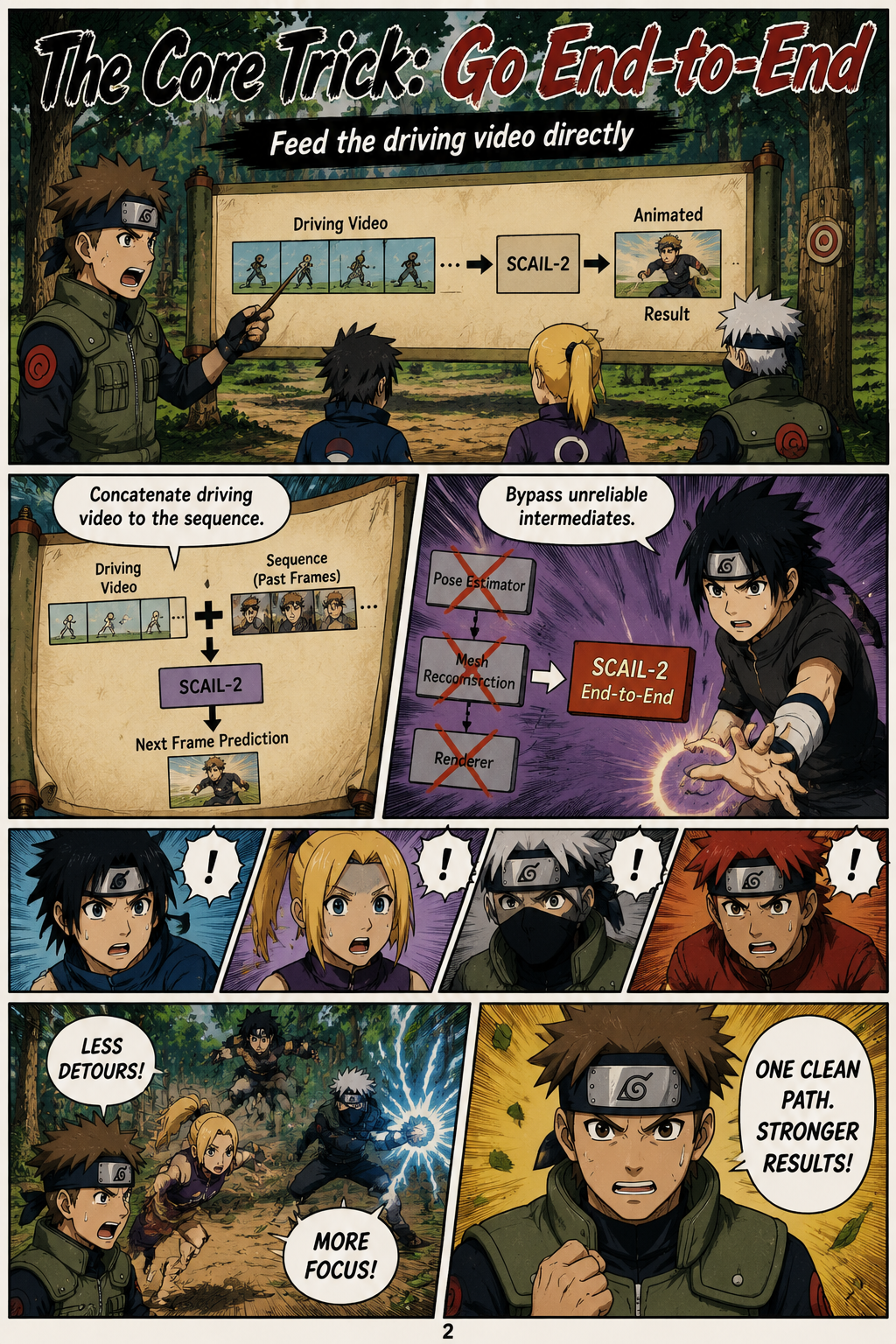
SCAIL-2’s core proposal is an end-to-end driving paradigm in which the model directly receives the driving video rather than a pose-only abstraction of it. In the paper’s formulation, a latent video diffusion model encodes both generated video content and the driving video through a shared VAE latent space, allowing the driving context to preserve visual information such as occlusion, environment structure, object contact, and fine motion cues. This design is intended to bypass explicit pose estimation while still letting the denoising model condition generation on motion, text, reference images, and task-specific context. The authors describe this as directly concatenating driving videos to the sequence so the model can infer the required motion and scene information from raw visual input. The result matters because the same mechanism can handle cases where skeleton-based conditioning is unreliable or impossible, including non-human driving sources and interaction-heavy videos.
Unifying Many Tasks
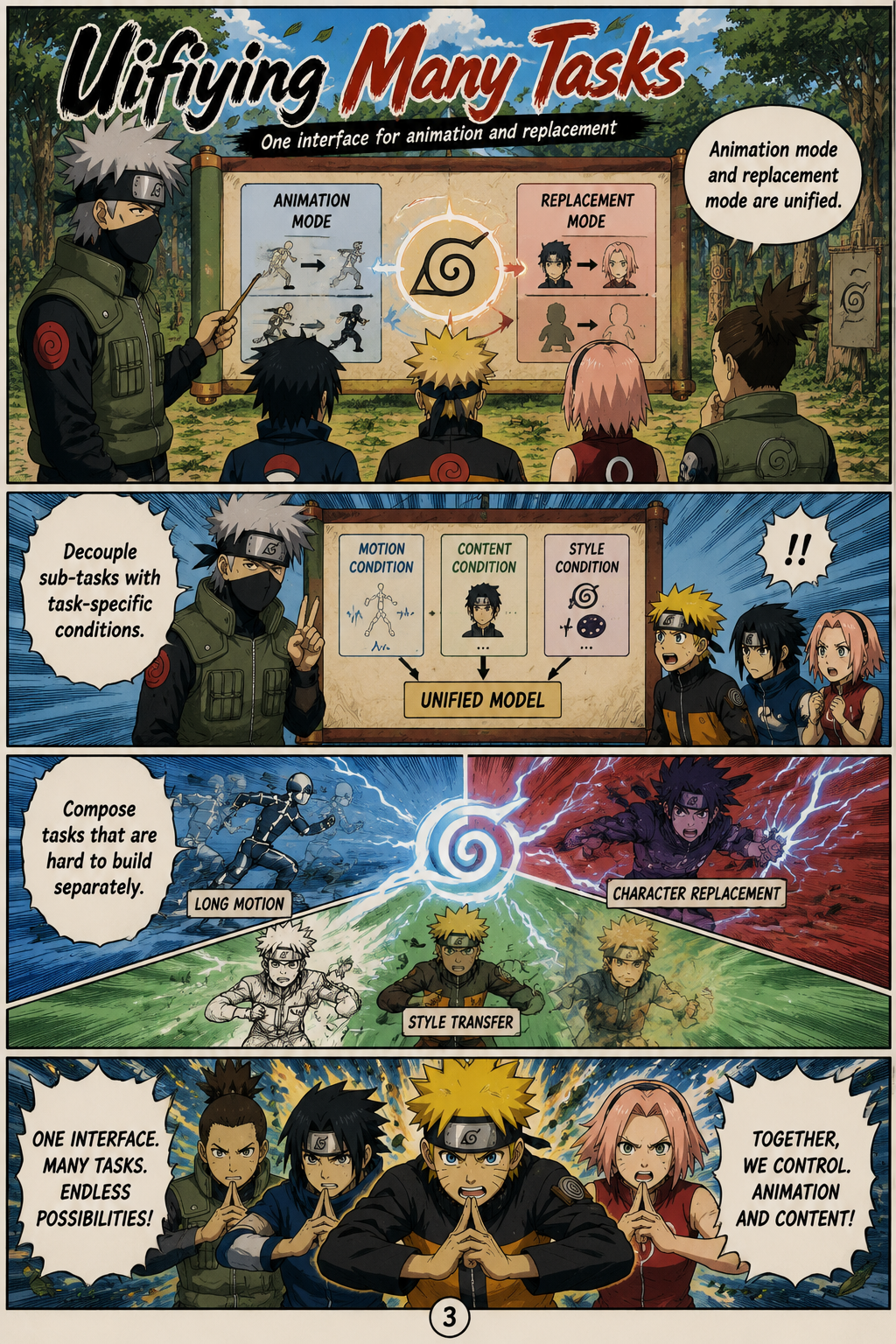
The paper unifies multiple controlled animation tasks by treating them as variants of one conditional generation problem rather than as separate pipelines. It defines a binding map from driving characters to reference characters and an environment source that selects either the reference image environment or the driving video environment. Under this formulation, character image animation keeps the reference environment, while character replacement uses the driving environment, and both single-character and multi-character cases share the same binding logic. The authors decompose the unified goal into Motion Binding, Environment Weaving, and Universal Transfer, which respectively require routing each driving motion to the correct target, integrating characters into the selected scene, and separating pose from identity without leakage. This unified interface is designed to support compositional tasks that would be difficult to cover with dedicated datasets or separate task-specific generators.
How They Train Without Enough Real Data
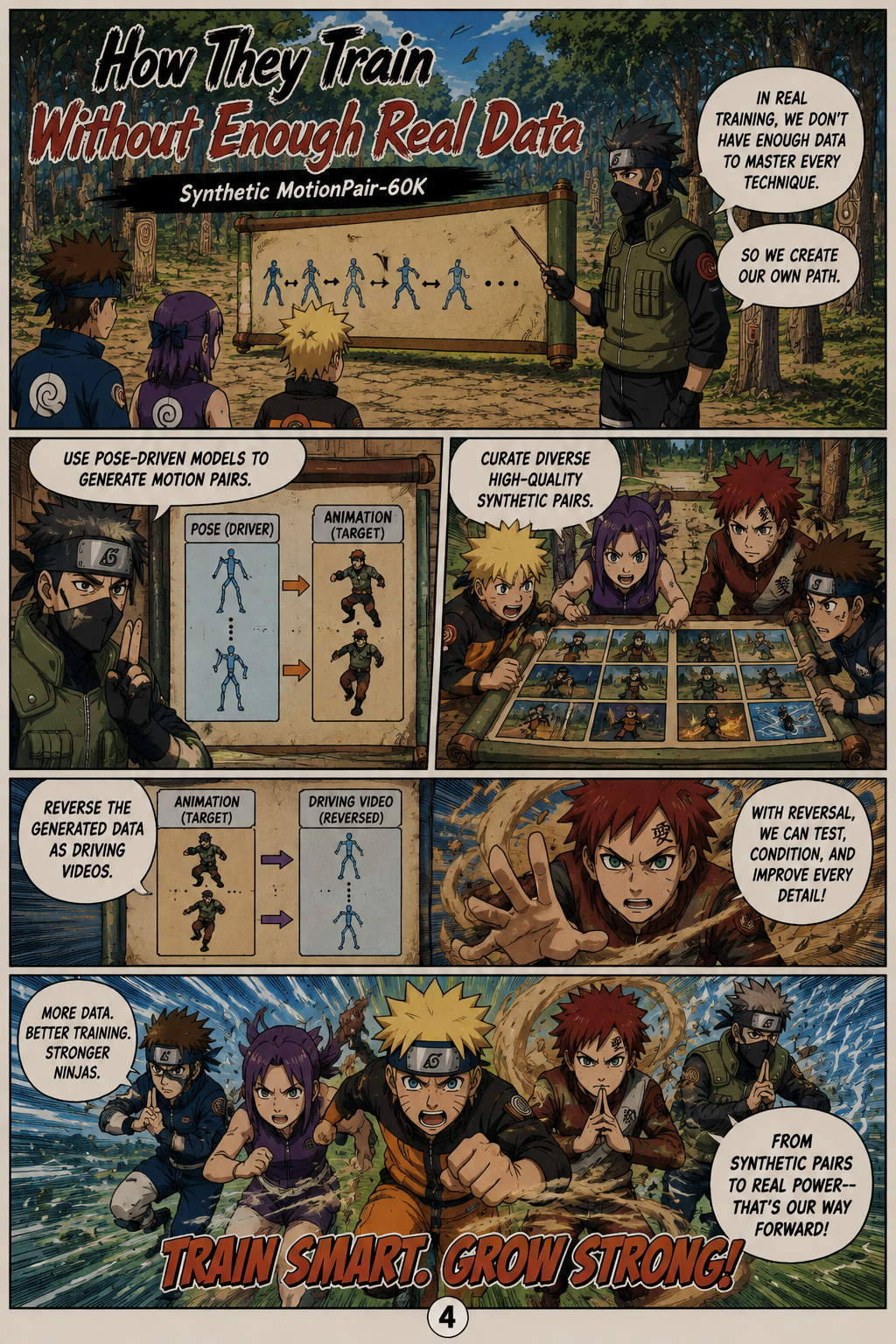
A major obstacle for end-to-end character animation is the lack of real paired videos in which different characters perform the same motion under the required conditions. To address this, the paper constructs MotionPair-60K, a heterogeneous synthetic dataset built from an agentic motion-pair synthesis pipeline. The method uses pose-driven animation generators to create paired videos, then reverses the generated result into a driving video so the model can learn end-to-end conditioning from synthetic cross-identity motion pairs. The described pipeline includes a Candidate Selector, Prompt Weaver, Quality Checker, and a multi-reference image generation model to select suitable character references, plan pose and background descriptions, edit reference frames, and filter low-quality outputs. This data strategy lets SCAIL-2 train on diverse animation and replacement situations even though naturally occurring end-to-end paired data is scarce.
Soft Guidance and Final Refinement
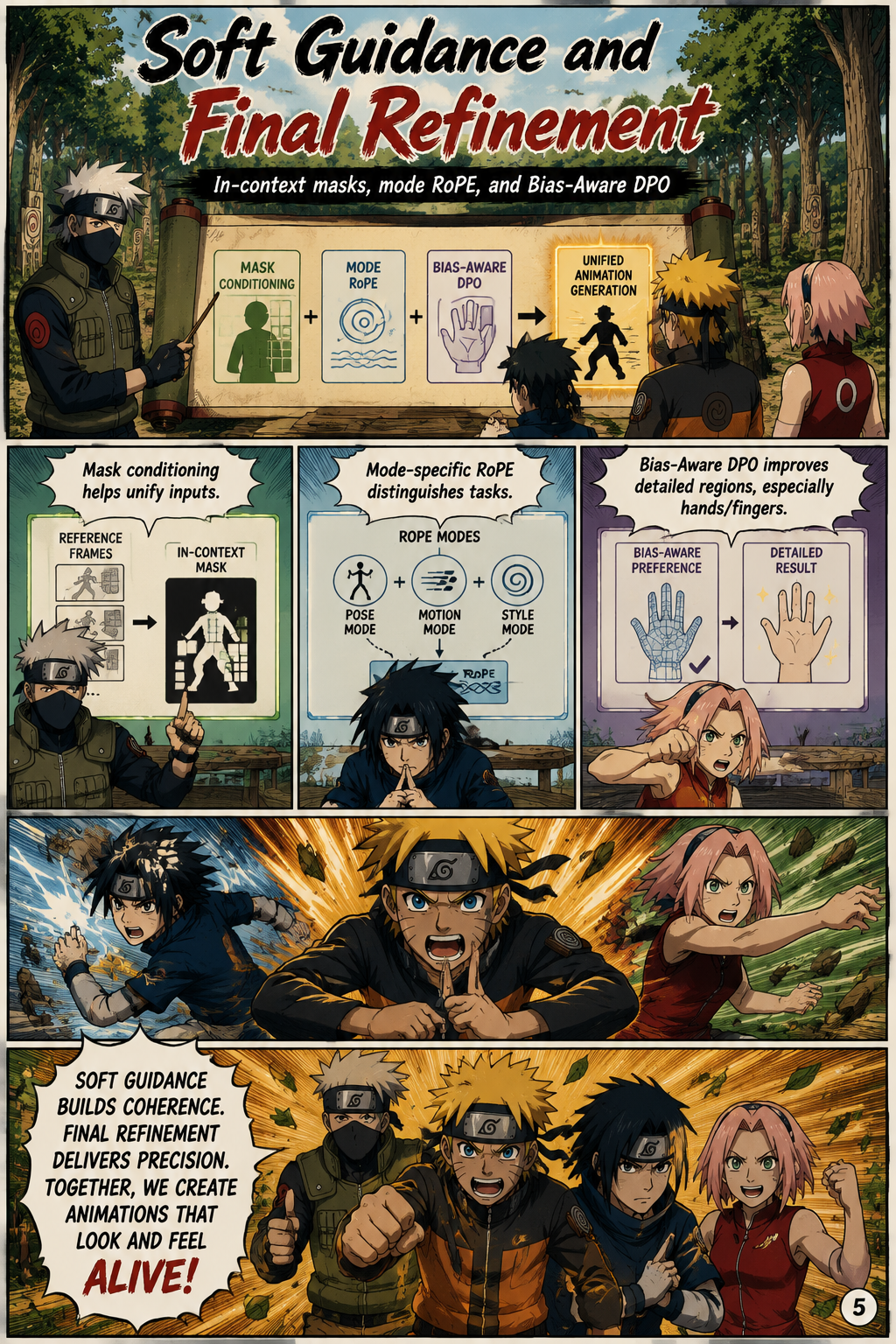
Beyond raw driving-video conditioning, SCAIL-2 adds soft task guidance through in-context mask conditioning and mode-specific context RoPE. The in-context mask includes an environment switch for choosing the relevant scene source and character binding slots for specifying which driving character should animate which reference character. Mode-specific RoPE gives the transformer a way to distinguish task modes while keeping animation and replacement inside a shared model. The paper also introduces Bias-Aware DPO as a post-training method for reducing synthetic-data artifacts, with special emphasis on detailed hand and finger motion where the authors report synthetic discrepancies are most pronounced. In experiments, the paper states that SCAIL-2 substantially outperforms existing state-of-the-art approaches across character animation tasks, with notable generalization in complex interactions, cross-identity motion following, non-human inputs, and environment integration.