ReadPaper Blog
RynnWorld-Teleop: An Action-Conditioned World Model for Digital Teleoperation
RynnWorld-Teleop addresses a central bottleneck in robot learning: collecting large, diverse, action-labeled demonstrations is slow because physical teleoperation ties every trajectory to a real robot, a fixed workspace, and manual resets. The paper proposes digital teleoperation, where an operator’s hand-pose stream controls a robot-centric generative world model that synthesizes egocentric robot videos from a single reference image while preserving retargetable action labels. Its importance is that the resulting state-action trajectories can train imitation-learning policies, including policies reported to transfer zero-shot to real robots and to improve real-data training when used as augmentation.
Source: RynnWorld-Teleop: An Action-Conditioned World Model for Digital Teleoperation
Research question
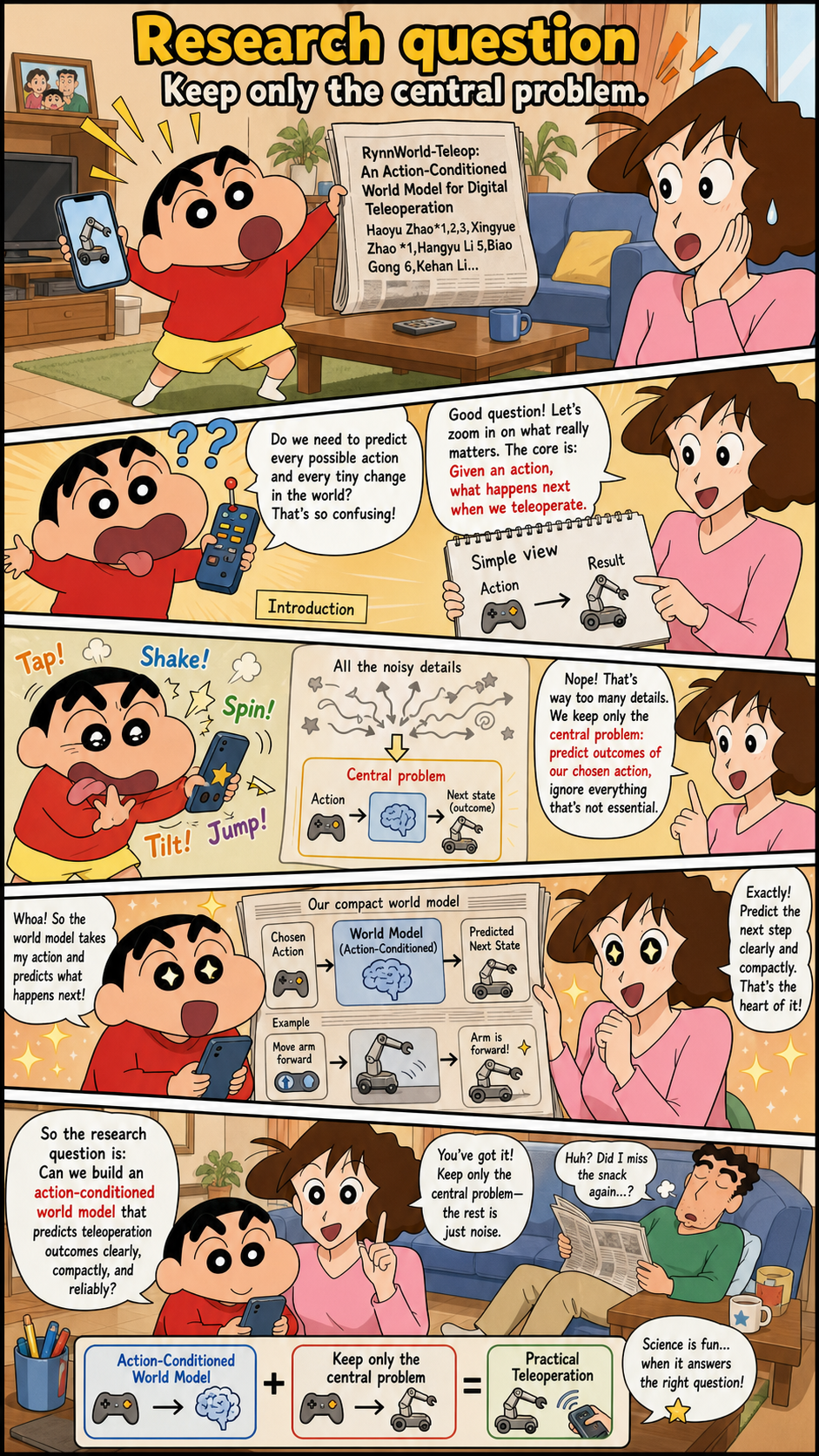
The paper asks how robot learning can scale when high-quality demonstrations remain constrained by physical teleoperation. Vision-language-action models and robotic world models increasingly need large, diverse trajectory datasets, but conventional collection requires real hardware, particular objects, fixed workspaces, and time-consuming resets. RynnWorld-Teleop reframes this data bottleneck as an infrastructure problem rather than only a learning-algorithm problem. The proposed answer is digital teleoperation: replace the physically moving robot during data collection with a generative model that produces the robot’s egocentric observations. This matters because, if the generated observations remain synchronized with usable action labels, imitation learning can consume the resulting trajectories as if they came from ordinary robot demonstrations.
Why old methods fall short
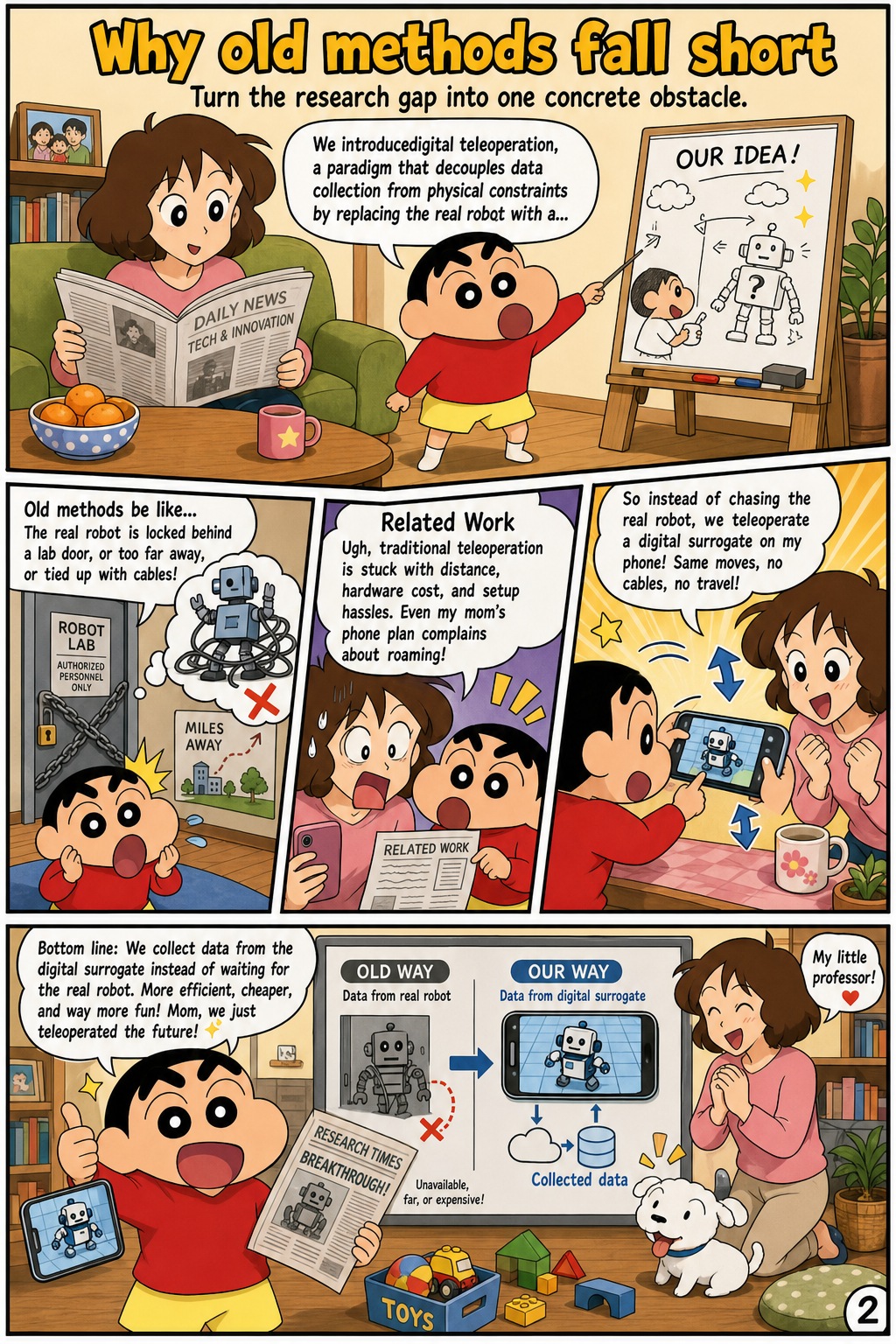
The paper positions RynnWorld-Teleop against two related but incomplete research threads. Human-to-robot video translation methods such as Phantom, Masquerade, X-Humanoid, Mitty, and H2R can visually transform human demonstrations into robot-like videos, but the paper argues that they are largely passive because they do not produce recoverable robotic actions for future control. Action-conditioned egocentric world models, including systems such as Hand2World, GeneratedReality, InterDyn, and CosHand, offer more interactive synthesis, but the excerpt characterizes them as mostly human-centric because they still model human hands rather than a robot embodiment. RynnWorld-Teleop identifies three requirements for a practical digital teleoperation system: it must be robot-centric, action-grounded, and real-time. The research gap is therefore not merely better video generation, but video generation that is controllable, embodiment-aware, and directly useful as robot training data.
Core idea
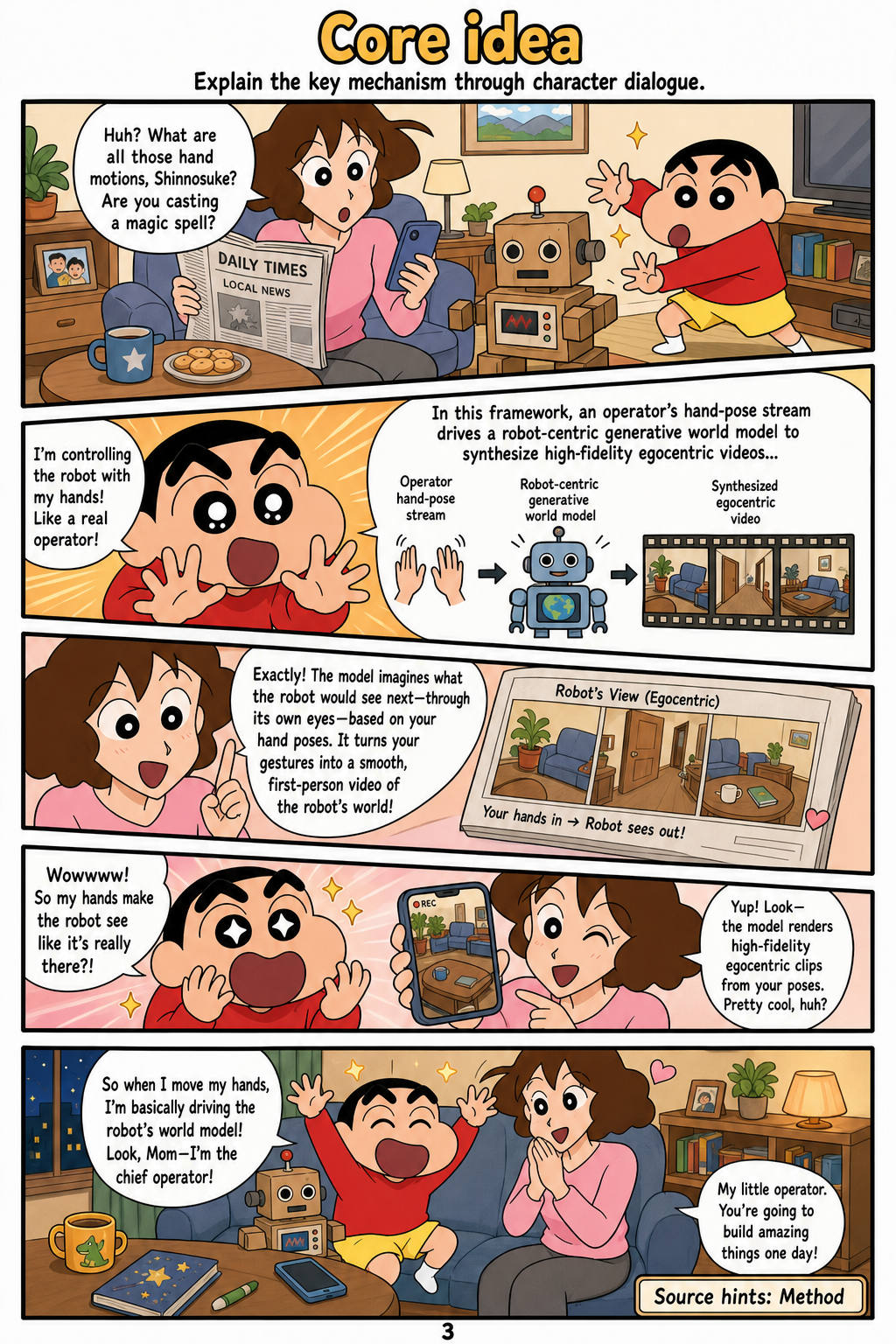
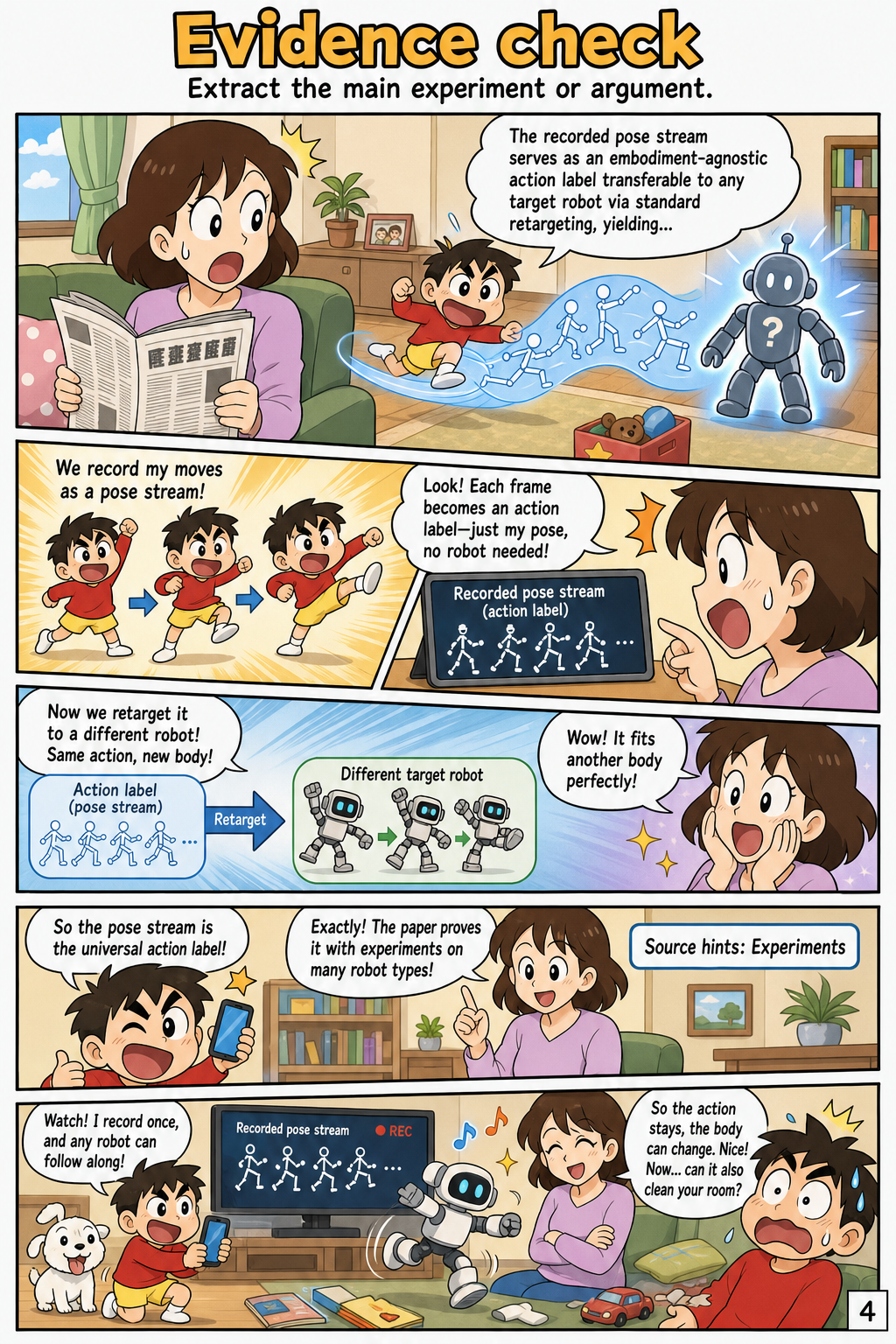
The core method takes a reference image of a target scene and a time sequence of operator hand poses, then synthesizes a corresponding egocentric robot video. The hand-pose stream acts as an embodiment-agnostic action source, while standard retargeting converts the same gesture sequence into robot-specific actions. To make 3D hand motion usable for a video model, RynnWorld-Teleop uses a depth-aware skeletal representation that renders 21-joint hand poses with camera-distance-modulated color and radius. The generative backbone builds on Wan-I2V with a 3D Variational Autoencoder and a Transformer-based denoiser trained under conditional flow matching. The architecture is designed so that the generated RGB observations and retargeted actions stay paired, yielding complete state-action trajectories for imitation learning.
Evidence check
The paper’s evidence centers on evaluating RynnWorld-Teleop both as a generative model and as a data engine for downstream robot policies. Its training pipeline first absorbs manipulation priors from large-scale egocentric human videos, then uses paired human–robot data to bridge the embodiment gap through progressive cross-domain training. For interactive use, the system applies streaming autoregressive distillation, distilling a bidirectional teacher into a causal student with a rollout-consistent schedule. The excerpt reports that this compression enables single-pass inference at more than 40 FPS on a single H100 GPU, which is crucial because operators must remain in the control loop. Most importantly, the paper reports that policies trained only on RynnWorld-Teleop-generated data achieve effective zero-shot Sim2Real transfer across dexterous and diverse bimanual tasks, and that adding digitally teleoperated data to real-world datasets consistently improves success rates.
One thing to remember
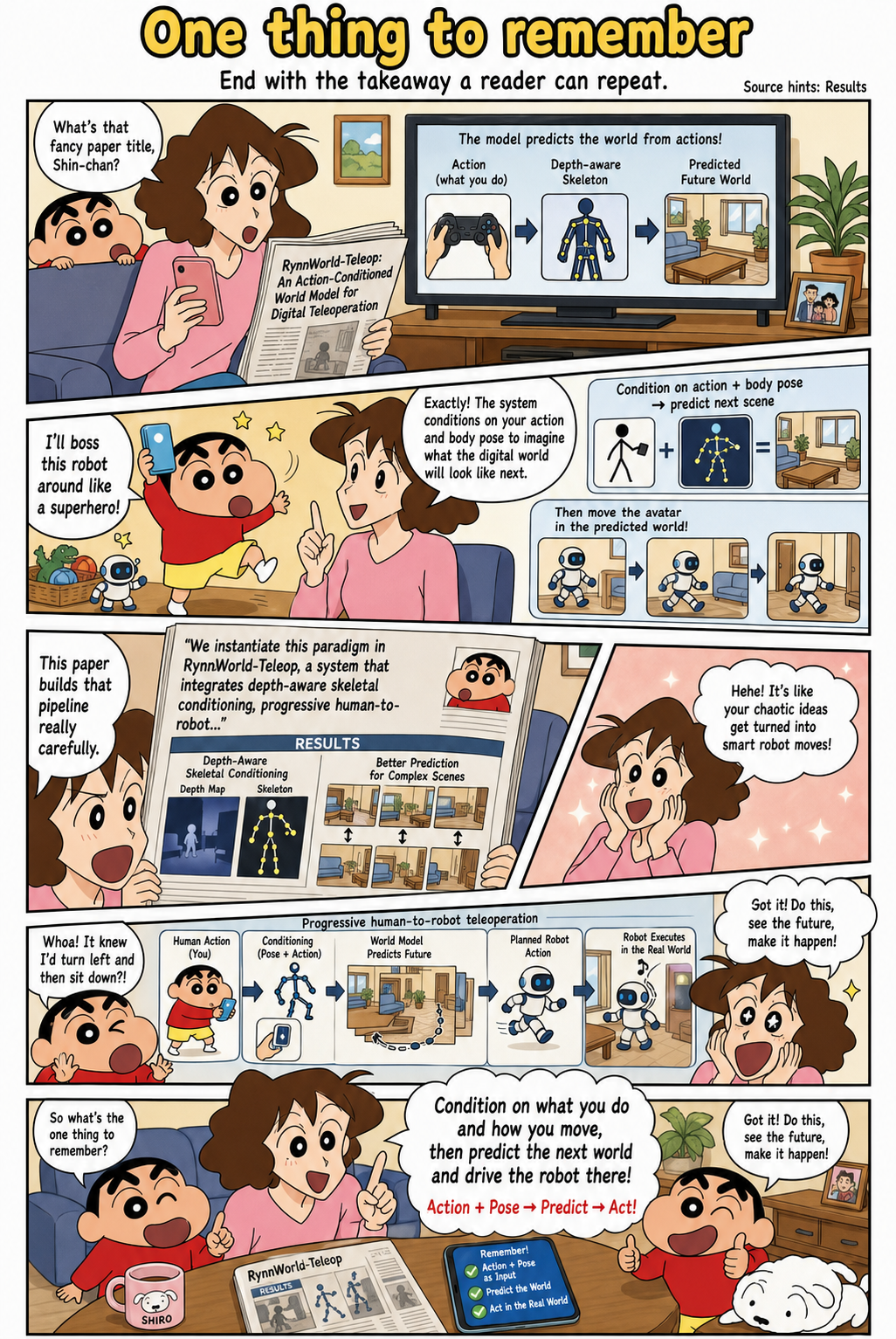
The main implication is that digital teleoperation can turn generative world models into scalable sources of robot demonstrations rather than only visual simulators. RynnWorld-Teleop’s combination of depth-aware skeletal conditioning, progressive human-to-robot training, and streaming autoregressive distillation is meant to satisfy the practical constraints that earlier approaches did not jointly meet. Because the action signal is preserved as a retargetable hand-pose stream, the same operator data can in principle support different robot embodiments through standard retargeting. Because the scene can be instantiated from a single reference image, the framework reduces dependence on physical assets and manual resets. The paper’s broader claim is that high-fidelity, action-conditioned synthetic trajectories can both substitute for some physical teleoperation and amplify real demonstration datasets for the next generation of robotic agents.