ReadPaper Blog
RynnWorld-4D: 4D Embodied World Models for Robotic Manipulation
RynnWorld-4D addresses a central limitation in robotic manipulation: robots need to predict not only future pixels, but also how 3D scene geometry and motion will evolve under interaction. The paper proposes a language-conditioned generative world model that jointly predicts synchronized RGB video, depth maps, and optical flow from a single RGB-D observation, producing a projective 4D representation closer to robot action space. Its importance is that these internal 4D representations can be reused by an inverse-dynamics policy for high-frequency, closed-loop manipulation, especially in tasks requiring spatial precision and temporal coordination.
Source: RynnWorld-4D: 4D Embodied World Models for Robotic Manipulation
Research question
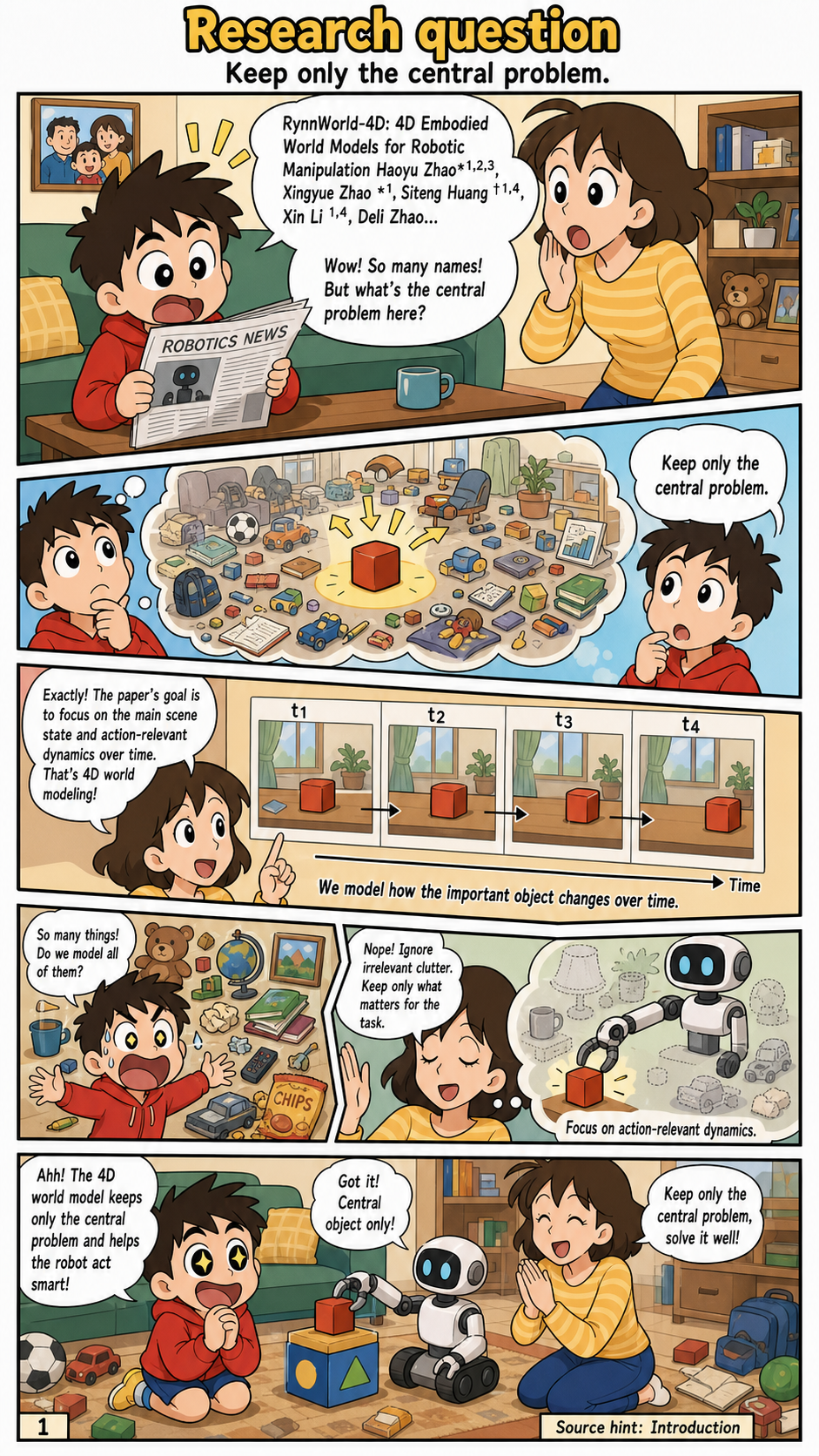
The paper begins from the problem that open-world robotic manipulation requires more than visual recognition: a robot must anticipate how objects, hands, tools, and surfaces move in 3D as actions unfold. Existing video-based world models can generate plausible 2D futures, but the authors argue that pixel-space prediction discards critical spatial relationships needed for 6-DoF pose reasoning and depth-aware control. RynnWorld-4D reframes future prediction as 4D embodied world modeling, where appearance, geometry, and motion are predicted together rather than treated as separate post-processing steps. The model is conditioned on a single RGB-D image and a language instruction, so the predicted future is tied both to the observed scene and to the intended manipulation goal. This matters because the representation is designed to narrow the gap between generative prediction and the low-level end-effector actions required by robotic systems.
Why old methods fall short
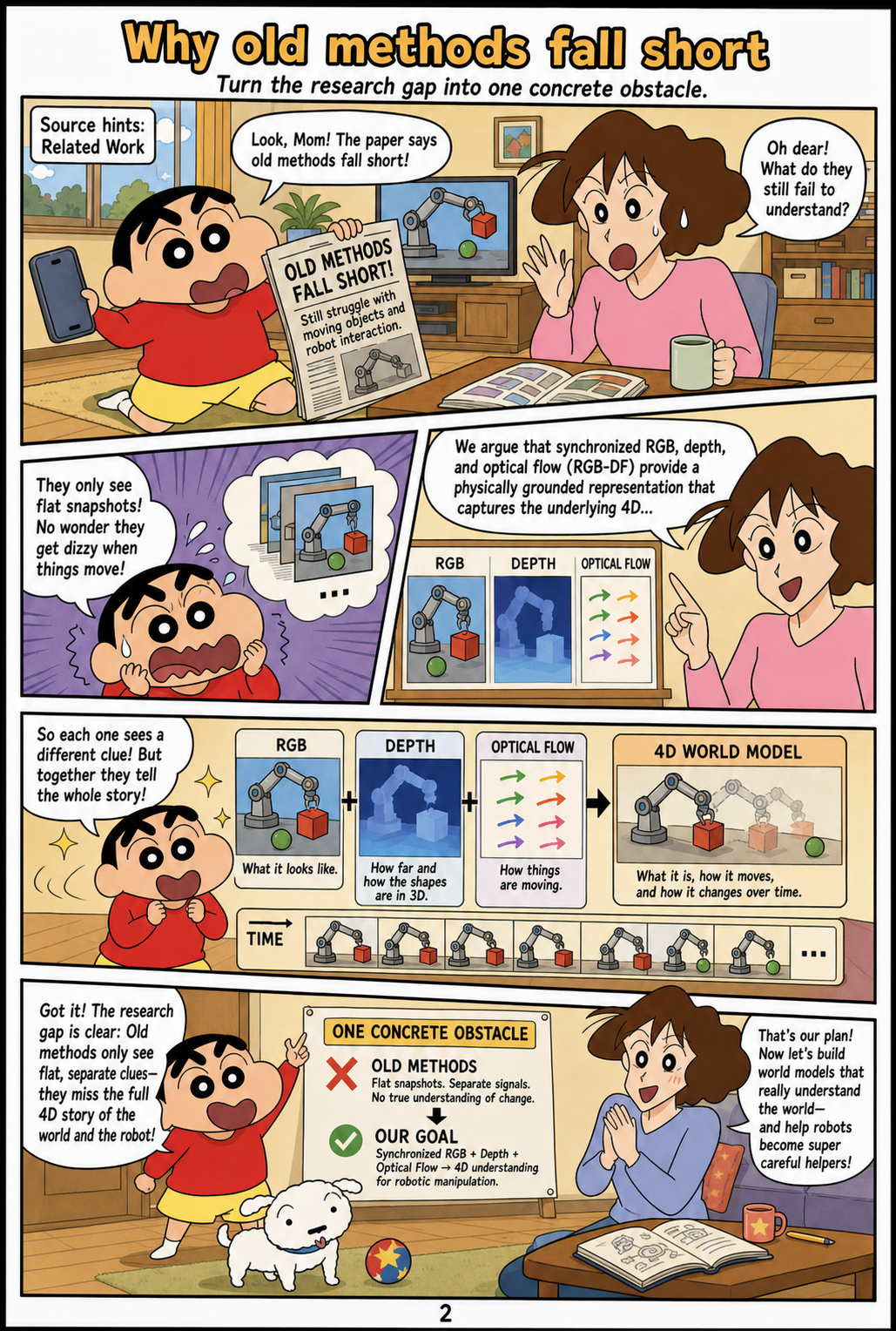
The paper positions RynnWorld-4D against two major families of prior work: 2D video world models and explicit 3D or 4D scene representations. Pure video models benefit from large-scale diffusion priors, but their 2D projective nature can produce unphysical temporal artifacts such as changing object scale or shape, and they do not directly encode the depth and motion cues needed for precise manipulation. NeRF- and 3D Gaussian Splatting-based dynamic scene methods offer richer geometry, but many are scene-specific, computationally intensive, dependent on multi-view inputs, or difficult to scale to diverse manipulation environments. Dynamic Structure-from-Motion methods can reconstruct time-varying point clouds, but the paper notes that they generally lack the generative ability to predict future states from a single observation. The authors therefore identify a practical gap: robotics needs a representation that is geometrically grounded, dynamically explicit, scalable with video diffusion models, and usable by downstream policies.
Core idea
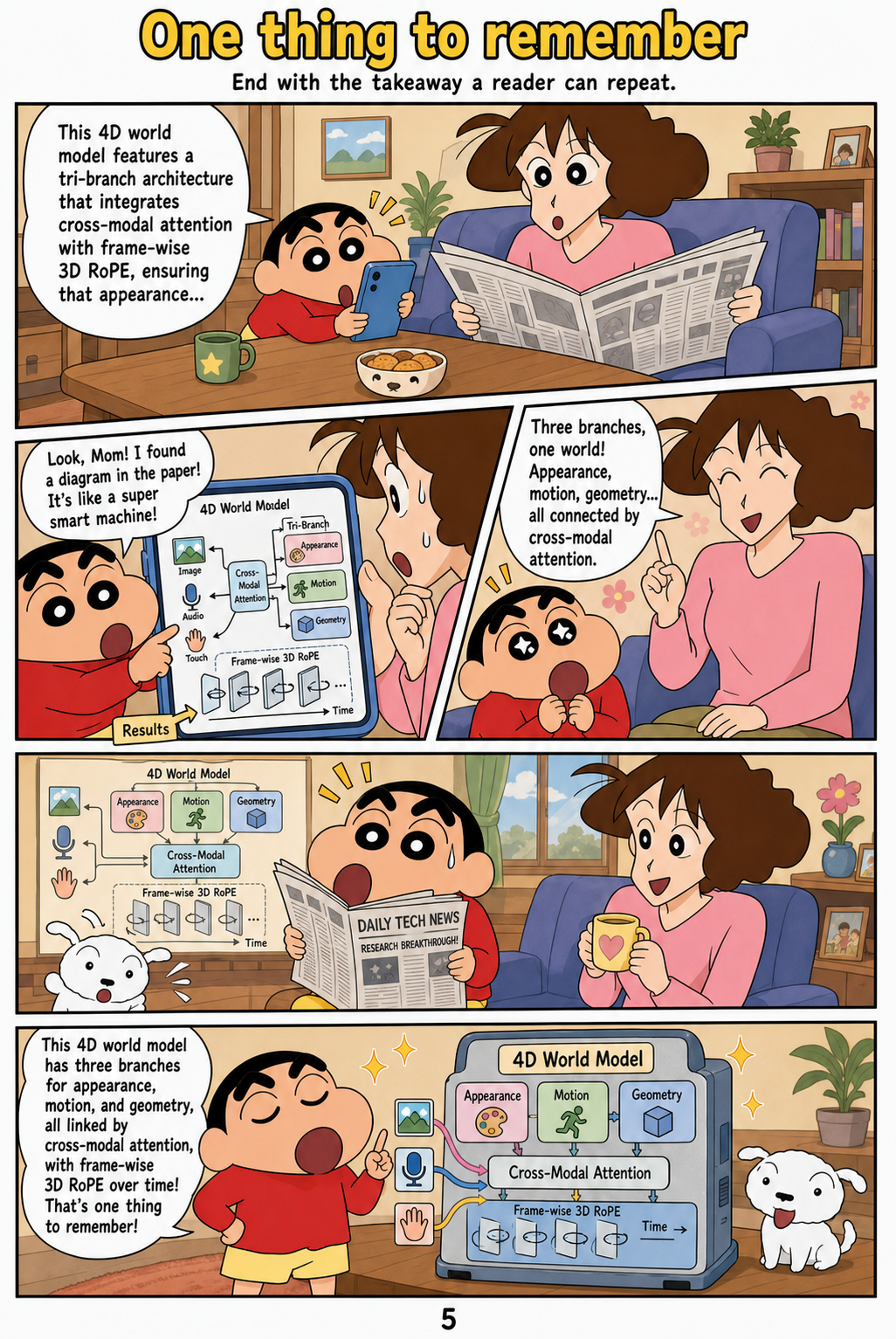
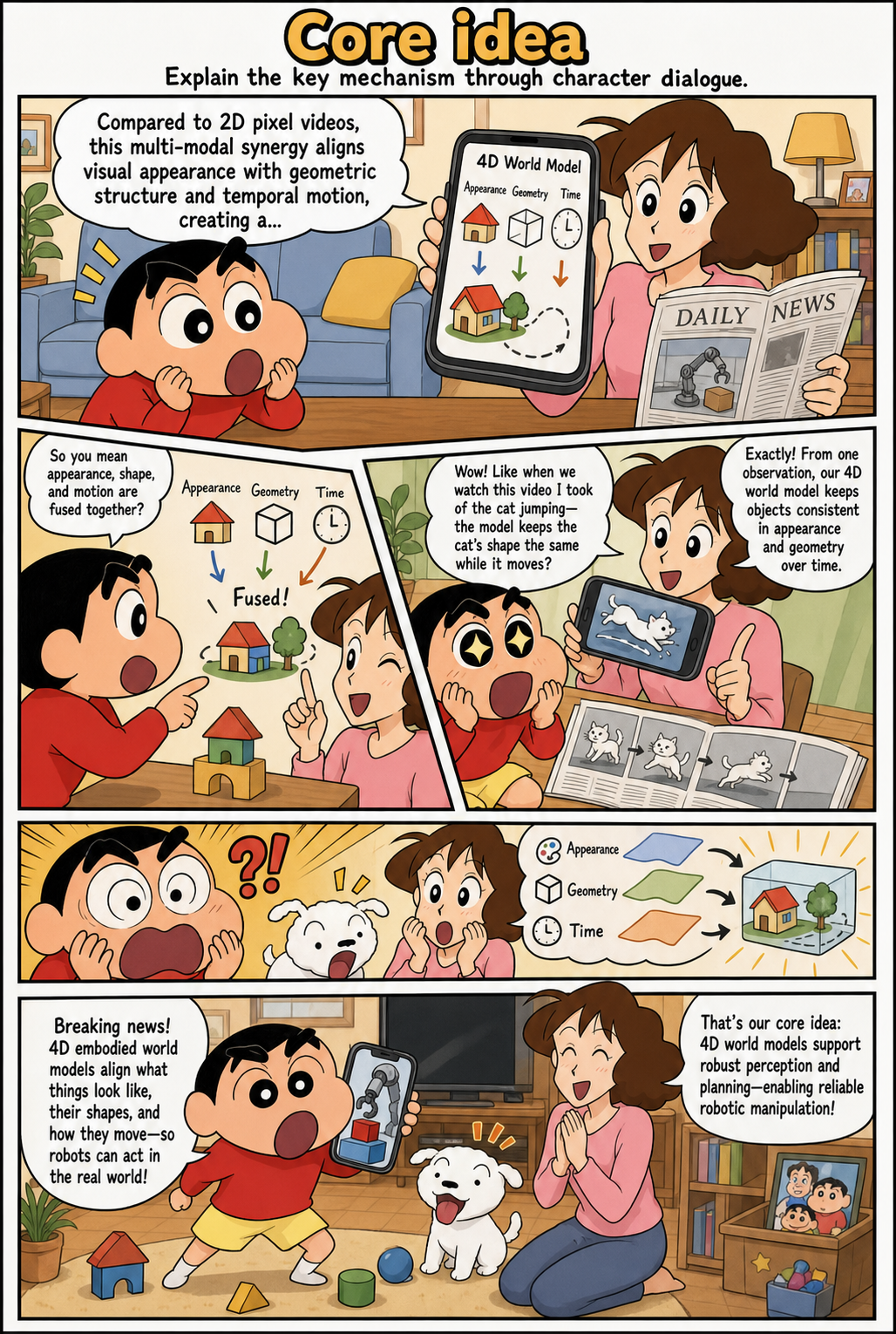
The core technical idea is a projective 4D representation based on synchronized RGB, depth, and optical flow, which the paper abbreviates as RGB-DF. RGB captures visual appearance, depth lifts pixels into 3D structure, and optical flow supplies temporal displacement; together, depth and flow can be back-projected under pinhole-camera assumptions into 3D scene flow. RynnWorld-4D implements this idea as a unified diffusion model that co-generates future RGB frames, depth maps, and optical-flow videos rather than predicting one modality and deriving the others afterward. Its tri-branch transformer architecture gives each modality its own branch while using shared cross-attention keys and values plus Joint Cross-Modal Attention to keep appearance, geometry, and motion aligned. The paper also uses frame-wise 3D RoPE to support temporally structured spatial reasoning across generated sequences. This design aims to preserve the generative strength of a pretrained video diffusion backbone while adding modality specialization for texture, geometry, and motion.
Evidence check
A major empirical foundation of the work is Rynn4DDataset 1.0, which the paper introduces to address the scarcity of large-scale 4D training data for embodied prediction. The dataset contains over 254.4 million frames drawn from egocentric human activity datasets such as Epic-Kitchens and EgoVid, as well as robotic manipulation datasets including RoboMIND, RDT-1B, Galaxea, RoboCoin, and AgiBot. Because dense 4D labels are not naturally available at this scale, the authors enrich the videos with pseudo-annotations for fine-grained instructions, monocular depth, and dense optical flow, using tools such as Qwen3-VL for captioning along with depth and flow estimators cited in the paper. This hybrid data strategy is meant to combine broad human object-interaction priors with robot-specific execution traces. Experiments reported in the excerpt evaluate whether the model produces temporally and spatially coherent RGB-DF predictions and whether those predictions support downstream manipulation control.

One thing to remember
The paper’s main takeaway is that RGB-DF prediction is not only a richer visualization target, but also a more action-relevant internal representation for robotic policies. RynnWorld-4D-Policy uses an inverse dynamics head that consumes the internal 4D representations of RynnWorld-4D directly, rather than repeatedly decoding videos through an expensive denoising loop at every control step. This single-forward-pass design is intended to support high-frequency closed-loop control, which is essential when dexterous manipulation depends on fast correction and tight temporal coordination. The authors report state-of-the-art performance on real-world dexterous bimanual manipulation tasks, with particular strength in tasks requiring spatial precision and coordinated motion. The broader implication is that embodied world models may become more useful for robotics when they predict physically grounded 4D structure instead of treating future generation as an RGB-only video problem.