ReadPaper Blog
Ring-Zero: Scaling Zero RL to a Trillion Parameters for Emergent Reasoning
Ring-Zero studies whether reinforcement learning with verifiable rewards, or zero RL, can elicit high-quality chain-of-thought reasoning when scaled to a trillion-parameter language model without human-annotated reasoning data. The paper addresses the limits of small-model zero-RL evidence by training Ring-2.5-1T-Zero with a stable self-iteration pipeline and evaluating both mathematical accuracy and chain-of-thought quality. Its central result is that trillion-scale zero RL improves sample efficiency and performance ceilings while producing emergent reasoning behaviors such as self-verification, structured formatting, and parallel reasoning.
Source: Ring-Zero: Scaling Zero RL to a Trillion Parameters for Emergent Reasoning
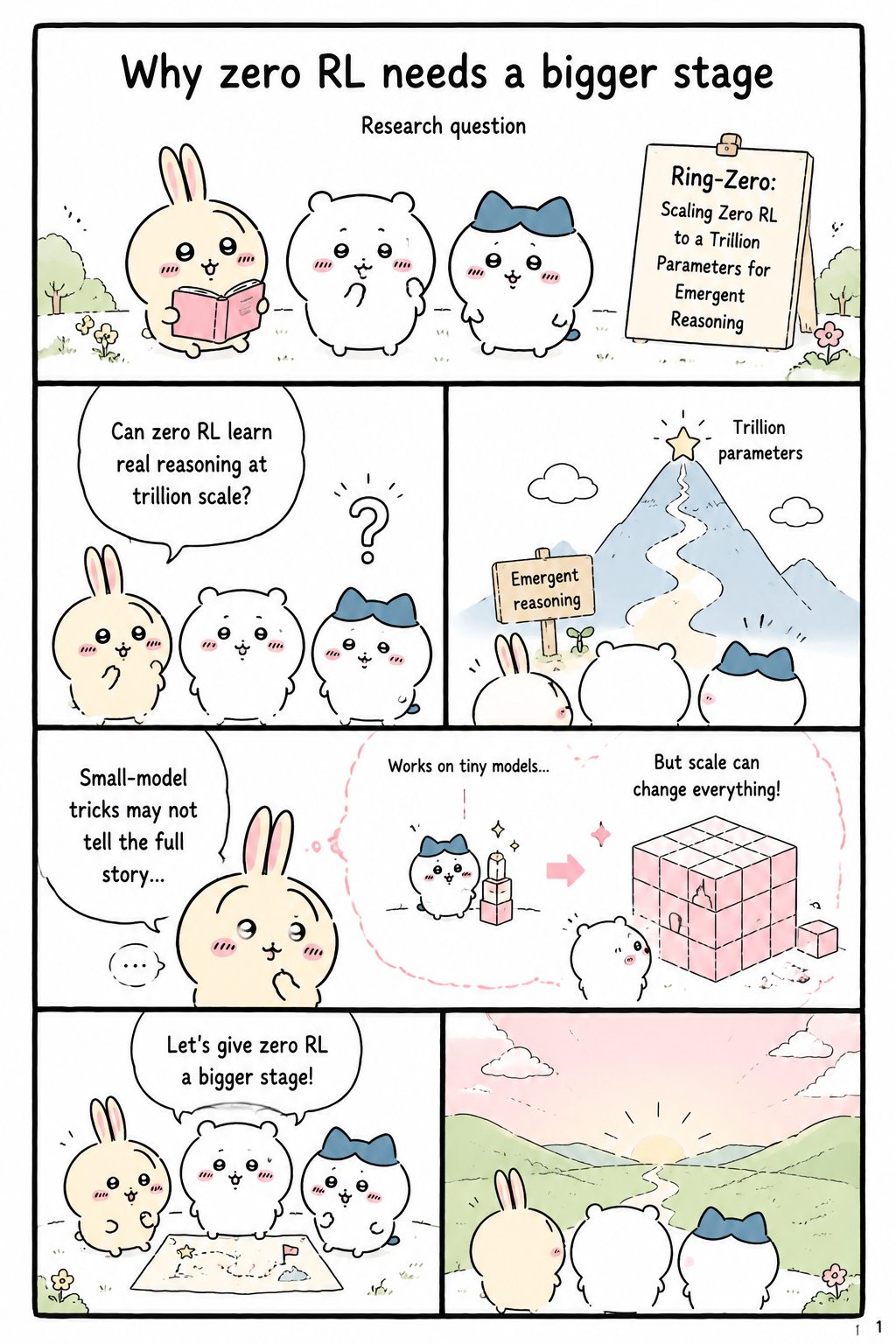
Why zero RL needs a bigger stage
Ring-Zero asks how zero RL behaves when applied to a trillion-parameter language model, a scale at which prior reinforcement learning with verifiable rewards studies had largely not operated because of computational constraints. The paper frames zero RL as a way to elicit chain-of-thought reasoning directly from a pretrained base model, bypassing supervised CoT demonstrations and relying instead on trial-and-error optimization with verifiable outcomes. This research question matters because smaller models may not expose the full training dynamics, latent capabilities, or emergent strategies available in much larger pretrained systems. The authors position Ring-2.5-1T-Zero as an empirical test of whether scale changes the ceiling of reasoning performance and the qualitative nature of learned reasoning traces. Their motivation is explicitly tied to the “bitter lesson”: large-scale computation and learning may outperform hand-crafted reasoning heuristics when enough model capacity and optimization are available.
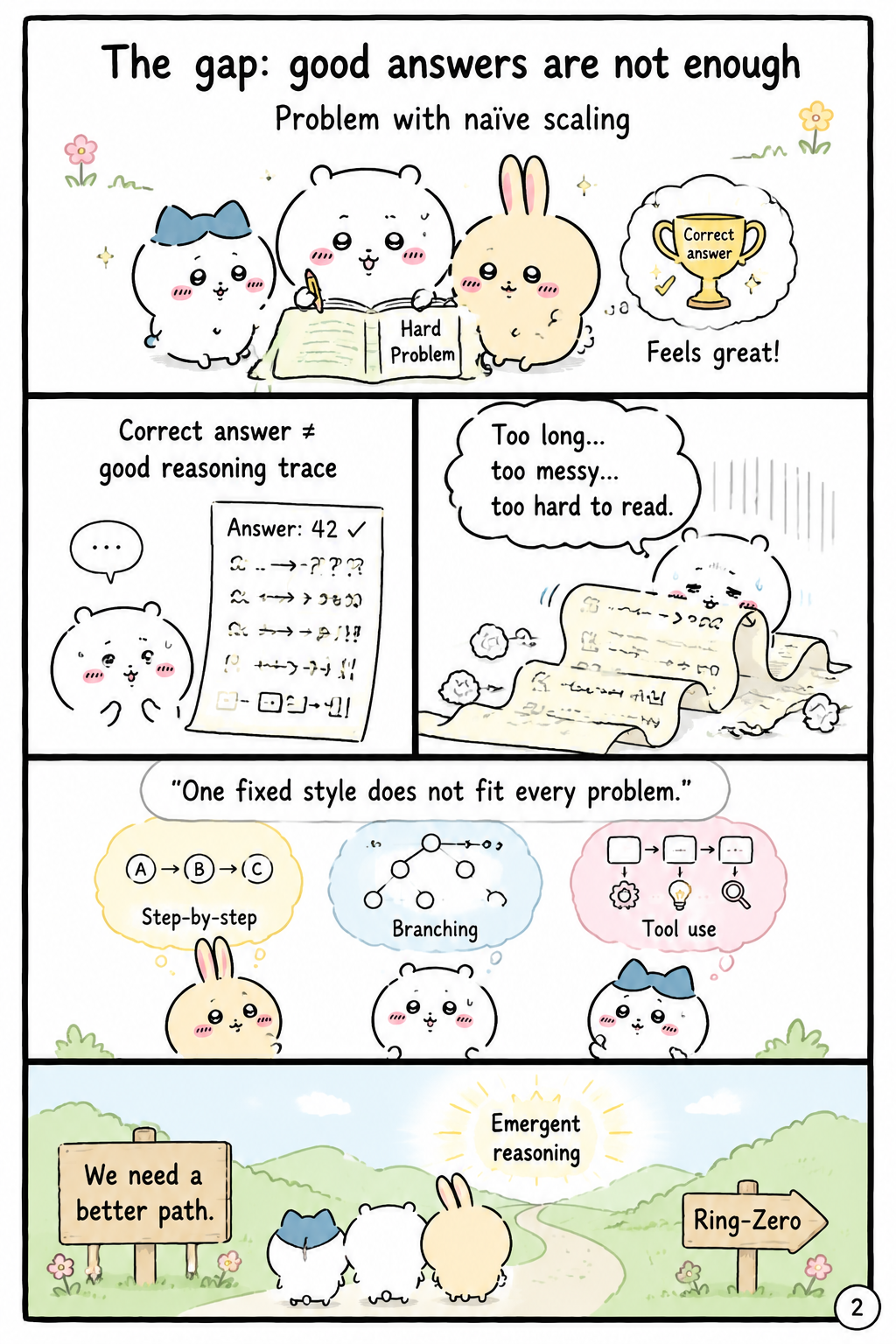
The gap: good answers are not enough
The paper argues that correct final answers are insufficient for evaluating reasoning models because chain-of-thought traces also need to be readable, reproducible, and efficient. In the authors’ diagnosis, naïve zero RL at scale can produce reasoning that is hard to follow, poorly formatted, excessively long, and wasteful in tokens. They identify an implicit length bias in standard algorithms such as GRPO, where token-level optimization can reward longer sequences in ways that initially help exploration but later cause uncontrolled redundancy. The paper also emphasizes that mathematical problems require different amounts of reasoning depth, while a fixed response budget tends to push models toward a single, inflexible reasoning mode. This analysis leads the authors to define high-quality CoT as not merely answer-correct but structured enough for human verification and concise enough for practical inference.
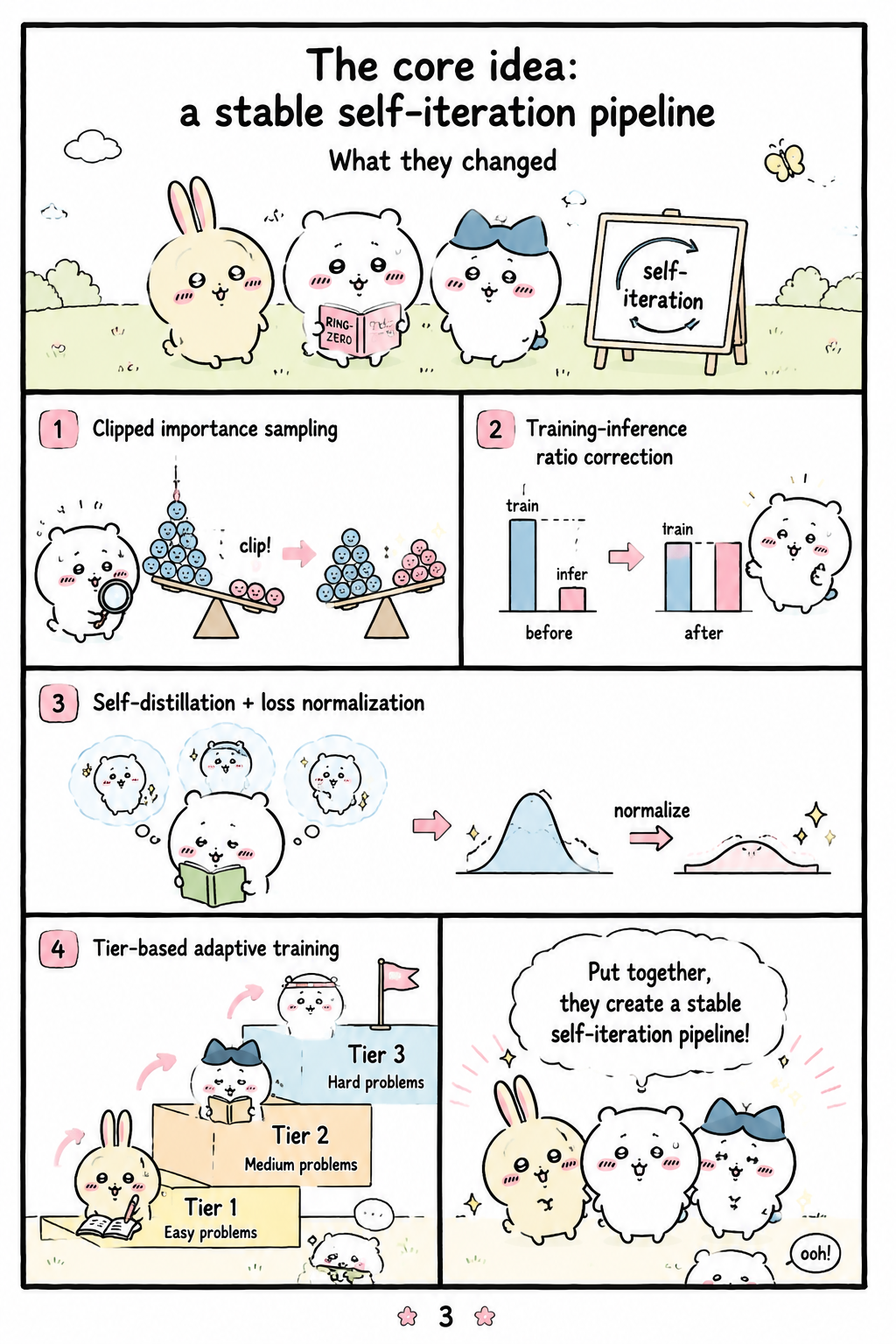
The core idea: a stable self-iteration pipeline
Ring-Zero proposes a multi-stage self-iteration pipeline designed to make trillion-scale zero RL stable without relying on heavy human-engineered reasoning templates. The pipeline combines clipped importance ratio policy gradient, training-inference ratio correction, self-distillation, sample-level loss normalization, and tier-based adaptive training. The first stage uses RL to incentivize reasoning from the Ling-2.5-1T-Base model, while self-distillation compresses chain-of-thought traces and helps reset the gap between the training and inference engines. Later stages shift toward sample-level loss for sustained improvement and introduce tier-based training so the model can allocate low, medium, or high reasoning depth depending on task difficulty. The system side of the method includes mixed-precision control, FP32 attention and language-model head computation, context parallelism, MLA and Lightning Attention optimization, and All-to-All context parallelism to keep training stable and efficient at 1T scale.
What happened at 1T scale
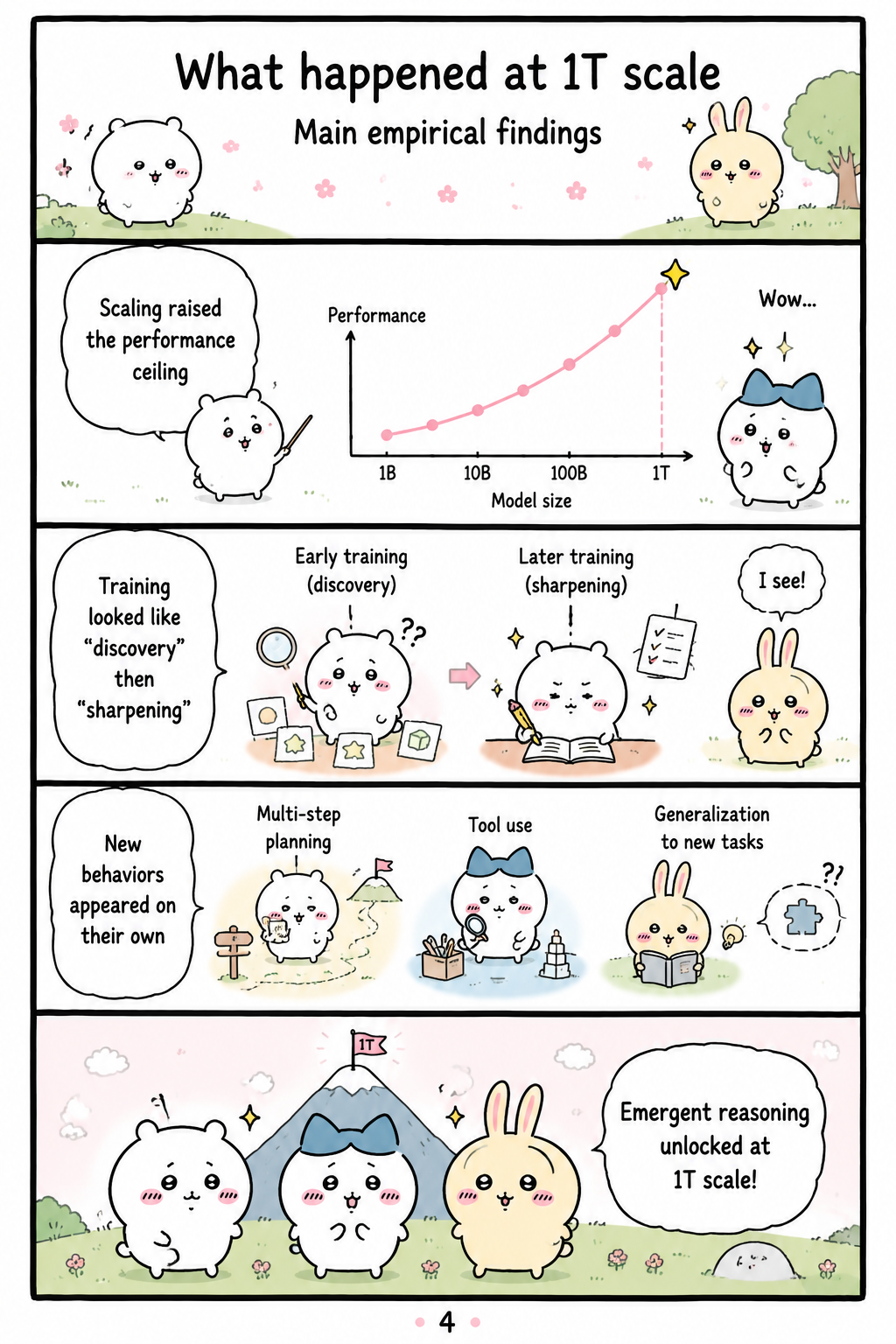
The paper reports three main empirical findings from scaling zero RL to one trillion parameters. First, Ring-2.5-1T-Zero shows substantially better sample efficiency and reaches a higher performance ceiling than the authors’ 104B comparison model, supporting the claim that model scale strongly shapes the attainable reasoning frontier. Second, the observed training dynamics combine an early “discovery” phase, in which the model unlocks new reasoning pathways, with a later “sharpening” phase, in which optimization refines behavior within the expanded capability boundary. Third, the authors observe spontaneous emergence of advanced cognitive behaviors without human-annotated CoT data or explicit hand-crafted incentives. The named emergent behaviors include anthropomorphism, structured formatting, self-verification, parallel reasoning, and context anxiety, which the paper interprets as evidence that large-scale self-iterative RL can discover useful reasoning strategies autonomously.
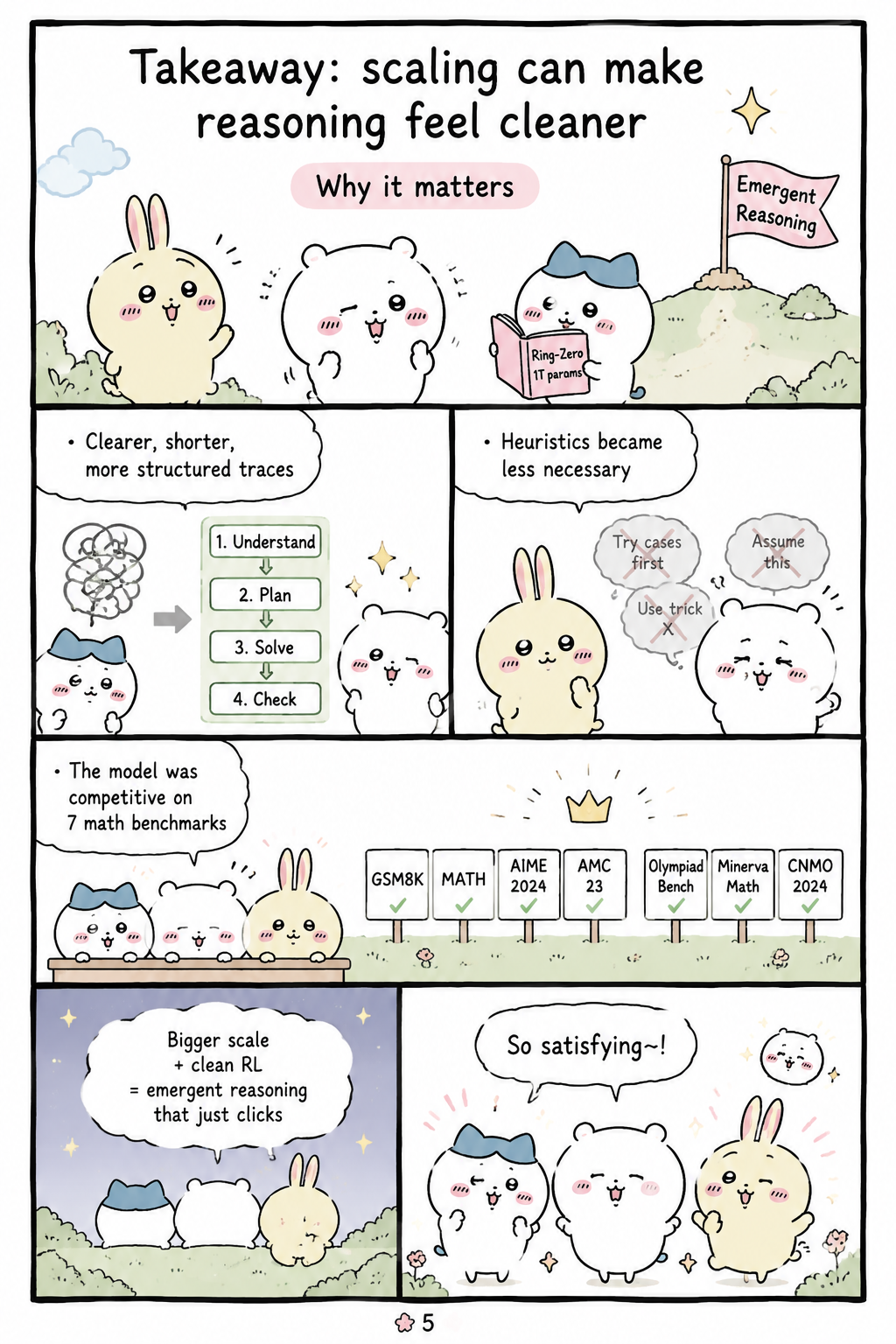
Takeaway: scaling can make reasoning feel cleaner
Ring-Zero’s broader implication is that scaling zero RL can improve not only benchmark answers but also the usability of reasoning traces. The paper evaluates Ring-2.5-1T-Zero on seven challenging mathematical benchmarks and reports competitive performance relative to frontier models, while avoiding claims based solely on final-answer accuracy. To inspect reasoning quality directly, the authors introduce a structured CoT evaluation framework with three dimensions: comprehensibility, reproducibility, and efficiency. Comprehensibility is assessed through an LLM-as-a-Judge pairwise comparison of logical coherence and clarity, reproducibility is measured by distilling generated traces into weaker student models and observing downstream gains, and efficiency focuses on concise, cost-effective generation. Under this framework, the authors argue that Ring-2.5-1T-Zero produces more structured, human-readable, and concise reasoning traces, suggesting that trillion-scale zero RL can reduce the need for manually designed reasoning heuristics.