ReadPaper Blog
ResearchStudio-Reel: Automating the Last Mile from Paper to Poster, Video, and Blog
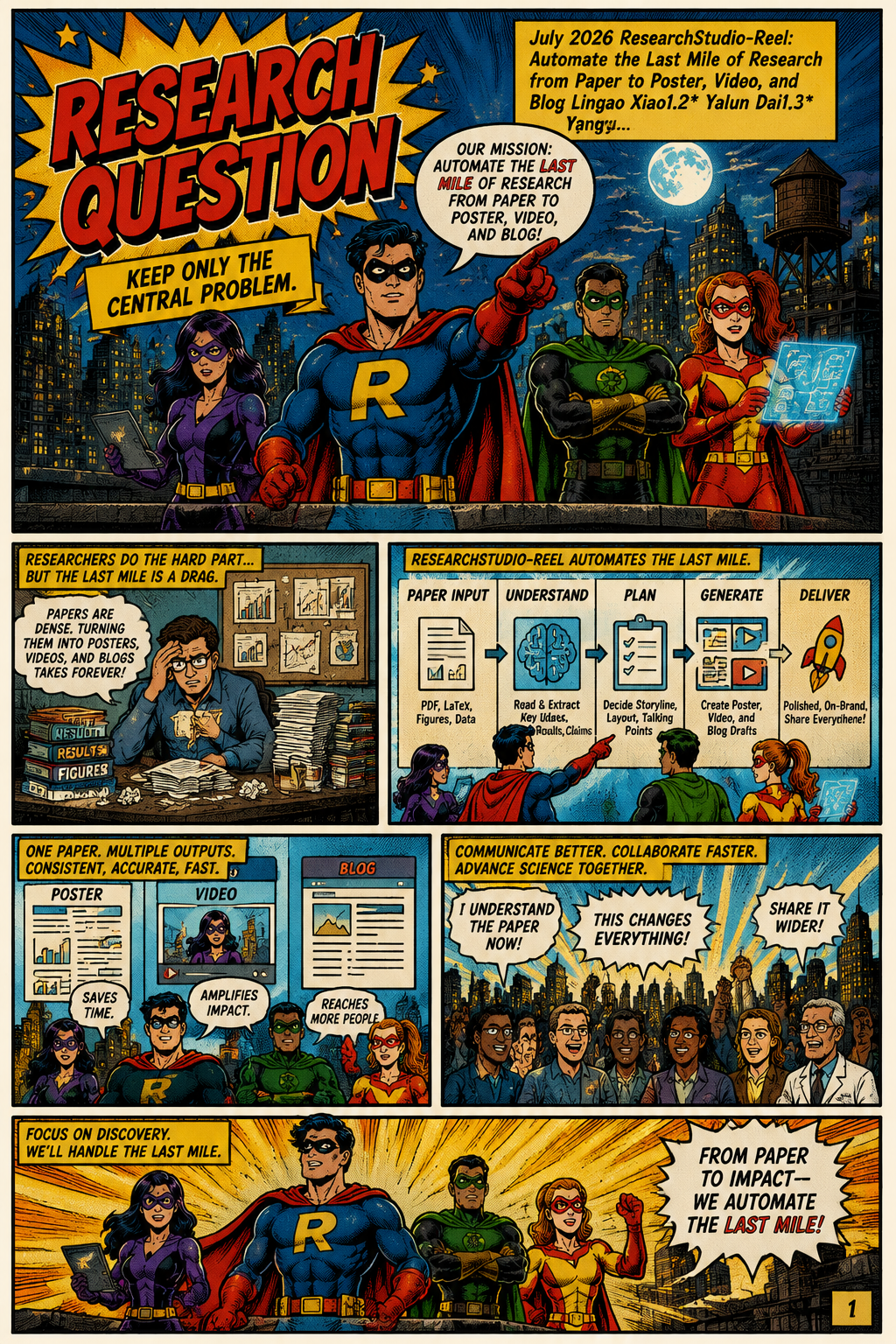
ResearchStudio-Reel addresses the manual last mile of research dissemination: turning an accepted paper into a conference poster, narrated talk video, and public-facing blog post. The paper proposes a five-skill pipeline built around one shared extractor, editable native-tool outputs, and hard pass/fail render gates, arguing that this architecture improves factual consistency, author control, and production quality across multiple dissemination artifacts.
Source: ResearchStudio-Reel: Automating the Last Mile from Paper to Poster, Video, and Blog
Research question
The paper studies a practical but under-automated problem in research workflows: after acceptance, authors still have to manually convert a dense PDF into a poster, a talk video, and a blog post. Its central claim is that this dissemination layer is structurally separate from writing the paper itself, yet it consumes time precisely when authors are already handling camera-ready deadlines and public communication needs. ResearchStudio-Reel treats this work not as a set of isolated formatting tasks but as a unified transformation from one source paper into several audience-facing artifacts. The motivation extends beyond individual convenience, because the same artifacts are useful for conference sessions, virtual tracks, lab announcements, graduate courses, and multilingual research organizations. The paper therefore frames the last mile of research communication as an architectural systems problem rather than merely a summarization or layout problem.
Why old methods fall short
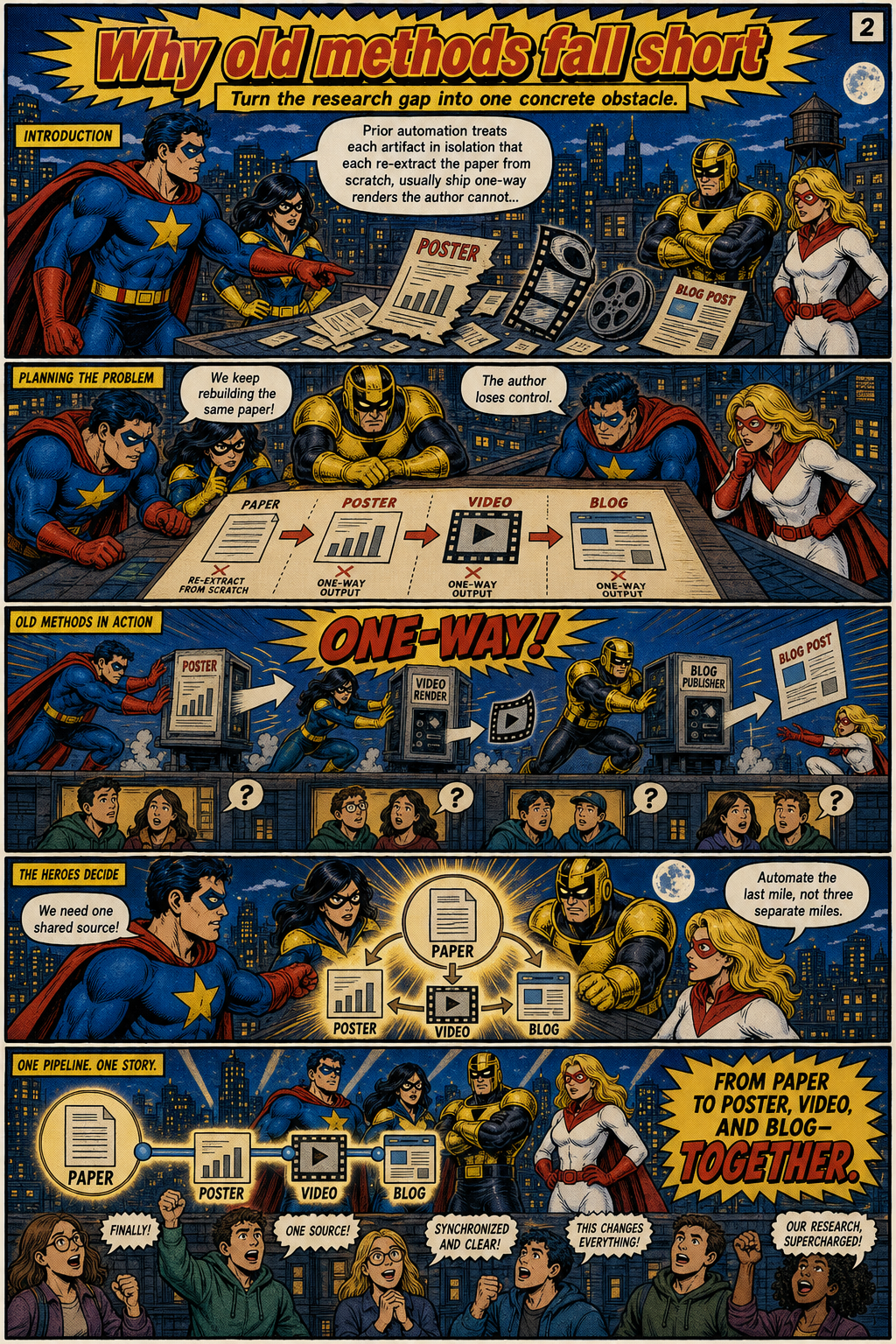
The paper identifies three recurring weaknesses in earlier automation systems for posters, videos, slides, and long-form summaries. First, prior systems often perform isolated extraction, meaning each artifact re-parses figures, captions, metadata, and claims from the paper independently, which risks inconsistency across outputs. Second, many systems produce one-way renders such as PDF posters, MP4 videos, or HTML and markdown text that authors cannot reopen and edit naturally in PowerPoint or Word. Third, quality control frequently depends on soft VLM-as-judge or aesthetic scores, which may accept an artifact with a plausible overall rating even when an important section is empty or poorly filled. By naming these gaps as G1, G2, and G3, the paper builds a concrete design target: a system must share evidence across artifacts, preserve editability, and use categorical render checks rather than relying only on learned preference plateaus.
Core idea
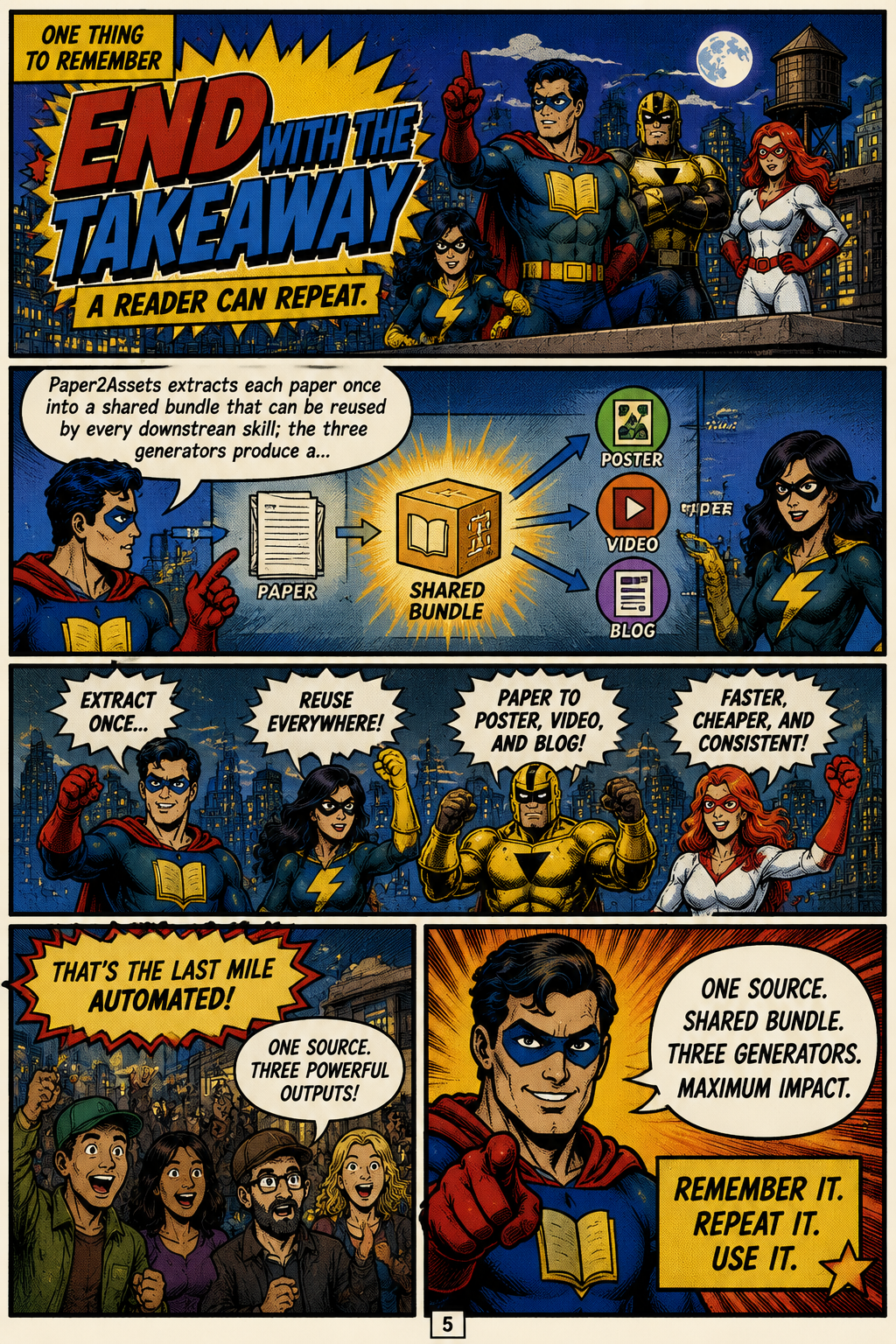
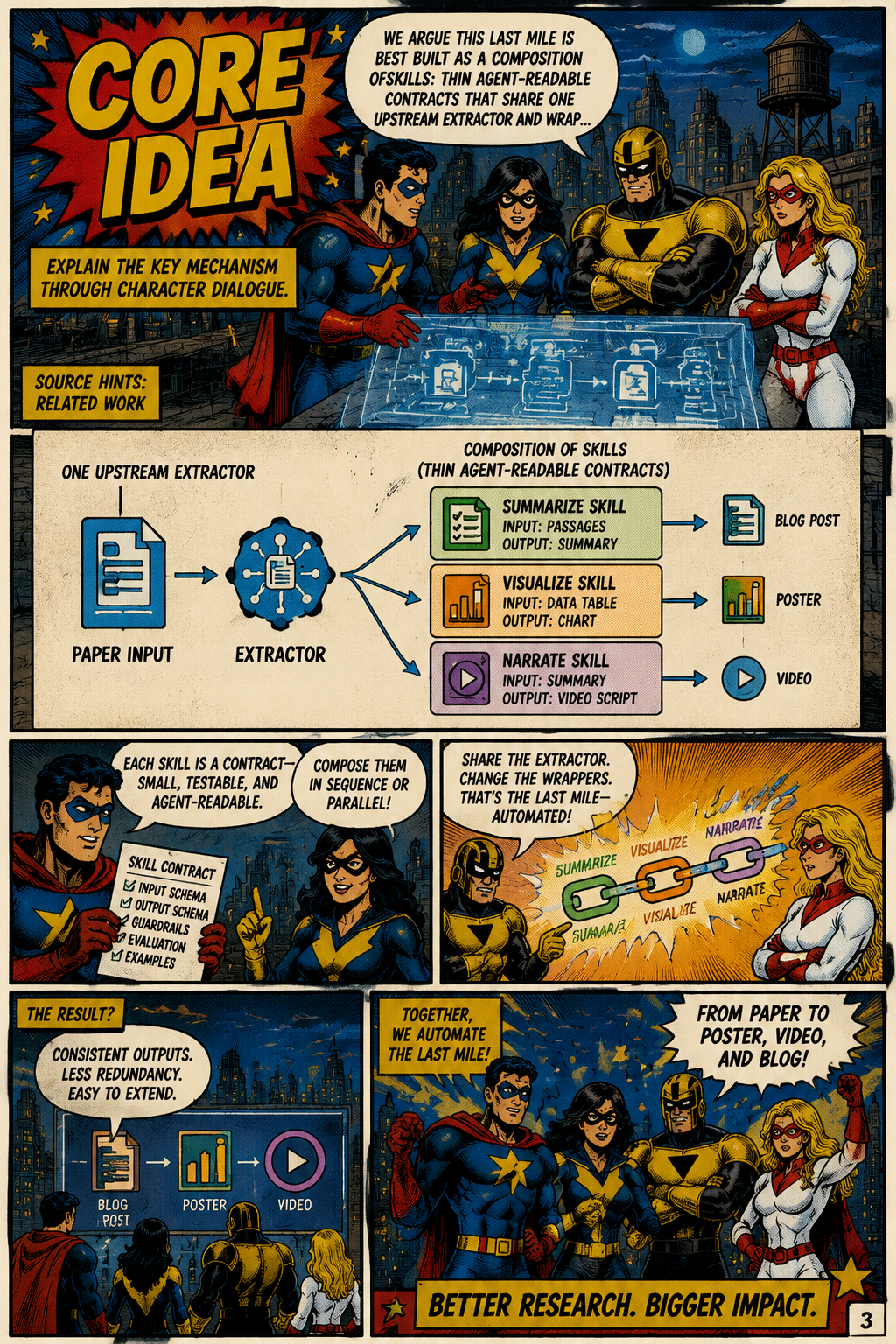
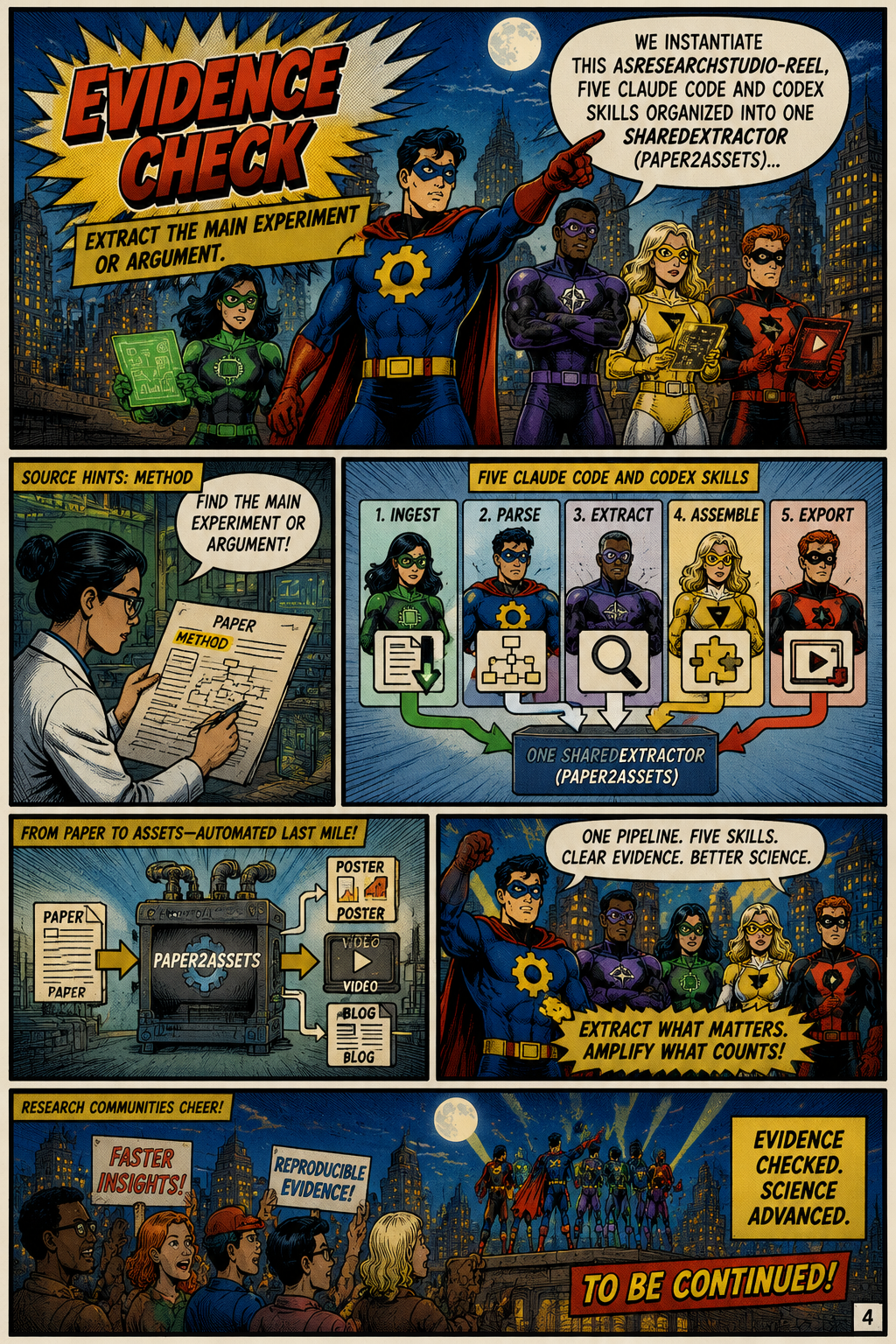
ResearchStudio-Reel’s core mechanism is a composition of five skills: Paper2Assets, Paper2Poster, Paper2Video, Paper2Blog, and Paper2Reel. Paper2Assets extracts the source paper once into a reusable bundle containing elements such as section IDs, figure handles, metadata, claim anchors, paper text, logos, captions, and narration-related files. The downstream generators then consume this shared bundle instead of re-deriving content separately, which is the paper’s response to cross-artifact factual consistency. The skills are described as thin agent-readable contracts that wrap deterministic primitives, including headless Chromium for HTML-to-PDF, LibreOffice and ffmpeg for slide-to-video workflows, python-docx for Word output, and Edge TTS for narration. The paper emphasizes the measured-fill loop as a key control mechanism: each artifact is iterated until a hard pass/fail render gate is satisfied, making the boundary between agentic generation and deterministic validation more explicit.
Evidence check
The method instantiates the architecture as three editable generators plus an interactive convergence layer. Paper2Poster produces a print-ready poster while also preserving an editable PowerPoint representation, addressing the problem that prior poster systems commonly stop at PDF or PNG output. Paper2Video builds an editable deck, narration-aligned video, subtitles, highlight transitions, and a shared timeline so that the resulting media remains aligned with source sections rather than becoming an opaque MP4. Paper2Blog produces bilingual Word .docx outputs, including a WeChat-style register and an English research-blog register, and applies layout-aware DOCX repair to catch near-blank pages, orphan tails, and under-filled images. Paper2Reel then binds the poster, video, captions, slides, and blog into a single navigable HTML surface, using section-level links so that the artifacts remain coordinated through the shared structure extracted from the paper.
One thing to remember
The evidence reported in the paper focuses most explicitly on the Paper2Poster benchmark and on capability audits across the full pipeline. The generated posters are reported to lead every aesthetic and information sub-criterion against prior automated systems and single-shot frontier LLMs, and the paper states that they surpass the authors’ own posters on aesthetics under two held-out VLM judges. The abstract further reports that ResearchStudio-Reel wins the overall score on 84% to 93% of papers, while also being the only audited pipeline to ship all three editable artifacts. These results support the paper’s broader argument that the important contribution is not a single better poster generator, but a reusable architecture for coordinated dissemination. The main implication is that research communication tools can become more reliable when they share one upstream evidence map, preserve native authoring formats, and enforce hard layout and rendering constraints before presenting outputs as finished.