ReadPaper Blog
ResearchStudio-Idea: An Evidence-Grounded Research-Ideation Skill Suite from ML Conference Outcomes
ResearchStudio-Idea addresses the first mile of machine learning research ideation: turning a broad problem into a grounded, differentiated, and auditable research proposal. The paper introduces Paper-Search, Scoop-Check, and IdeaSpark, a suite that combines literature retrieval, prior-art collision checking, pattern-guided idea generation, and outcome-informed auditing. Its evidence comes from ML conference outcomes and automated blind evaluations showing that IdeaSpark improves proposal quality while preserving competitive novelty.
Source: ResearchStudio-Idea: An Evidence-Grounded Research-Ideation Skill Suite from ML Conference Outcomes
Research question
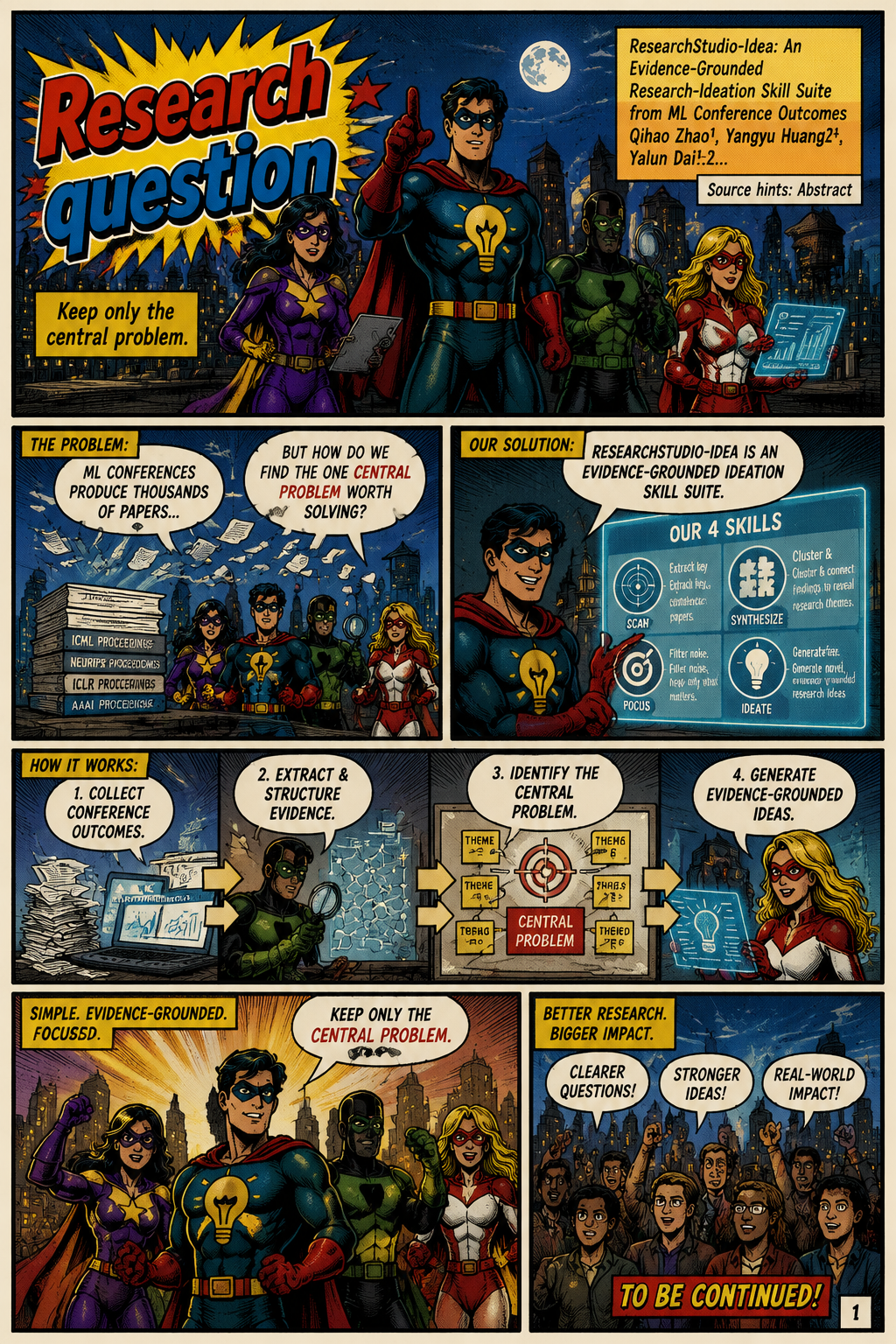
The paper asks whether large language models can support research ideation as a reusable, evidence-grounded skill rather than as open-ended brainstorming. Its motivation is that producing a plausible research direction is no longer the hard part; the harder problem is grounding that direction in current literature, identifying a real bottleneck, differentiating it from prior work, and auditing risk before experiments begin. ResearchStudio-Idea frames this as a “first-mile” research workflow, focused on the stage before implementation and paper writing. The authors position the suite as outcome-grounded skill induction, meaning that traces from accepted, highly cited, and rejected machine learning papers are converted into operational guidance for idea development. This framing matters because it treats ideation as a structured research practice with evidence, constraints, and failure modes, not merely as text generation.
Why old methods fall short
The paper argues that prior LLM-based research agents, multi-agent systems, search-based ideation methods, and novelty tools leave an important gap between idea generation and defensible proposal construction. Existing systems can retrieve papers, propose hypotheses, coordinate agents, or plan experiments, but the authors emphasize that these capabilities do not automatically produce a well-scoped, literature-aware, and differentiated research direction. The obstacle is that early research decisions require simultaneous reasoning about context, bottlenecks, novelty claims, implementation risks, and likely failure modes. ResearchStudio-Idea therefore separates reusable skills for literature grounding and novelty checking while integrating them into a larger ideation loop. This design reflects the paper’s claim that research ideation needs explicit phase contracts and validators, not just stronger base models.
Core idea
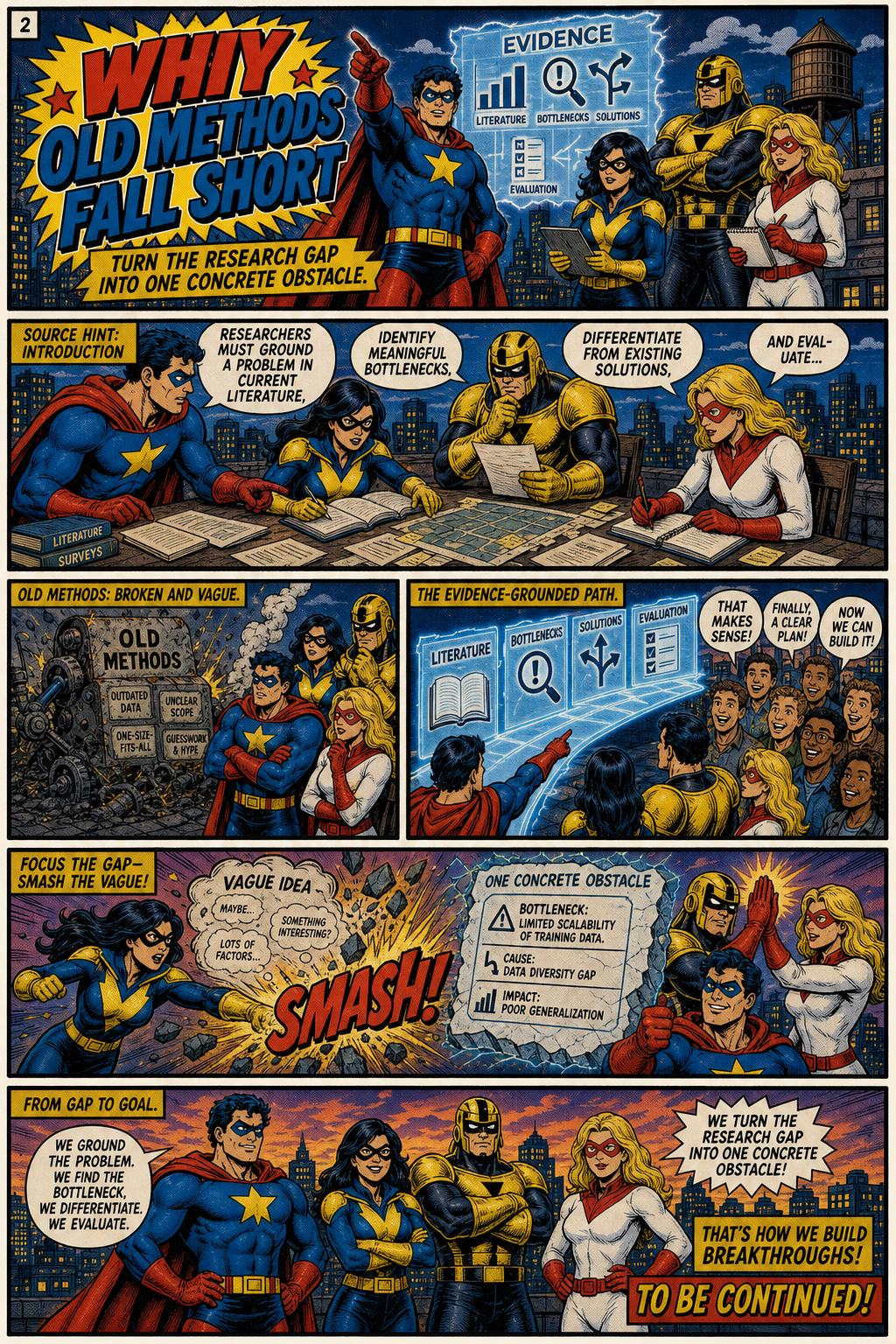
The core contribution is a three-part skill suite consisting of Paper-Search, Scoop-Check, and IdeaSpark. Paper-Search performs multi-source literature grounding across resources including arXiv, DBLP, OpenAlex, OpenReview, Semantic Scholar, and Crossref, giving the workflow a broader evidence base than a single search index. Scoop-Check decomposes a novelty claim into axes such as problem framing, core mechanism, key insight, and application domain, then checks for collisions with retrieved prior work. IdeaSpark composes these components into an end-to-end process that evaluates evidence readiness, reconstructs the research context, identifies unresolved bottlenecks, selects relevant ideation patterns, instantiates one candidate direction, retrieves potentially conflicting work, and renders a structured idea card. The mechanism is designed to make each proposal traceable to evidence and to make novelty pressure visible rather than implicit.
Evidence check
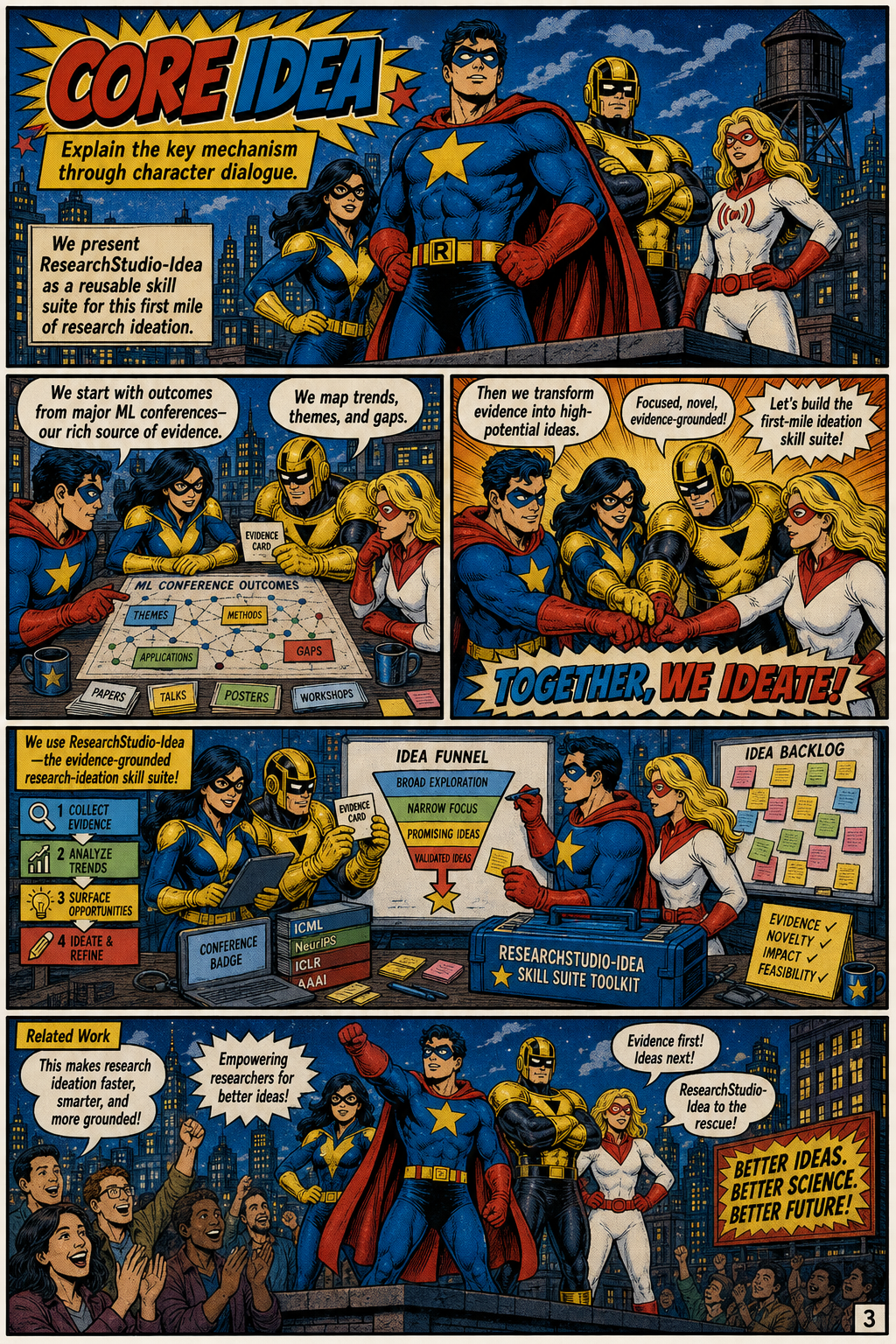
The paper’s method for building IdeaSpark begins with a corpus of 1,947 machine learning conference papers from ICLR, ICML, and NeurIPS between 2021 and 2025. The corpus includes Oral papers, a separately tracked high-citation subset, and rejected submissions, allowing the authors to study not only successful outcomes but also nearby failed attempts. They extract innovation signatures through a two-stage process, beginning with base fields and then rewriting them into domain-agnostic abstractions. Unsupervised pattern discovery identifies 31 recurring ideation sub-patterns, which are consolidated into 15 reusable ideation patterns. Each pattern becomes an operational card containing research contexts, bottleneck types, differentiation strategies, supporting precedents, and common failure modes, so the induced patterns can guide generation rather than remain descriptive analysis.

One thing to remember
The evaluation centers on whether IdeaSpark produces better research proposals than baseline LLM prompting while maintaining novelty. The paper reports blind automated-judge evaluations over 100 ICLR-2026-Oral problem seeds, comparing IdeaSpark against Opus-4.8 bare, Opus-4.8 self-generated, and GPT-5.5 bare baselines. The reported results show that IdeaSpark achieves stronger idea-quality scores while remaining competitively novel, whereas one baseline illustrates a failure mode in which apparent novelty does not correspond to substantive proposal quality. The paper also reports that IdeaSpark has the highest mean idea-quality across 21 ICLR primary-area domains, suggesting that the gain is broad rather than tied to a narrow field. The main implication is that large-scale conference outcomes contain reusable signals about how impactful research directions are formulated, differentiated, and audited, and that those signals can be operationalized as practical LLM skills.