ReadPaper Blog
Reinforcement Learning Elicits Contextual Learning of Unseen Language Translation
The paper studies how large language models can translate extremely low-resource or completely unseen languages when given rich linguistic context such as grammar descriptions, dictionary entries, and parallel examples. It argues that the central problem is not memorizing individual languages, but learning a transferable meta-skill for using in-context linguistic resources, and it proposes reinforcement learning with a chrF translation-quality reward to elicit that skill. The reported evidence suggests that RL-trained models generalize better to unseen languages than ordinary in-context learning or supervised fine-tuning, with implications for scalable support of endangered and under-documented languages.
Source: Reinforcement Learning Elicits Contextual Learning of Unseen Language Translation

When New Languages Break the Old Tricks
The paper frames unseen and extremely low-resource language translation as a demanding test of whether large language models can reason from linguistic evidence rather than rely on pretraining exposure. Prior work has shown that models can sometimes translate new languages after continued training or by receiving a grammar book in context, but the paper argues that these approaches often overfit to particular languages and transfer poorly at test time. The authors emphasize that this limitation matters scientifically because it probes out-of-distribution generalization, and socially because many endangered languages lack large parallel corpora. Their motivating example is the setting where an LLM must translate using only limited resources such as grammar books, dictionaries, morphological information, and a small number of examples. The paper’s core claim is that progress in this regime requires models that can exploit explicit linguistic documentation on demand, not models that merely accumulate language-specific parameters.
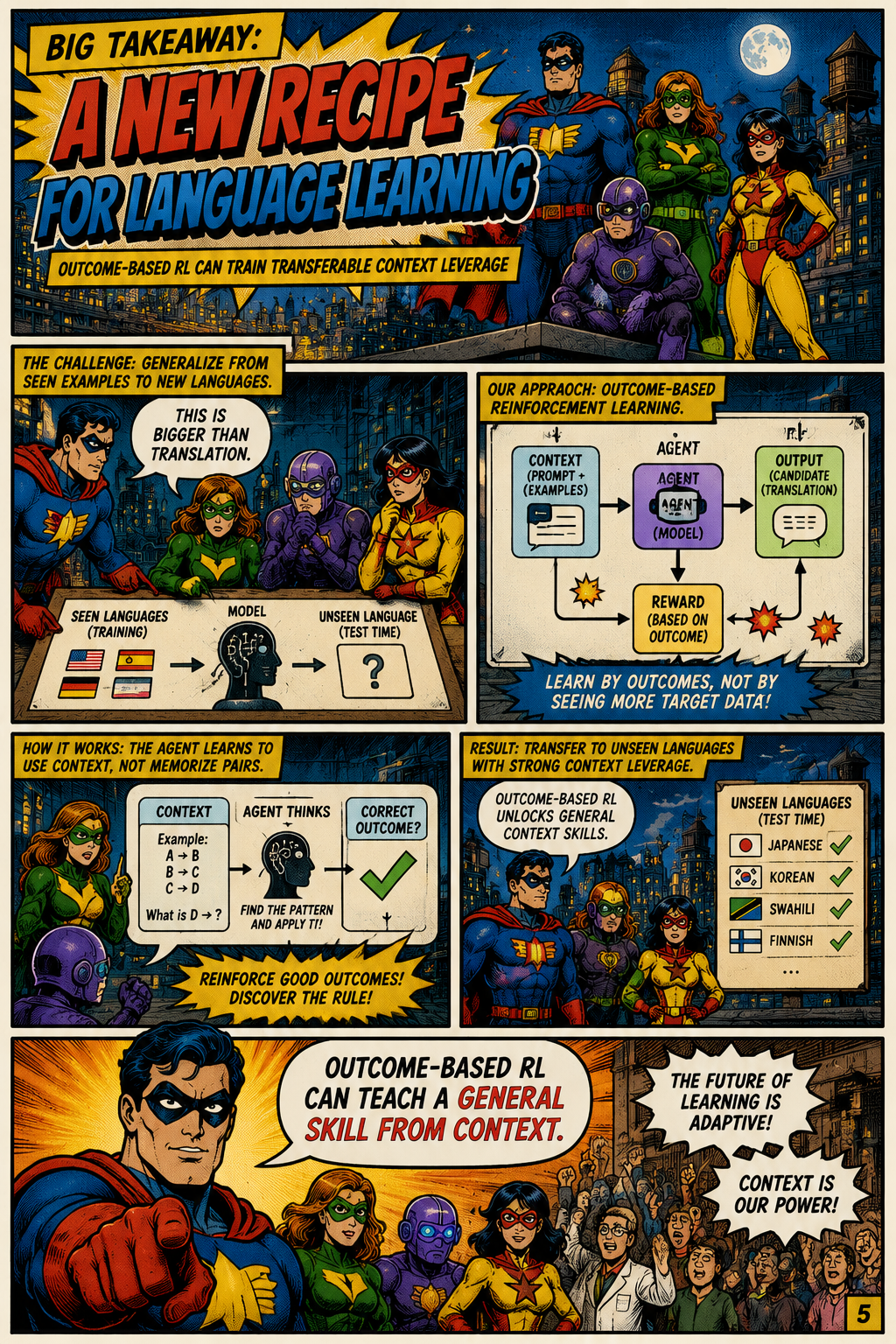
The Gap: Memorization vs. Meta-Skill
The central conceptual contribution is a reframing of low-resource translation as language-independent meta-learning. Instead of teaching a model the facts of one target language, the paper aims to teach the model a meta-skill of contextual leveraging: extracting relevant rules, lexical mappings, and grammatical patterns from the prompt and applying them to a new translation problem. This view connects in-context learning and post-training under a single objective, because both are judged by whether the model can use a contextual support set of linguistic resources at inference time. The authors contrast this target with supervised fine-tuning, which can improve performance on training languages while still encouraging memorization of in-domain patterns. By making contextual use itself the object of training, the paper positions unseen language translation as a verifiable, context-dependent reasoning problem.
RL Enters the Scene
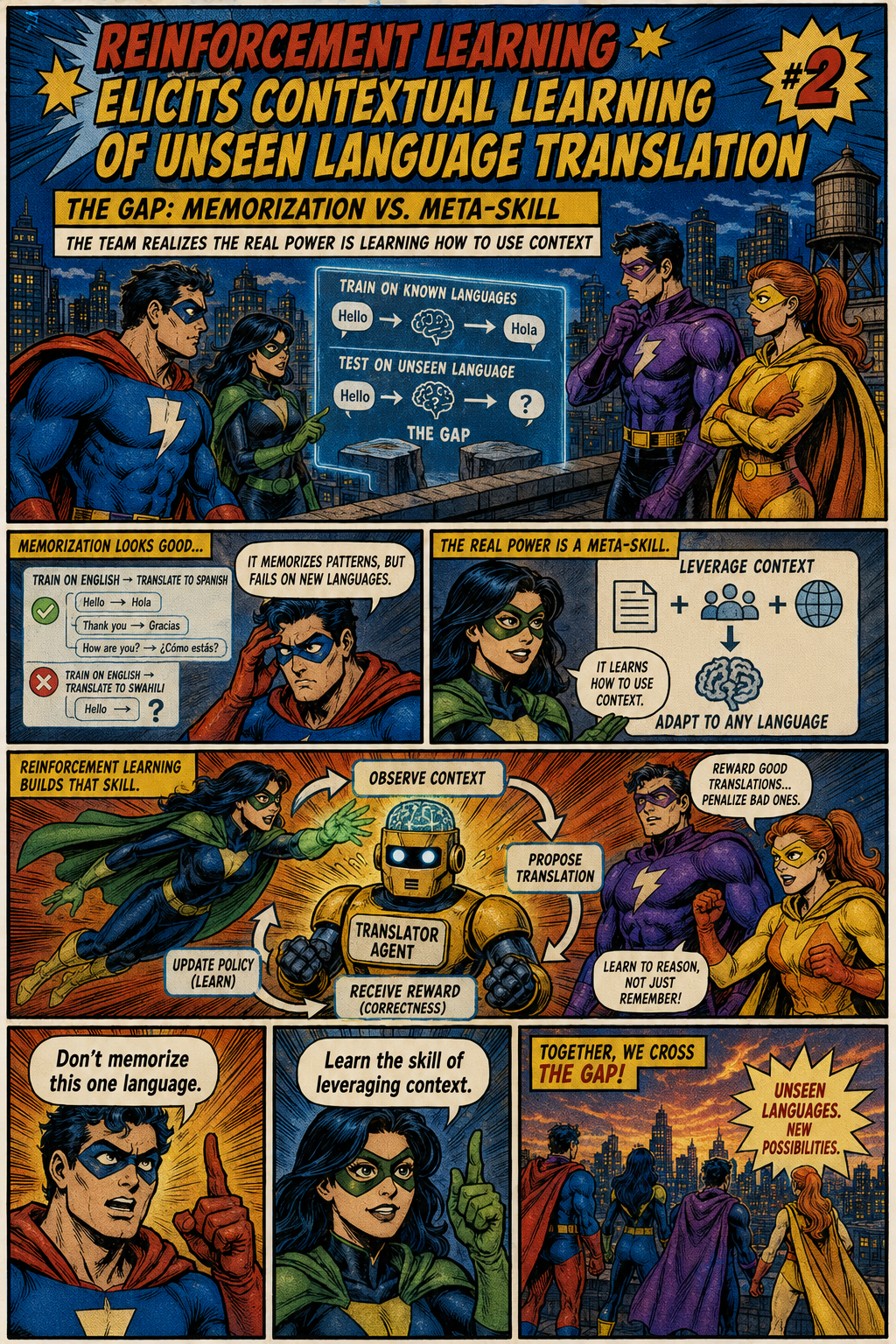
The proposed method applies reinforcement learning to translation conditioned on rich linguistic context, using an outcome reward rather than a handcrafted sequence of reasoning steps. The model receives prompts that include task instructions, dictionary sections, retrieved parallel sentences, and grammar passages, and it is trained to produce translations whose quality is rewarded by a surface-level metric such as chrF. The paper situates this recipe within reinforcement learning with verifiable rewards, extending the logic of RLVR from domains like mathematics and coding to multilingual linguistic reasoning. Its data construction covers fourteen very low-resource languages, including Choguita Rarámuri, Gyeli, Japhug, Kagayanen, Kalamang, Tuatschin, Ulwa, Vamale, and six standardized Romansh varieties: Puter, Vallader, Surmiran, Sursilvan, Sutsilvan, and Rumantsch Grischun. The methodology also includes extracting sentence pairs from Language Science Press grammar books, handling Romansh resources separately, and augmenting limited dictionary coverage with synthetic entries derived from parallel data and grammar books.
What the Paper Claims the Team Learned
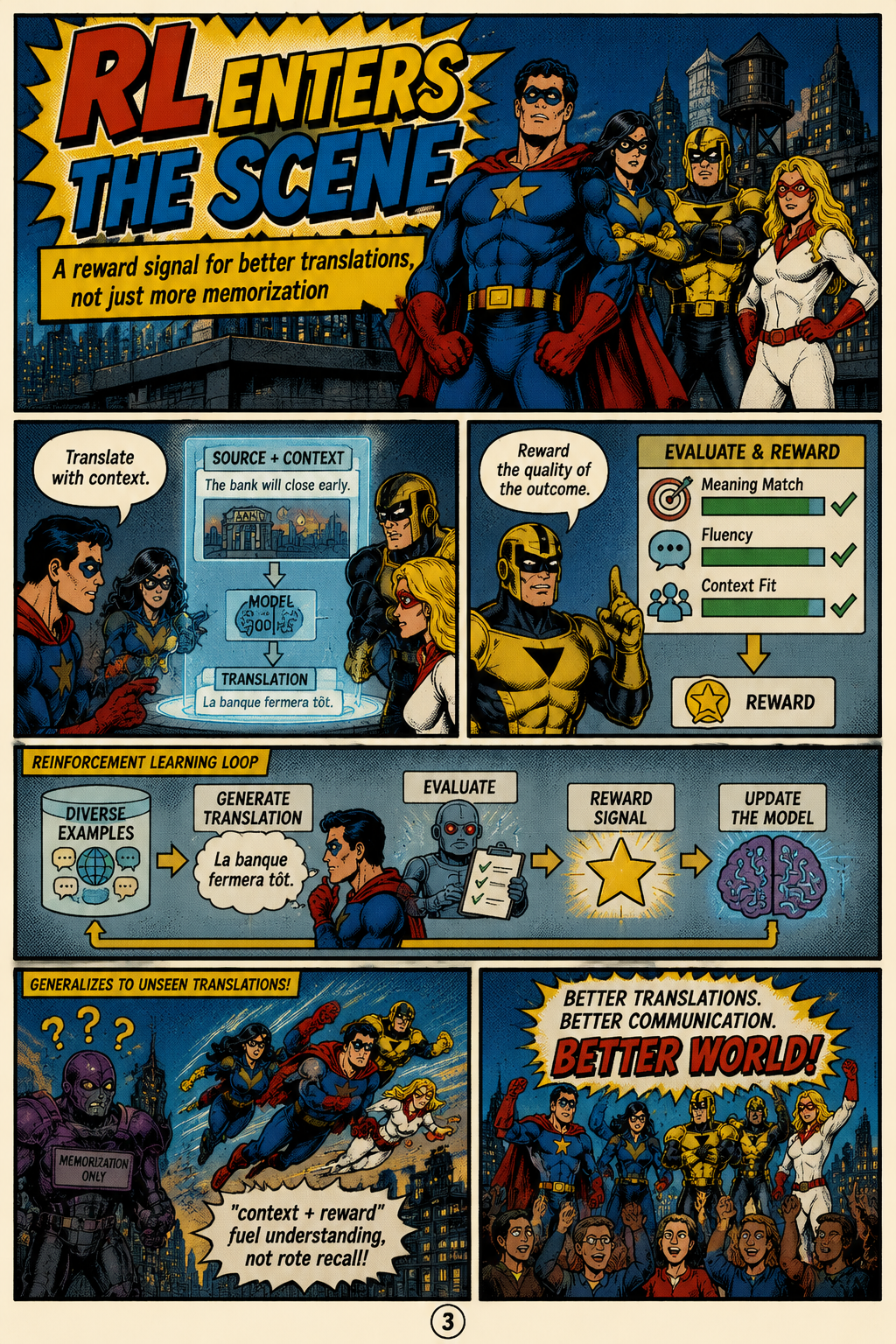
The paper reports that reinforcement learning improves the model’s ability to extract and apply relevant linguistic information from context when translating completely unseen languages. In the authors’ controlled comparisons, RL-trained models outperform both standard in-context learning and supervised fine-tuning in the unseen-language setting described in the abstract and introduction. This result supports the paper’s claim that a lightweight surface reward such as chrF can still guide models toward transferable behavior when the task is structured around contextual linguistic evidence. The contrast with supervised fine-tuning is important because the paper argues that SFT tends to overfit in-domain training languages, whereas the RL approach better preserves the ability to generalize from new context. The empirical finding therefore strengthens the broader thesis that outcome-based optimization can elicit a reusable strategy for using grammars, dictionaries, and examples rather than simply improving memorized translation behavior.
Big Takeaway: A New Recipe for Language Learning
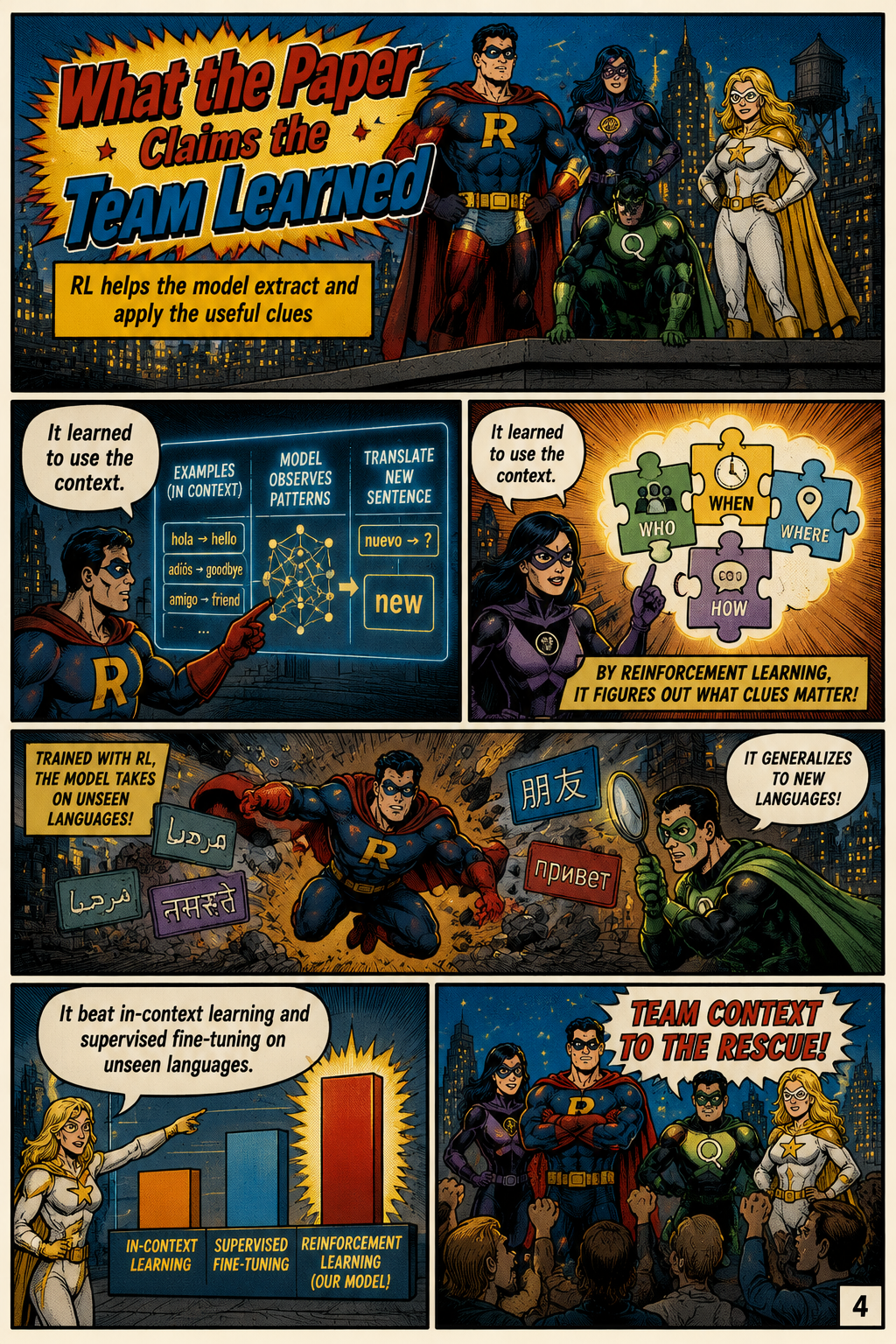
The broader implication of the paper is that outcome-based reinforcement learning may be a practical recipe for teaching LLMs to learn languages from context. By treating translation from a new language and its documentation as a rewardable task, the paper extends the relevance of RL beyond conventional reasoning benchmarks and into low-resource natural language processing. This matters for endangered-language documentation because many languages have grammar descriptions, lexicons, or scattered examples but lack the large-scale parallel data that modern machine translation systems usually require. The paper’s approach suggests that future systems could become better at making use of heterogeneous linguistic resources, including grammar books, morphological paradigms, bilingual dictionaries, and retrieved examples. Its stated limitation is not that chrF fully captures translation adequacy, but that even a simple surface-level reward can provide evidence for a general direction: training models to leverage context as a transferable capability.