ReadPaper Blog
PraMem: Practice-derived Experiential Memory for Long-horizon Behavior Prediction
The paper introduces PraMem, a training-free framework for improving LLM-based long-horizon behavior prediction by turning a user’s lengthy historical sequence into practice data rather than merely compressing it. PraMem builds a user-specific, time-evolving experiential memory containing behavioral-pattern experience and bias-alert experience, which helps the LLM infer the next action more accurately while avoiding recurring cognitive biases.
Source: PraMem: Practice-derived Experiential Memory for Long-horizon Behavior Prediction
Research question
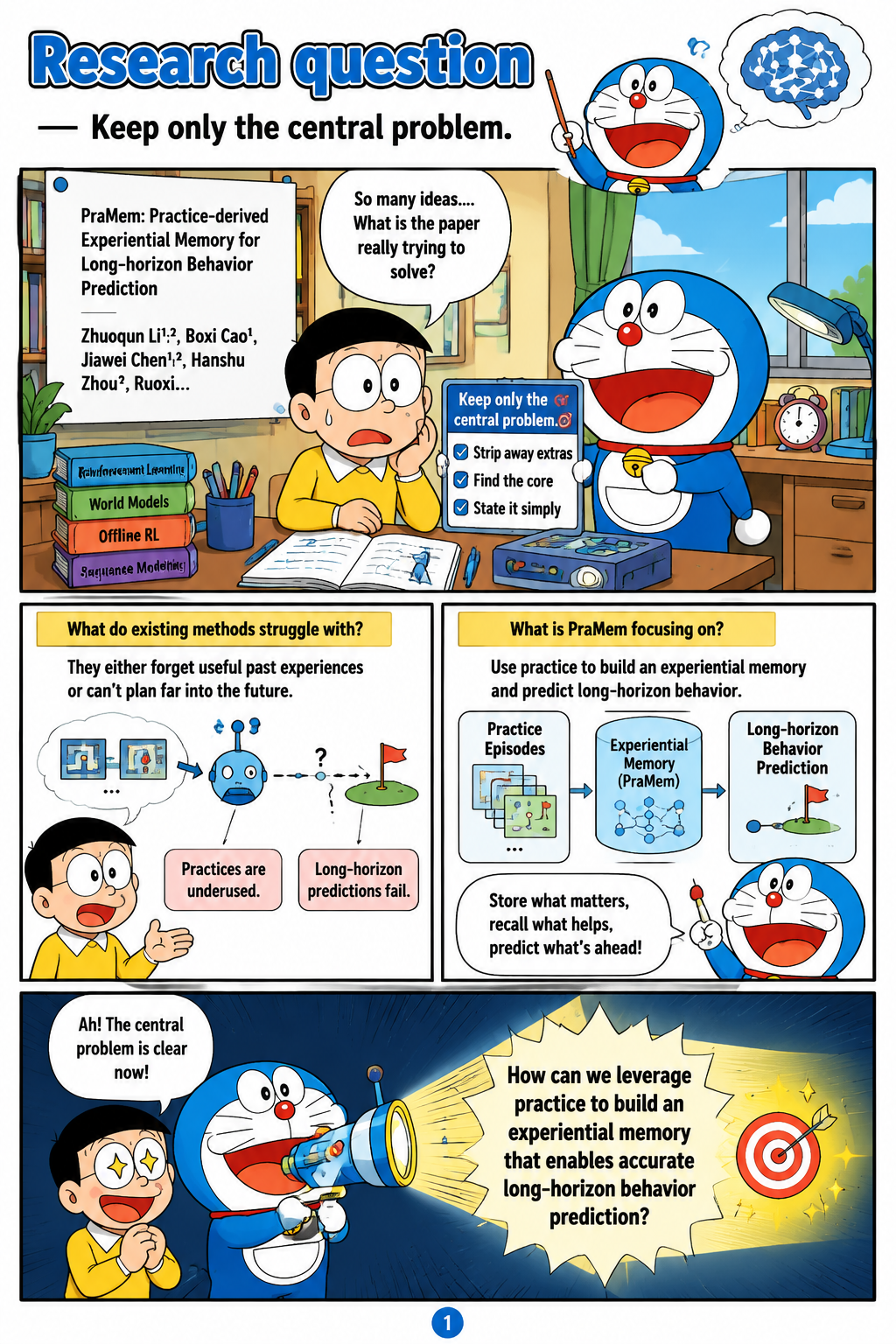
PraMem addresses the problem of long-horizon behavior prediction, where a model must infer a user’s next action from a lengthy sequence of past scene-action records. The paper argues that this task is important for recommendation systems, cognitive science, and interactive artificial intelligence because useful predictions depend on recognizing stable but often hidden behavioral regularities. Large language models offer a natural way to formulate the task as autoregressive generation over textual histories, but the authors emphasize that long sequences spanning many steps make direct prediction unreliable. The central difficulty is not only that the context is long, but that fine-grained user preferences such as brand, price, quality, and appearance may be scattered across the history. The paper’s main contribution is to propose PraMem, which performs beforehand practice on the historical sequence to construct an experiential memory that assists the final prediction.
Why old methods fall short
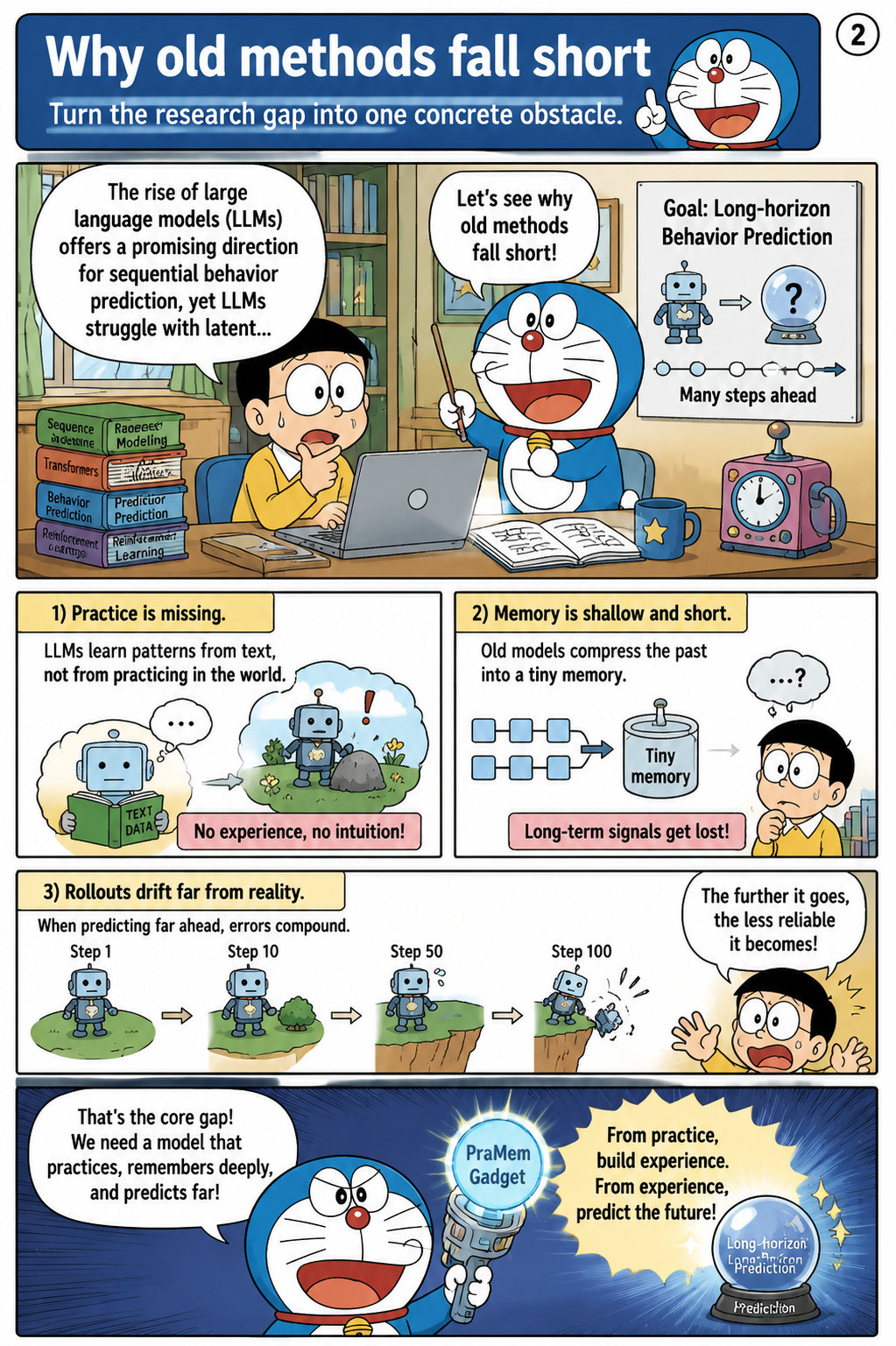
The paper identifies two failures that limit existing LLM-based approaches to long-horizon behavior prediction. First, LLMs struggle to induce latent behavioral patterns from ultra-long histories because the relevant evidence is dispersed and may not be obvious in any single record. Second, LLMs can exhibit model-intrinsic cognitive biases, including majority-following tendencies, training-induced prejudices, and disproportionate attention to particular records such as the most recent ones. Prior memory management work largely follows a context-compression paradigm, using extraction, aggregation, or retrieval to reduce the amount of historical text supplied to the model. The authors argue that compression can reduce context burden but does not guarantee reliable behavioral-pattern induction or correct the LLM’s own biased reasoning. This gap motivates PraMem’s shift from simply shortening the history to using the history as a source of supervised practice examples.
Core idea
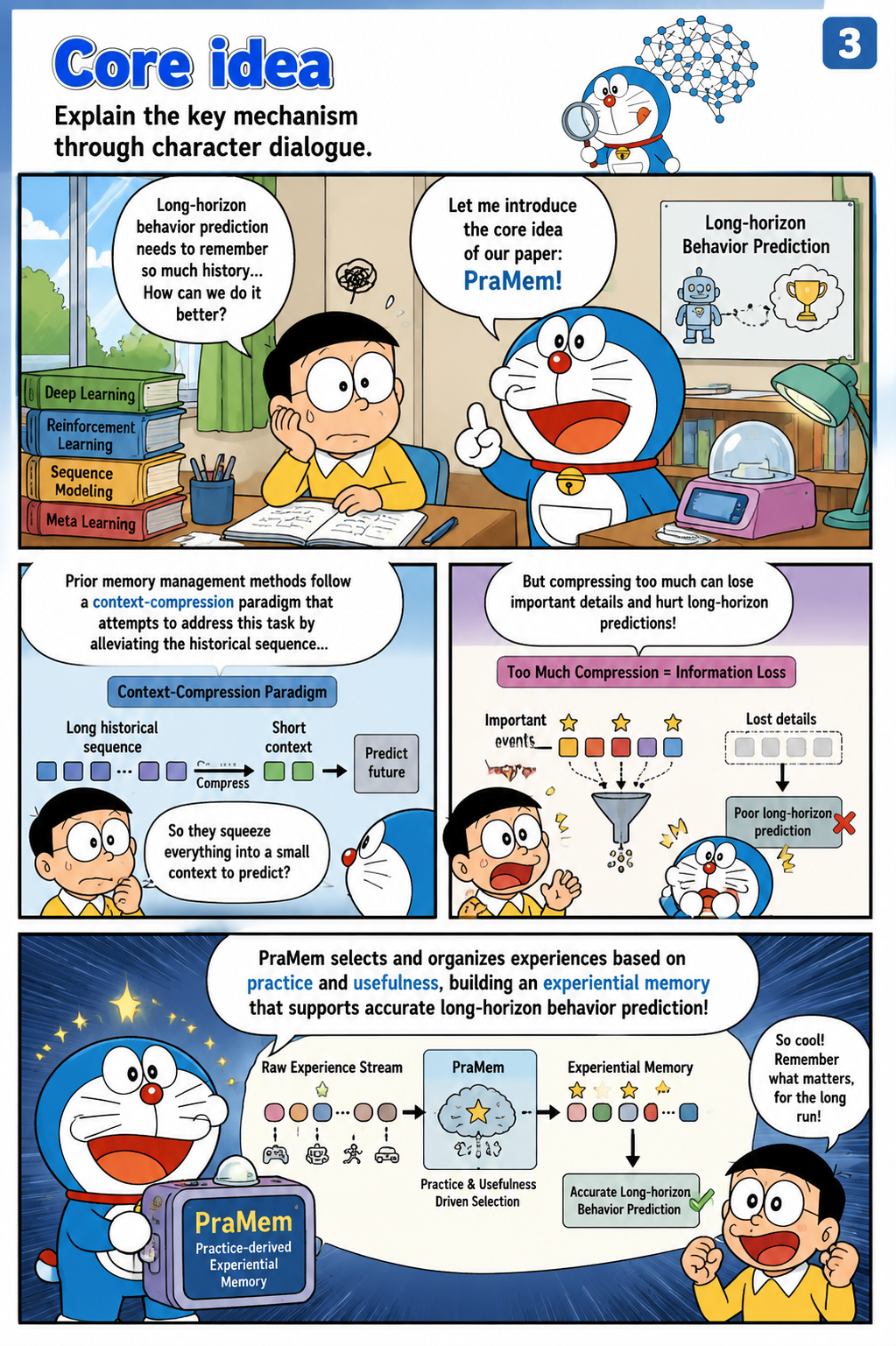
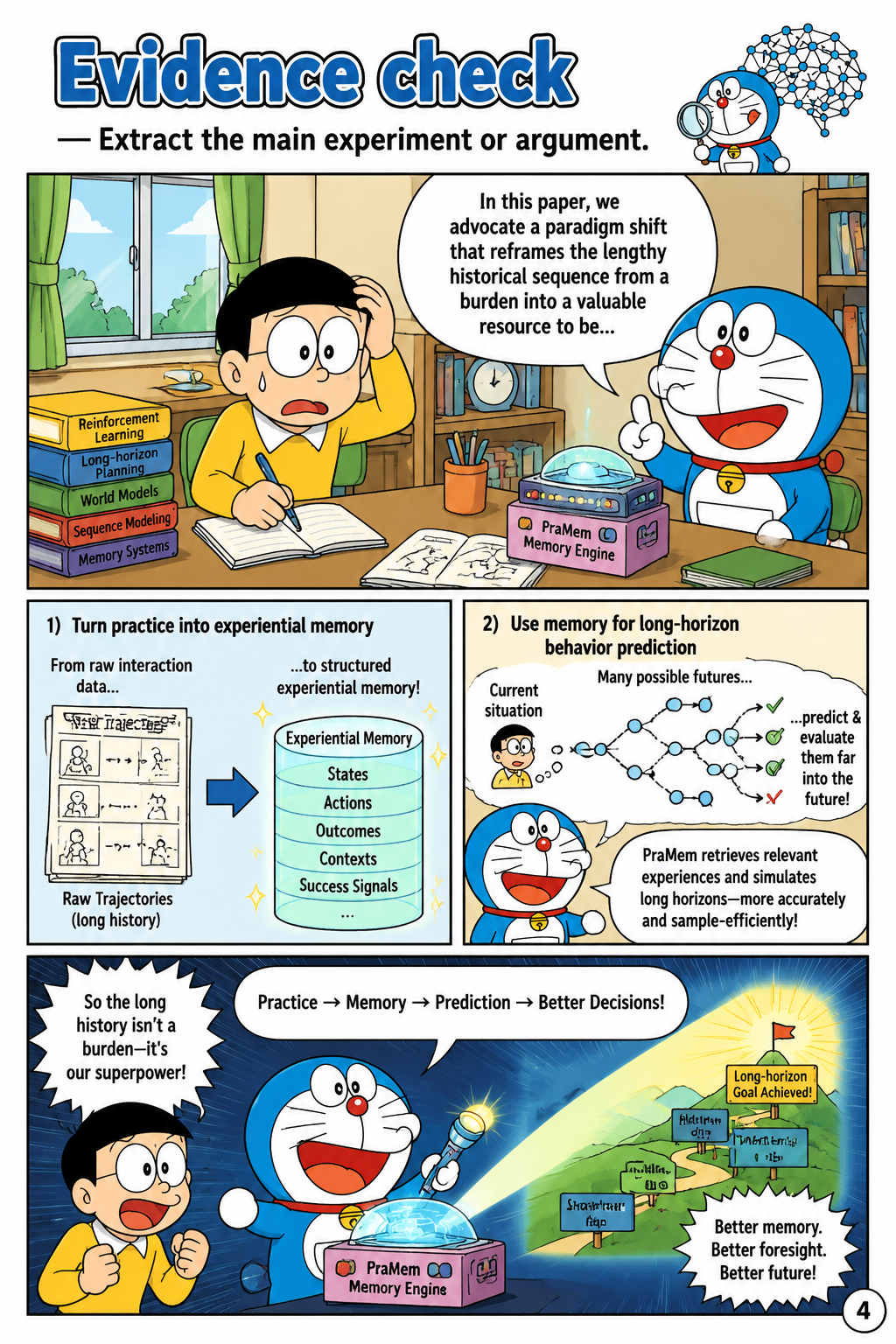
PraMem reframes a lengthy user history as a valuable resource because each segment of scene-action records can form a practice sample with a ground-truth next action. Instead of asking the LLM to induce patterns only at prediction time, the framework performs iterative trial-and-error before the target prediction and records what is learned in an experiential memory. This memory has two explicit components: pattern experience, which summarizes user behavioral regularities, and bias-alert experience, which warns the model about error-prone reasoning tendencies for the current user. In the paper’s formulation, the vanilla process predicts an action from the full history and current scene, while the PraMem process first updates memory through practice and then predicts using the current scene, the experiential memory, and only a short suffix of recent records. This design makes the memory both user-specific and time-evolving, since it is incrementally updated as new records accumulate.
Evidence check
The method maintains experiential memory through three iterative operations: existing experience trial, reflective proposal generation, and consensual experience adjustment. In the trial stage, PraMem samples segments from the historical sequence, turns them into practice cases with labels, and prompts the LLM to make predictions using explicit deep thinking under the current memory. In the reflection stage, the system compares the prediction, reasoning process, practice sample, and ground-truth label to generate proposals that revise, prune, or supplement the memory. Because individual observations may reflect accidental behavior, the adjustment stage updates the experiential memory only when multiple proposals provide consensus support for an operation. The paper also introduces a self-review mechanism to filter reflective proposals, requiring them to be both grounded in the practice sample and generalizable beyond it. Groundedness is tested by perturbing the historical sequence so that the underlying behavioral pattern changes, while generalizability is tested by rewriting the prediction scene into similar but distinct virtual scenes.
One thing to remember
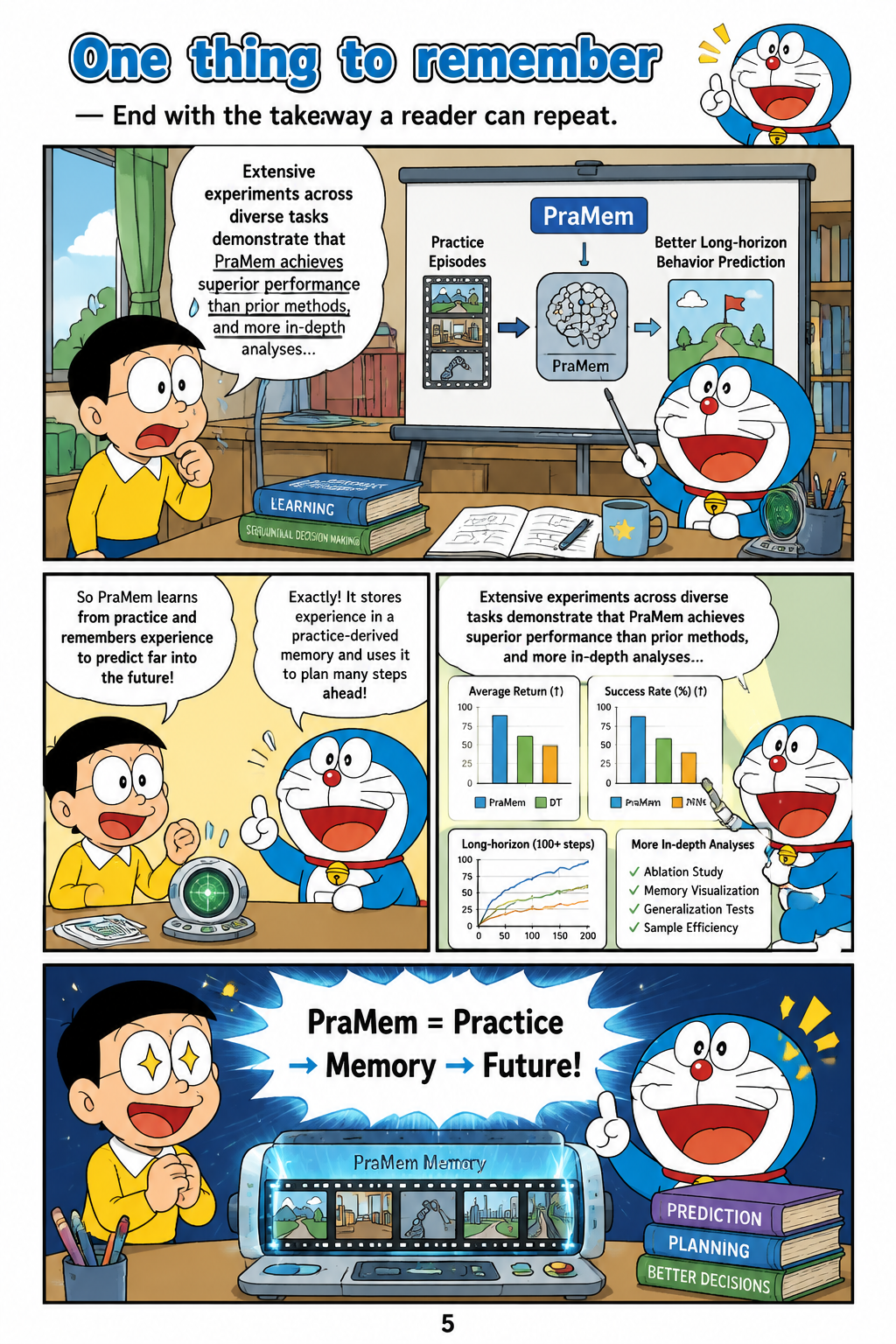
The paper reports extensive experiments across diverse long-horizon behavior prediction tasks and compares PraMem with strong memory management baselines. The reported results show that PraMem achieves superior performance, supporting the claim that practice-derived experiential memory is more effective than treating long histories mainly as text to compress. Ablation studies are used to verify the contribution of individual components, including the iterative memory update process and the self-review mechanism for reflective proposals. Additional analyses examine how experiential memory evolves during practice and how pattern experience and bias-alert experience contribute to prediction behavior. The broader implication is that long user histories can serve as supervision for test-time or pre-prediction adaptation without model training, allowing LLMs to better capture latent behavioral patterns while reducing recurring reasoning biases.