ReadPaper Blog
Phone Segmentation and Recognition through Phonological Activation Mapping
This paper addresses the problem of automatically locating phone boundaries and identifying phone labels in speech, two tasks that are usually modeled separately despite being tightly linked in human perception. It proposes S3M-based Phonological Activation Mapping (SPAM), which projects self-supervised speech model representations onto phonological feature directions and then uses lightweight, gradient-descent-free heads for both segmentation and recognition. The result matters because it aims to make phonetic transcription more interpretable, sample-efficient, and usable for low-resource languages, atypical speech, and phones not observed during training.
Source: Phone Segmentation and Recognition through Phonological Activation Mapping

Two Tasks, One Speech Stream
The paper begins from a practical bottleneck in phonetic transcription: phone segmentation asks where each speech sound begins and ends, while phone recognition asks which IPA phone occurred, and both are expensive to annotate by hand. The authors note that expert phonetic transcription can require tens of hours for a single hour of speech, and that even trained transcribers may disagree about boundaries and labels. Modern systems often separate the tasks, treating recognition as a sequence-to-sequence or CTC-style problem and segmentation as frame-wise boundary classification. Bharadwaj, Choi, McIntosh, and colleagues argue that this separation misses the way phonetic perception naturally combines identity and timing. Their central research question is whether a single representation can support both phone recognition and phone segmentation without training large task-specific models.
Hidden Phonetic Structure
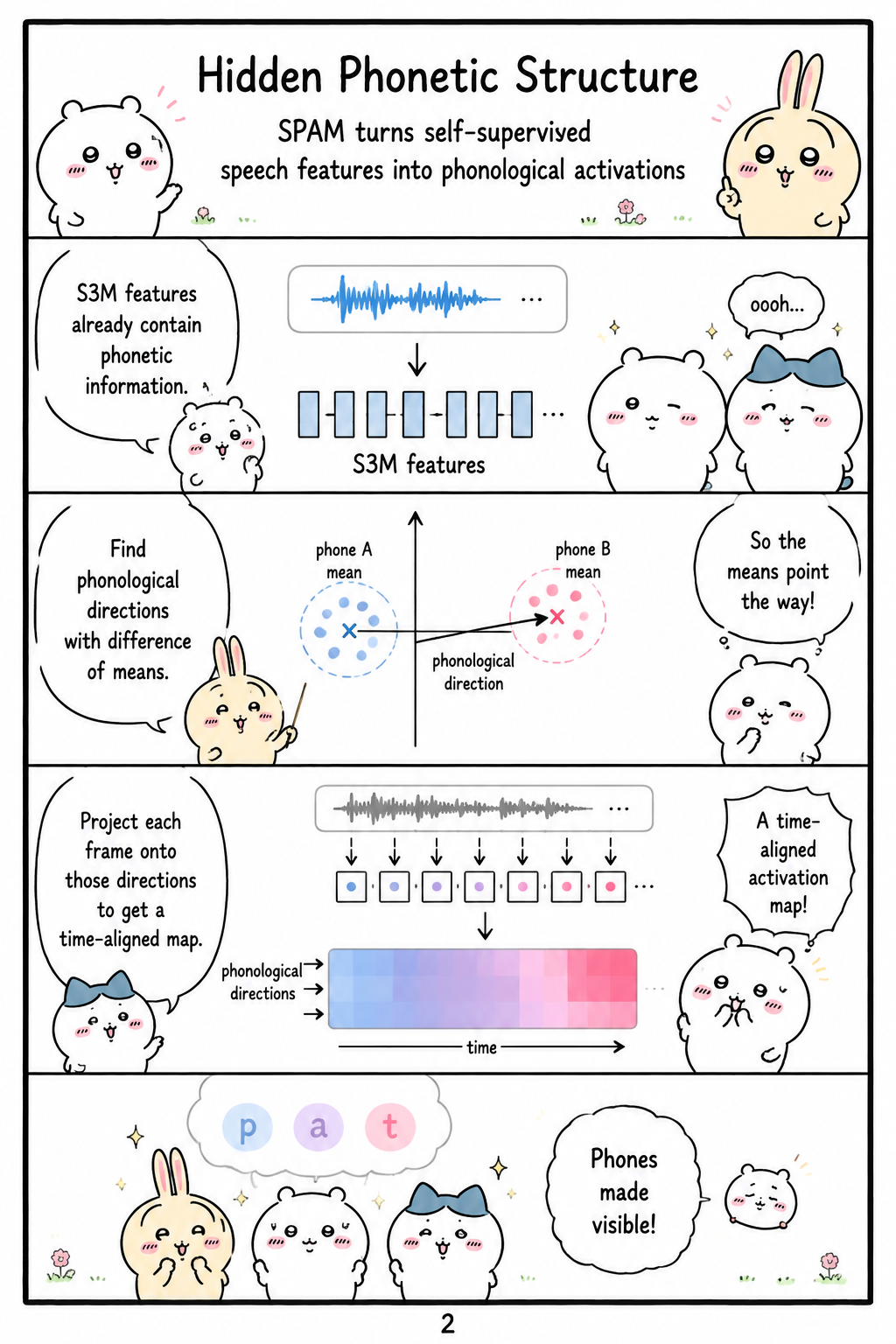
The method builds on the claim that self-supervised speech models, or S3Ms, already contain latent phonetic structure in their representation spaces. Instead of treating phones as atomic categories, the paper uses phonological feature decomposition, where a phone is represented by features such as voicing, tongue height, backness, nasality, and rounding. Using PanPhon, which maps thousands of IPA segments to phonological feature bundles, the authors estimate phonological vectors in S3M space by a difference-of-means procedure: the mean representation of segments with a feature is contrasted with the mean representation of segments without it. Each frame representation from a model such as WavLM-large is then projected onto these feature directions, yielding a vector of phonological activations for that time step. Stacking these vectors over time produces S3M-based Phonological Activation Mapping, or SPAM, a time-aligned representation intended to expose linguistically meaningful structure already present in the speech model.
Reading Phones From Activations
For recognition, the paper avoids a learned classifier and instead matches SPAM activations to canonical PanPhon feature vectors. Each candidate phone in the PanPhon inventory is converted into a normalized vector over the same phonological channels used by SPAM, and the system predicts the phone whose canonical vector best aligns with the activation pattern at a segment’s center frame. This recognition head is therefore gradient-descent-free, relying on phonological feature geometry rather than a trained softmax over observed labels. A key implication is open-vocabulary behavior within the cataloged PanPhon inventory: the recognizer can output phones that did not appear in the training transcriptions, because adding a phone only requires its phonological feature specification. The paper positions this as a major advantage over CTC, transducer, and encoder-decoder recognizers that typically depend on much larger phone-labeled corpora or pseudo-labeling pipelines.

Finding Boundaries
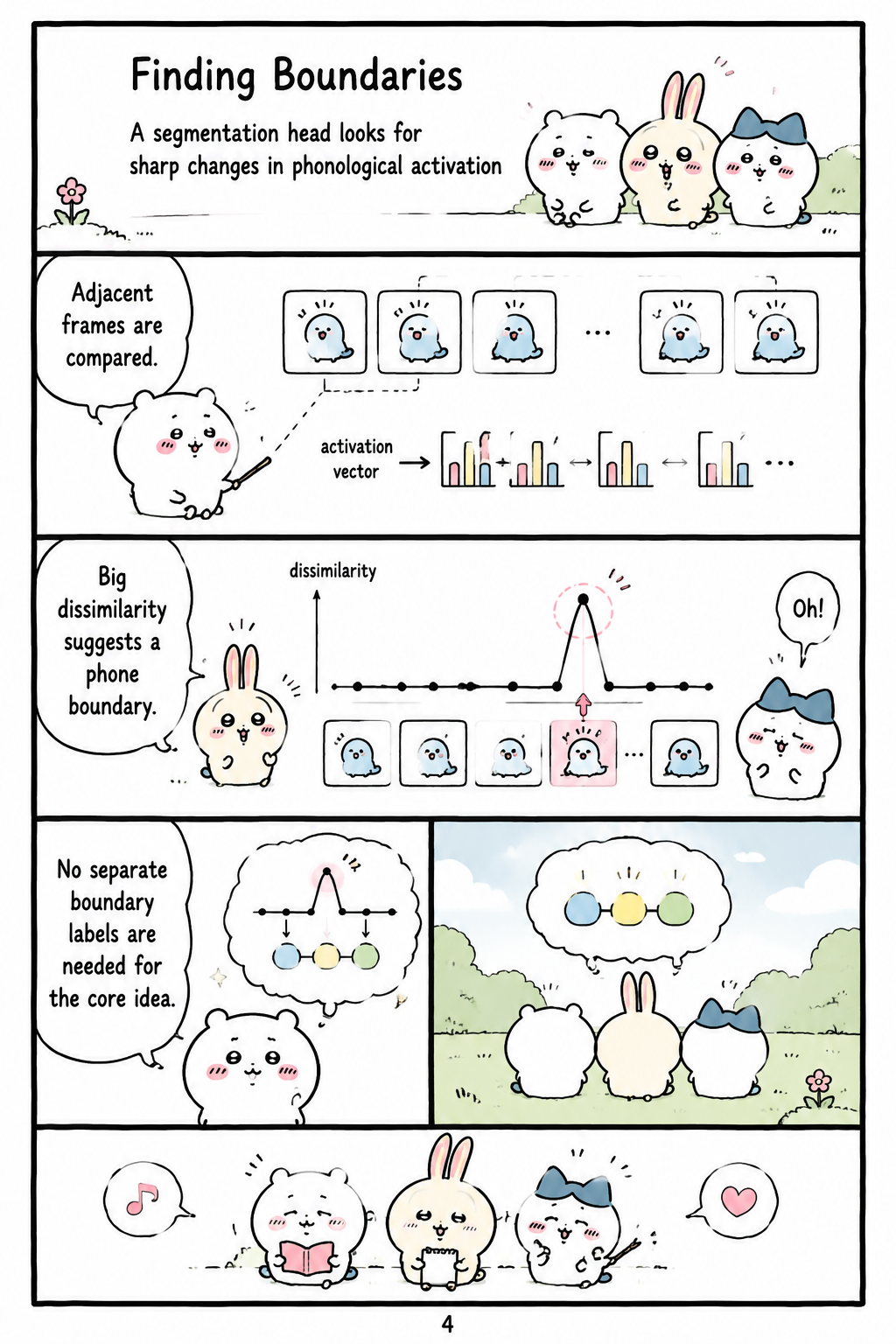
For segmentation, the paper uses the temporal structure of SPAM to detect phone boundaries as sharp changes in phonological activation. The segmentation head computes dissimilarity between adjacent activation patterns, following the intuition that a boundary should coincide with a transition in features such as voicing, nasality, place, or manner. The excerpt describes this head as lightweight and gradient-descent-free, with prominence-based peak detection applied to segmentation signals derived from SPAM and also from mel-spectrogram information. The method also adds special handling for silence, closure, and release, because stops and affricates include acoustic phases that are not fully captured by ordinary PanPhon feature contrasts. By grounding boundary detection in phonological activation changes, the system links segmentation directly to the same representation used for recognition rather than treating boundary placement as an unrelated binary frame-labeling task.
Why It Matters
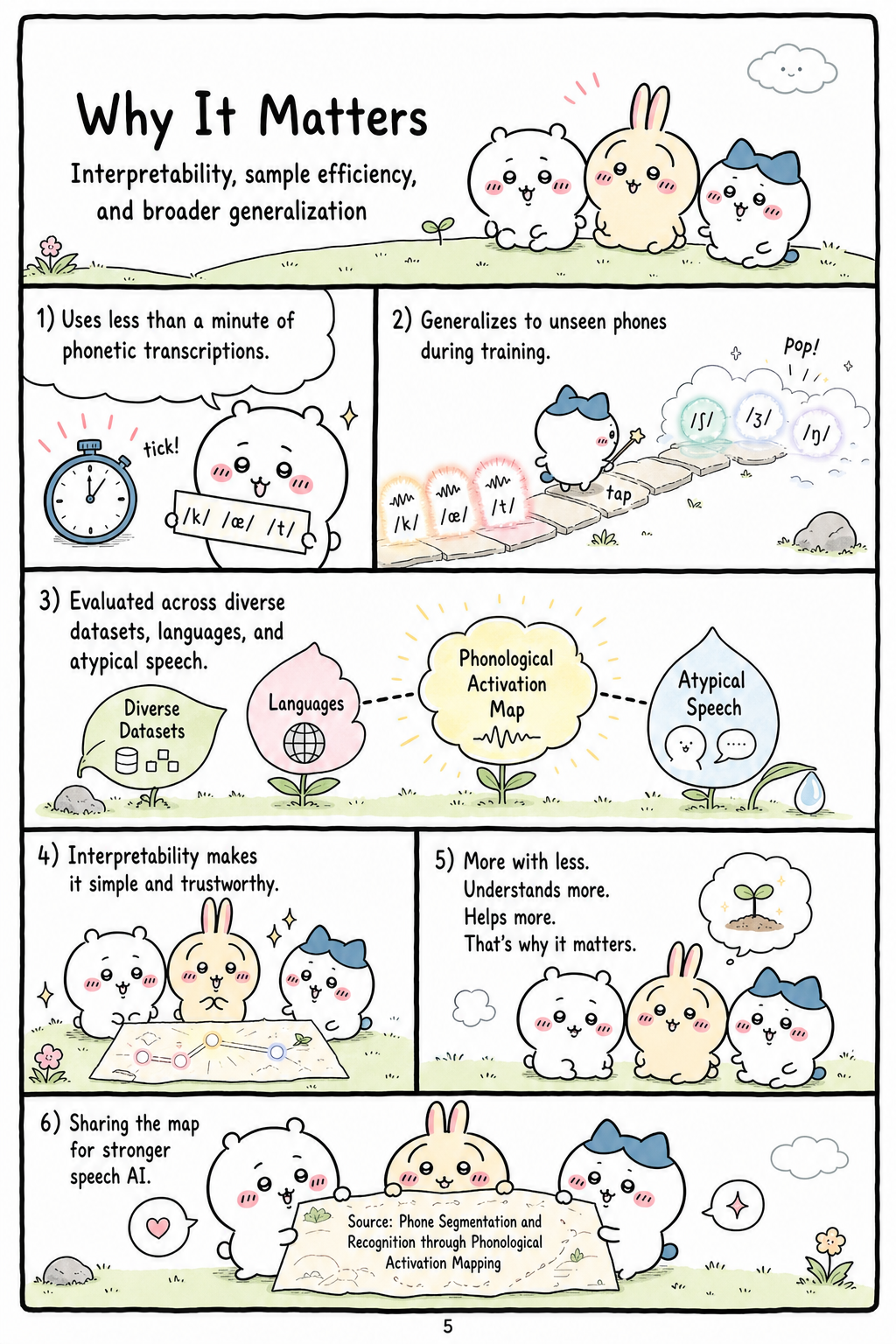
The paper’s broader claim is that SPAM offers interpretability, sample efficiency, and generalization because it steers a phonetic subspace already present in self-supervised speech representations. The authors report that the method requires less than a minute of phonetic transcriptions to estimate the phonological vectors, which directly addresses the scarcity and cost of expert IPA annotations. They also claim strong segmentation and recognition performance across diverse datasets, with emphasis on realistic settings such as low-resource languages and atypical speech. Because the representation is expressed in phonological features rather than opaque phone IDs, the approach gives users a way to inspect activations for properties like voicing or nasality over time. The implication is that phonetic tools can become more portable across languages and speech conditions by combining self-supervised acoustic representations with linguistically structured feature inventories such as PanPhon.