ReadPaper Blog
OvisOCR2 Technical Report
The paper introduces OvisOCR2, a compact 0.8B end-to-end document parsing model that converts a document page image into a Markdown representation in natural reading order, including text, formulas, tables, and visual regions. It addresses the complexity and error accumulation of multi-stage OCR pipelines by using a single image-to-Markdown model trained with a mixed real-and-synthetic data engine, reinforcement learning on a larger branch, on-policy distillation, and model fusion. The reported results matter because OvisOCR2 reaches 96.58 on OmniDocBench v1.6 and 75.06 Avg3 on PureDocBench, placing an end-to-end parser ahead of pipeline-dominated systems on major benchmarks.
Source: OvisOCR2 Technical Report
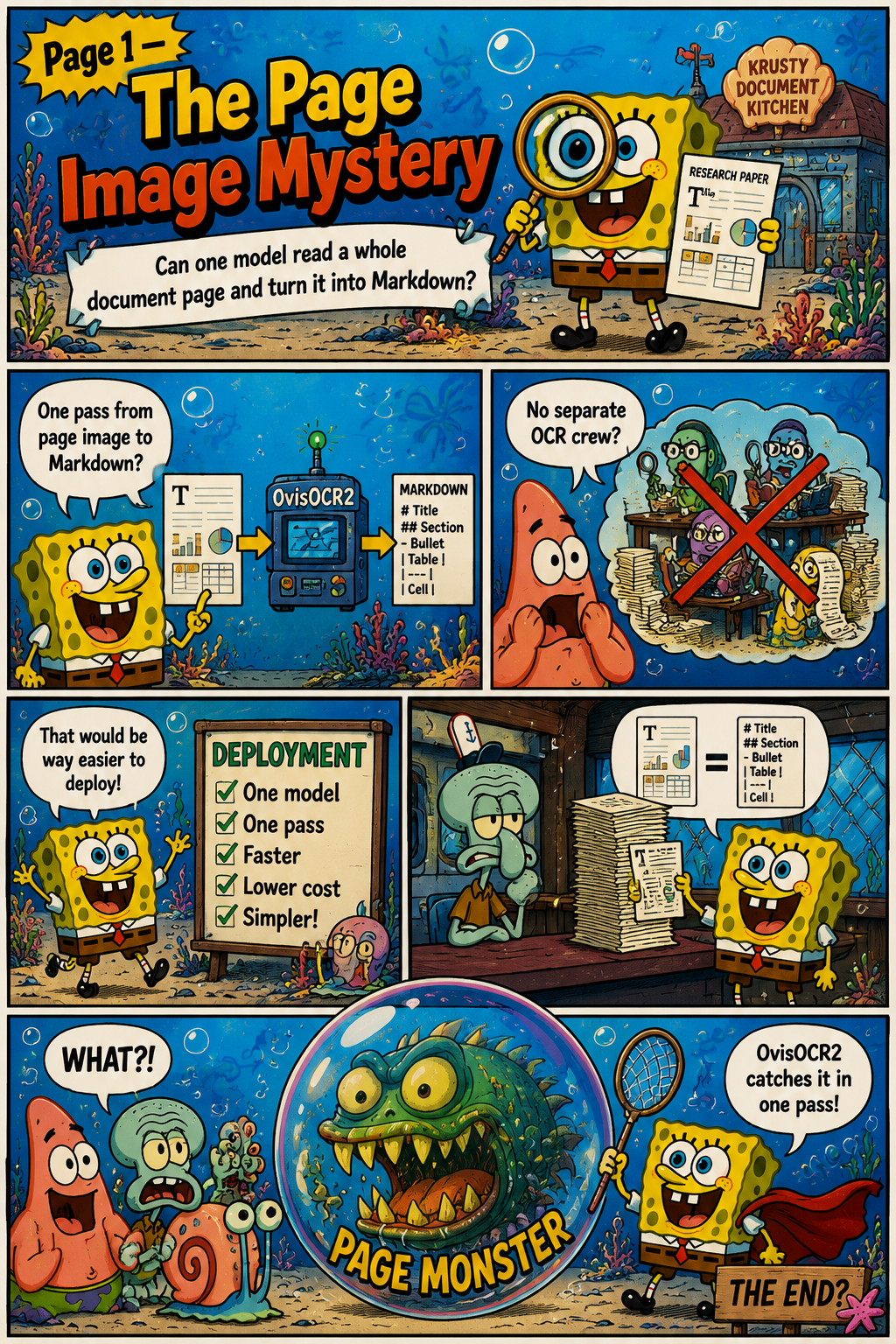
Page 1 — The Page Image Mystery
The OvisOCR2 Technical Report frames document parsing as a page-level image-to-Markdown problem rather than a narrow text-recognition task. The paper argues that practical parsing must preserve not only transcribed text, but also natural reading order, tables, formulas, figures, headers, footers, and other layout-dependent regions. OvisOCR2 is designed to take a document page image as input and generate a unified Markdown serialization in one pass, making the output suitable for indexing, retrieval, and downstream document intelligence applications. This formulation is important because it treats the page as a structured visual object whose meaning depends on spatial organization as well as content. By targeting Markdown directly, the paper aligns the model’s output with a representation that can encode headings, LaTeX-style formulas, HTML tables, and image-region placeholders within a single sequence.
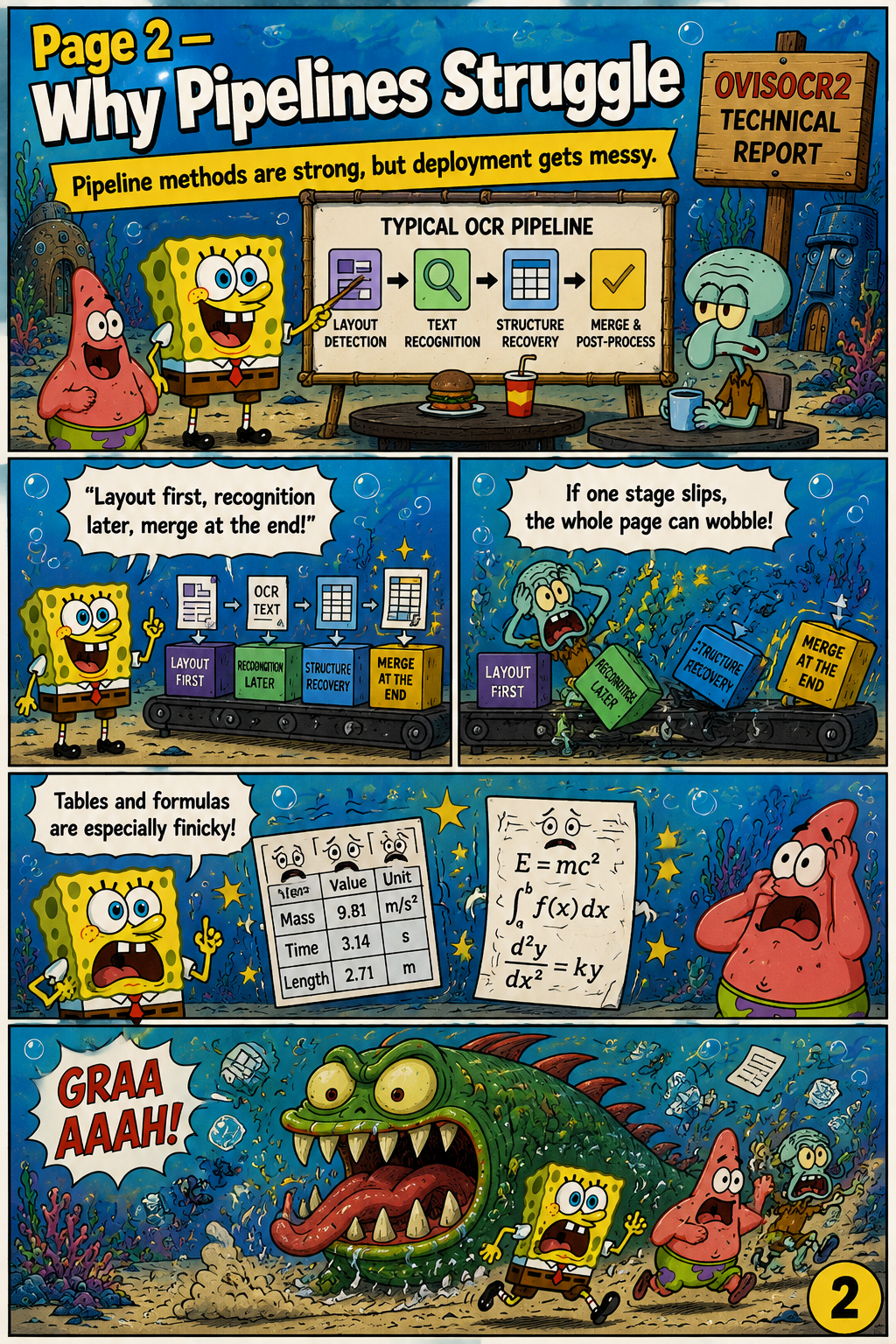
Page 2 — Why Pipelines Struggle
The paper contrasts OvisOCR2 with pipeline methods that decompose parsing into layout analysis, region-level recognition, and page-level merging. It acknowledges that such pipelines remained strong on benchmarks such as OmniDocBench v1.6, where the leading systems at the time were pipeline-based, but it identifies deployment complexity as a major cost of this design. Separate layout and recognition models can have different runtime requirements, and errors can propagate when an early stage misses a table boundary, crops a formula imprecisely, or assigns the wrong reading order. The report uses these failure modes to motivate an end-to-end alternative in which a single model can condition on full-page context throughout generation. The implication is that better document parsing may come not only from stronger recognizers, but also from avoiding brittle interfaces between intermediate modules.
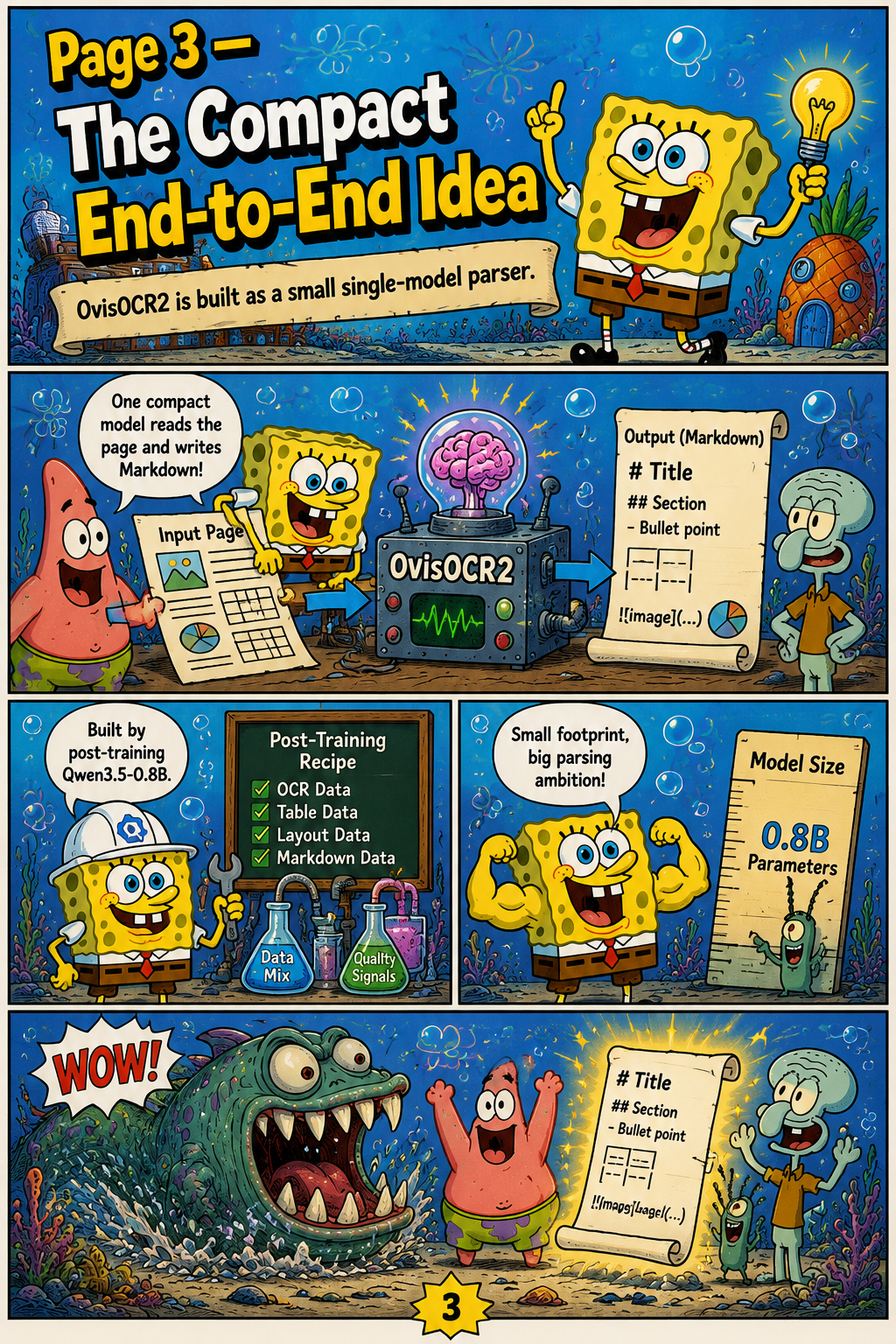
Page 3 — The Compact End-to-End Idea
OvisOCR2 is presented as a compact parser built by post-training Qwen3.5-0.8B, the smallest model in the Qwen3.5 family cited by the report. The paper’s ambition is notable because it seeks state-of-the-art document parsing while keeping the deployment footprint small and relying on one end-to-end model rather than several specialized components. Its training recipe combines supervised fine-tuning, reinforcement learning on a 4B branch with a multi-component reward design, on-policy distillation back into the 0.8B model, and model fusion. This sequence suggests that the authors use a larger branch to explore and optimize parsing behavior, then transfer those improvements into the smaller deployable model. The design positions OvisOCR2 as evidence that compact multimodal models can handle long, structured document outputs when post-training and distillation are tailored to the task.
Page 4 — Data Engine: Real + Synthetic
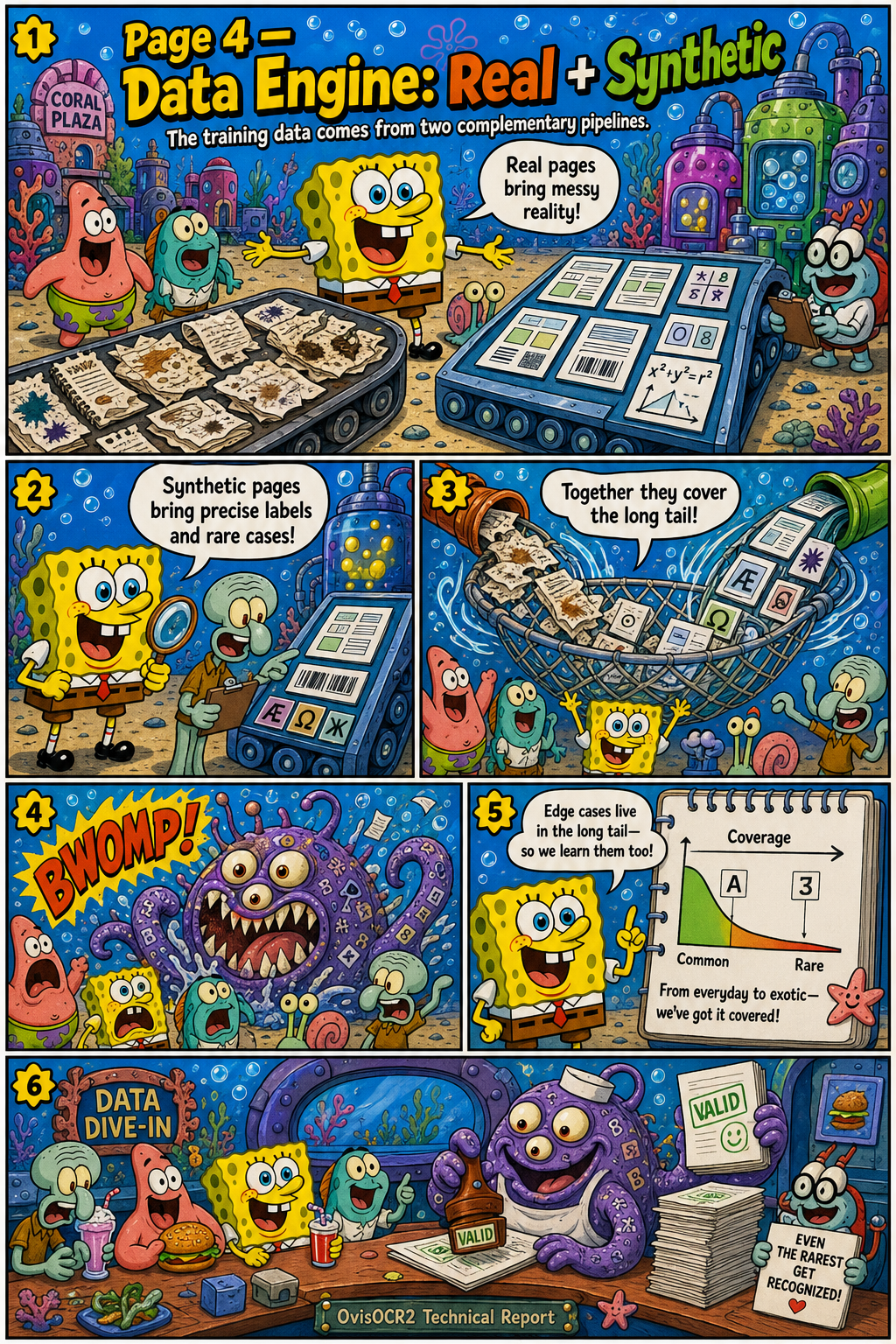
A central contribution of the paper is its data engine, which combines filtered real-document annotations with synthetic pages generated from shared HTML sources. The real-world pipeline uses specialized OCR parsers such as PaddleOCR-VL-1.5 and MinerU2.5-Pro to obtain structured candidates, then converts their JSON outputs into a unified Markdown schema through rule-based normalization and conservative filtering. The report describes detailed normalization for categories, text blocks, headings, LaTeX-style formulas, HTML tables, and visual regions encoded as bounded image tags, followed by manual subset-level spot-checking for text correspondence, formula accuracy, table alignment, visual-region alignment, and reading-order consistency. The synthetic pipeline follows a source-of-truth principle in which the same HTML source produces both the rendered document image and the Markdown target, reducing parser-derived label noise. Together, the two pipelines are intended to balance real visual diversity with controllable coverage of long-tail cases such as complex table topologies, dense formula-text interleaving, extreme multi-column layouts, and long Markdown outputs.
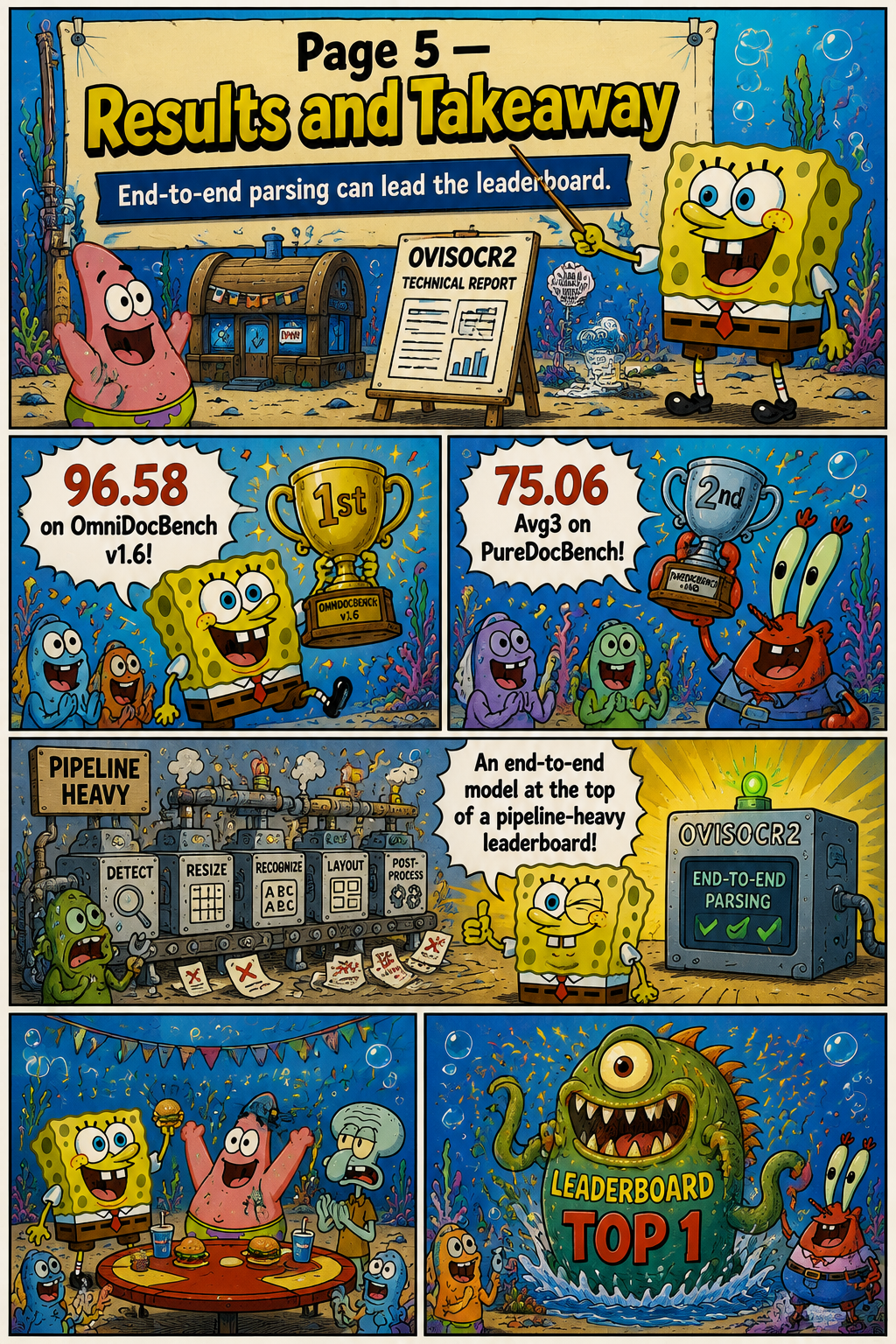
Page 5 — Results and Takeaway
The paper reports that OvisOCR2 achieves an overall score of 96.58 on OmniDocBench v1.6, which it identifies as a state-of-the-art result that moves an end-to-end parser ahead of the pipeline methods previously leading that leaderboard. It also reports the highest Avg3 score of 75.06 on PureDocBench, reinforcing the claim that the approach generalizes beyond a single public benchmark. To test broader robustness, the authors evaluate on an in-house benchmark of more than 1,000 pages spanning long-tail and challenging document scenarios. OvisOCR2 obtains the best overall performance among compared methods on this internal benchmark and leads across all three difficulty tiers according to the report. The reported strength on handwriting and complex-table subsets supports the paper’s broader implication that end-to-end document parsing can be both deployable and competitive in difficult real-world workflows.