ReadPaper Blog
Nemotron-Labs-Diffusion: A Tri-Mode Language Model Unifying Autoregressive, Diffusion, and Self-Speculation Decoding
The paper introduces Nemotron-Labs-Diffusion, a language-model family that unifies autoregressive decoding, diffusion decoding, and self-speculation within one architecture. It addresses the inference bottleneck of token-by-token autoregressive generation by training with a joint AR-diffusion objective, enabling the same model to trade off accuracy, parallelism, and throughput across deployment regimes. The result matters because the reported 3B, 8B, and 14B models improve the accuracy–speed frontier against open-source autoregressive and diffusion baselines while preserving practical serving compatibility.
Research question
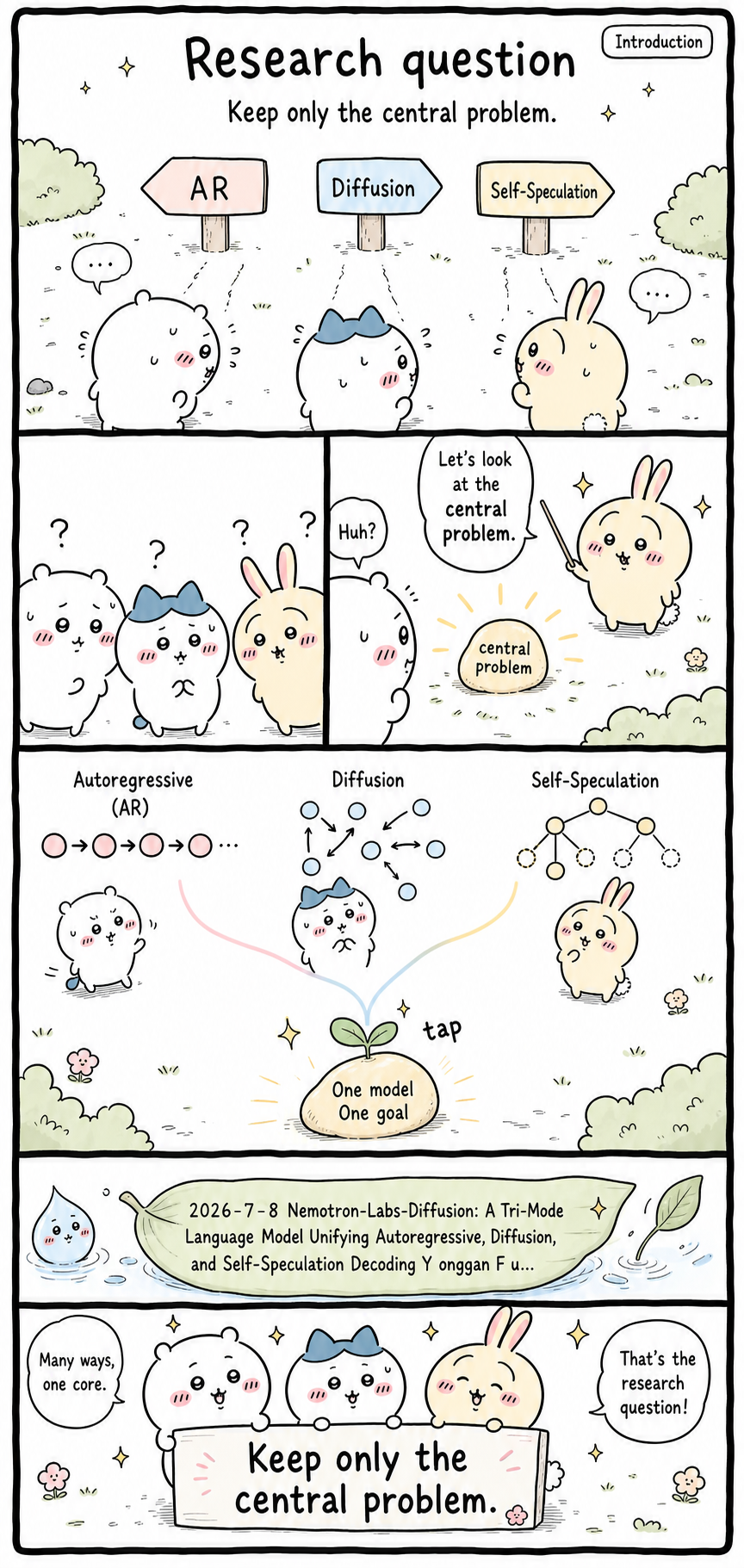
Nemotron-Labs-Diffusion is motivated by a central limitation of modern autoregressive language models: strict left-to-right token generation exposes little parallelism at inference time. The paper argues that this bottleneck becomes especially costly in low-batch or low-concurrency settings, where hardware can be under-utilized even when the model itself is strong. Diffusion language models offer a contrasting route by predicting multiple tokens per forward pass, but prior diffusion LMs often trail autoregressive models in accuracy and learning efficiency. The authors therefore frame the main research question as whether autoregressive and diffusion modeling should compete, or whether their strengths can be combined inside a single language model. Their answer is a tri-mode model that can run in AR mode, diffusion mode, or self-speculation mode without changing the underlying architecture.
Why old methods fall short
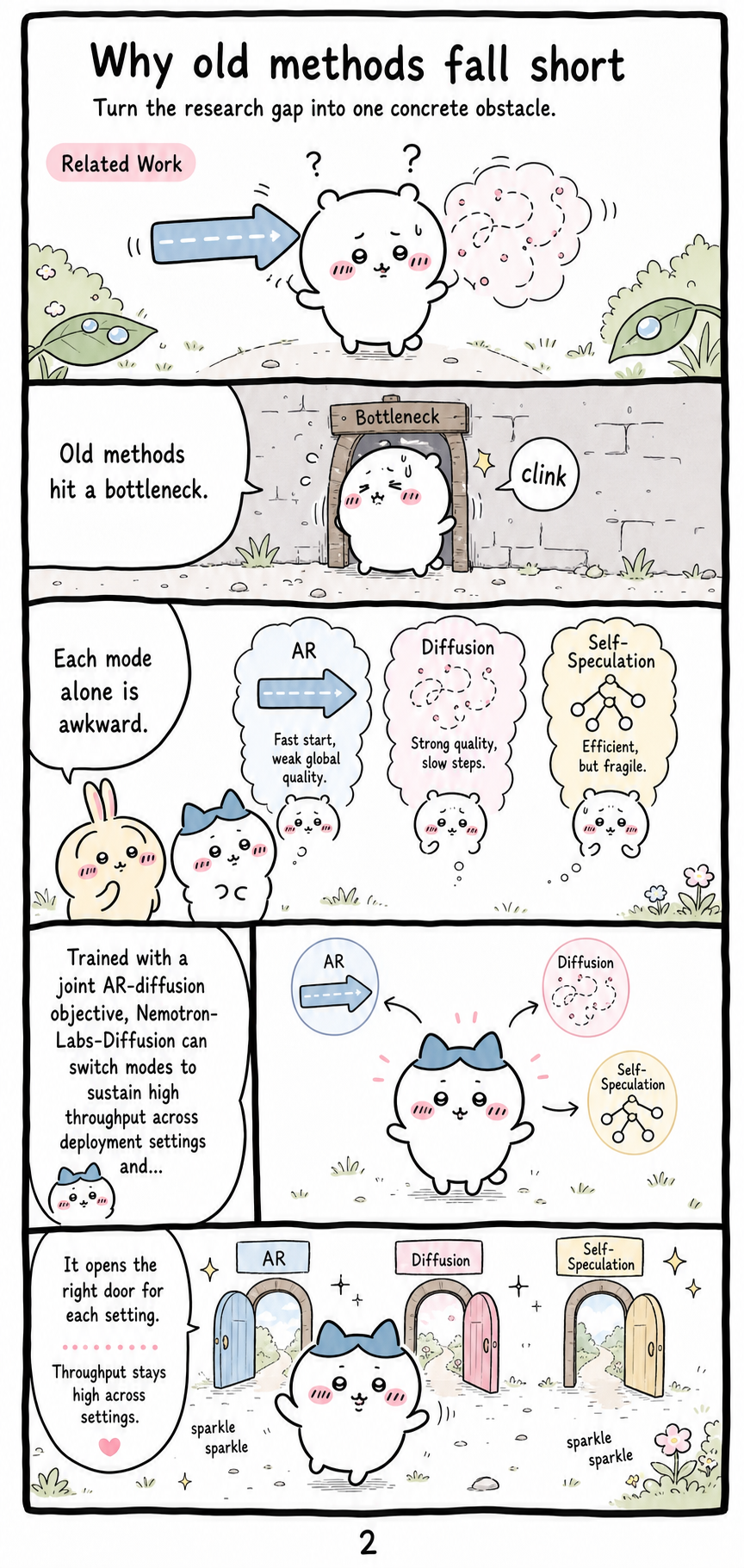
The paper identifies two obstacles that have limited earlier attempts to use diffusion for language modeling. First, diffusion objectives can waste capacity by treating token permutations more uniformly than natural language warrants, whereas language has a strong left-to-right prior that autoregressive training exploits well. Second, even when diffusion enables parallel generation in principle, existing systems have not consistently beaten multi-token prediction methods in practical accuracy–efficiency trade-offs. Nemotron-Labs-Diffusion addresses this gap by treating diffusion not as a replacement for autoregression, but as an additional supervision and decoding capability. The authors emphasize deployment diversity: high-concurrency cloud serving, low-concurrency personal inference, and future parallel decoding regimes impose different throughput constraints. A model that can switch among decoding modes is therefore positioned as a more useful systems primitive than a model optimized for only one generation strategy.
Core idea
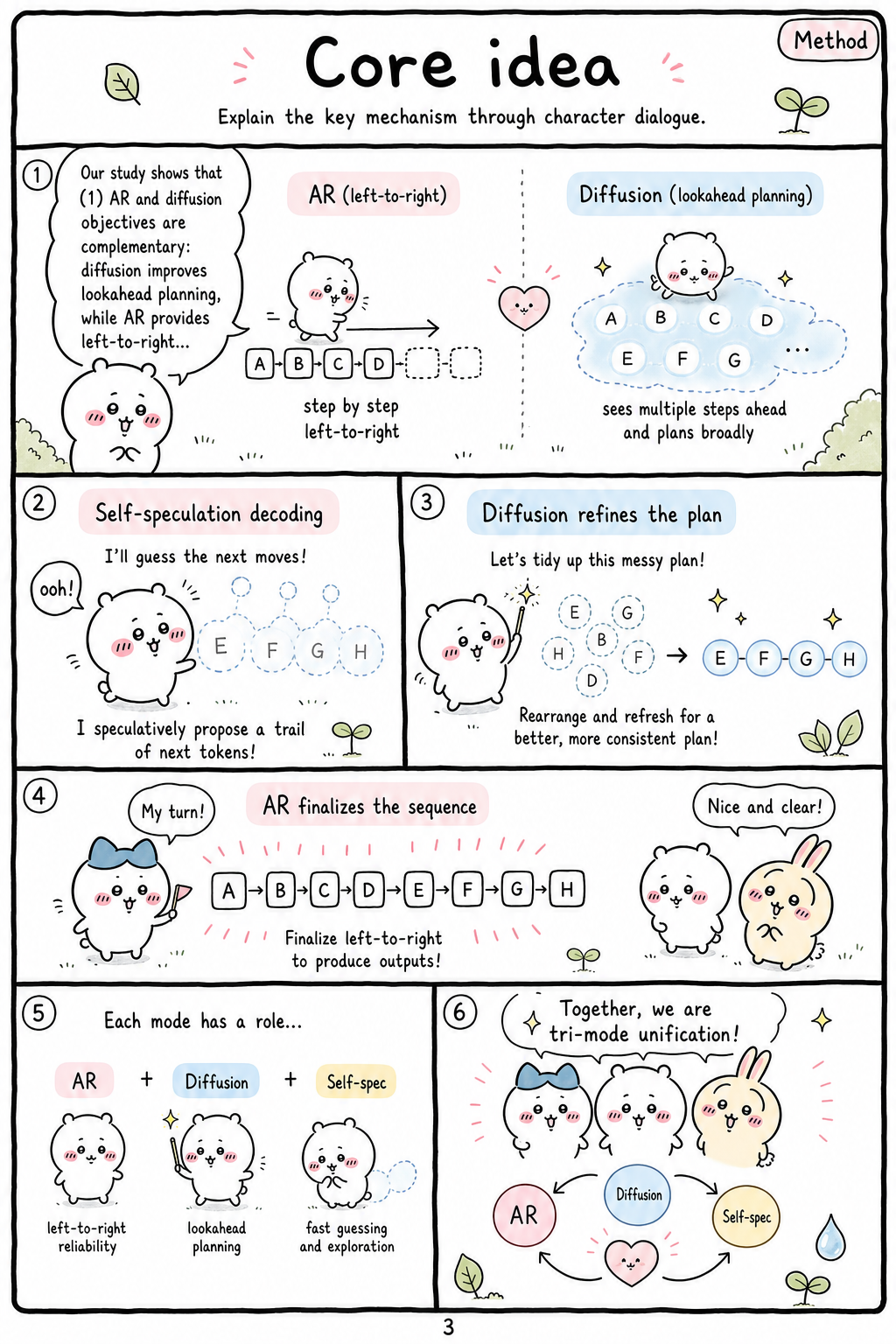
The core method is a joint training framework that combines an autoregressive next-token loss with a block-wise diffusion denoising loss. In the autoregressive objective, the model learns the standard left-to-right factorization, preserving linguistic priors and next-token accuracy. In the diffusion objective, a sequence is divided into contiguous blocks, tokens in the current block are corrupted, and the model learns to denoise that block while conditioning on the clean prefix. This design is bidirectional within a block to support parallel intra-block prediction, but causal across blocks so inference can still benefit from KV-cache reuse. The full objective is written as the AR loss plus a weighted diffusion loss, with the paper using a diffusion weight of 0.3 to balance loss magnitudes. Training is staged: the model first strengthens AR behavior, then activates the joint AR-diffusion objective so diffusion supervision complements rather than overwrites the left-to-right representation.
Evidence check
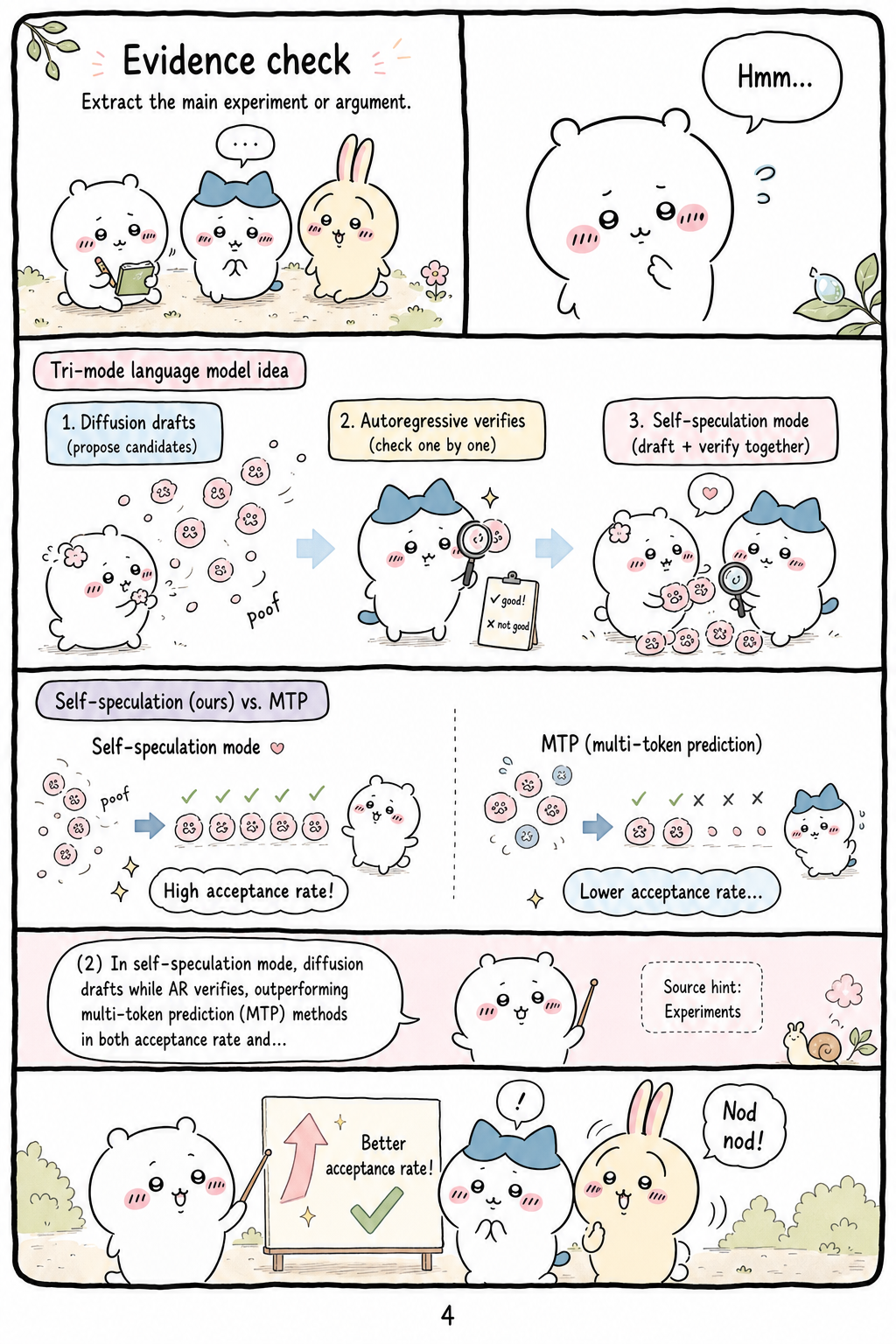
The empirical evidence combines ablations, benchmark comparisons, and serving measurements across the Nemotron-Labs-Diffusion family. The authors report models at 3B, 8B, and 14B parameters, including base, instruct, and vision-language variants, and compare them with open-source autoregressive and diffusion language models. Benchmarks named in the paper include HumanEval, MBPP, LiveCodeBench-CPP, GSM8K, Math500, AIME24, AIME25, GPQA, IFEval, and MMLU, covering coding, math, instruction-following, and general knowledge. For Nemotron-Labs-Diffusion-8B, the paper reports 6× more tokens per forward than Qwen3-8B while maintaining comparable accuracy, and a 4× throughput gain on SPEED-Bench using SGLang on an NVIDIA GB200 GPU. The ablation evidence also supports the training recipe: block-wise attention, global loss averaging, data-parallel-rank varying masking ratios, two-stage training, and the added AR loss each contribute to stronger results in the reported continuous pretraining study.
One thing to remember
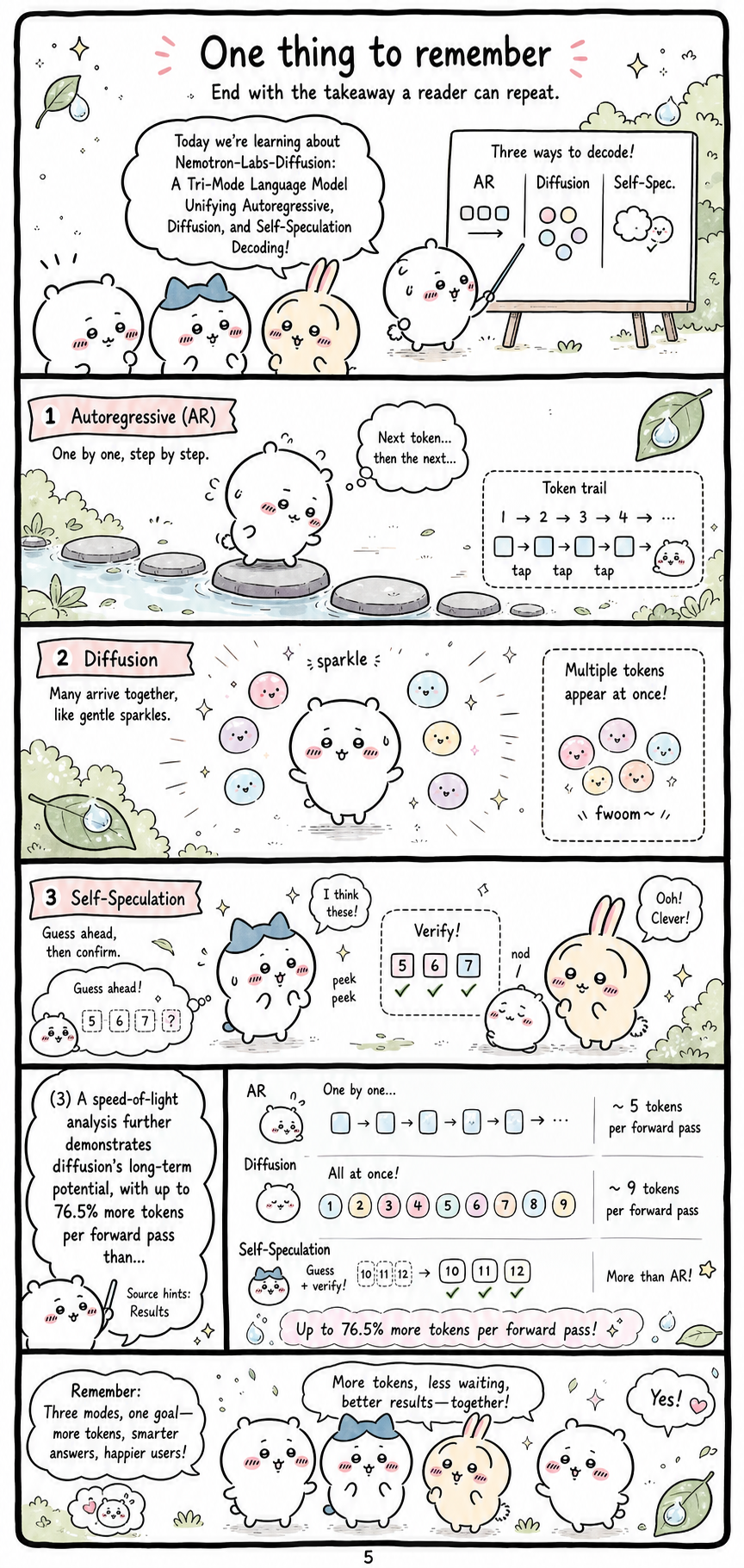
A major implication of the paper is that diffusion decoding may have more long-term headroom than current samplers can exploit. The authors’ speed-of-light analysis estimates an upper bound for diffusion decoding under an optimal sampler and finds that diffusion could correctly predict up to 76.5% more tokens per forward pass than self-speculation mode. At the same time, the paper notes that sampling tokens well enough to approach this bound remains an open challenge. This motivates the self-speculation mode: diffusion drafts candidate token blocks, while the same model’s AR mode verifies them, avoiding the separate auxiliary heads used in many multi-token prediction approaches. The broader takeaway is that AR priors, diffusion parallelism, and single-model verification can be harmonized into a practical tri-mode language model rather than treated as mutually exclusive design choices.