ReadPaper Blog
Language Models Need Sleep: Learning to Self-Modify and Consolidate Memories
The paper argues that large language models can use in-context information at prediction time but do not reliably turn that temporary knowledge into durable changes in their parameters. It proposes a biologically inspired “Sleep” paradigm in which models consolidate fragile short-term memories through Knowledge Seeding and then improve through a Dreaming process that uses reinforcement learning to generate synthetic rehearsal data. The result matters because it targets a central obstacle for continual LLM learning: adding new knowledge without leaving the model stale or damaging what it already knows.
Source: Language Models Need Sleep: Learning to Self-Modify and Consolidate Memories
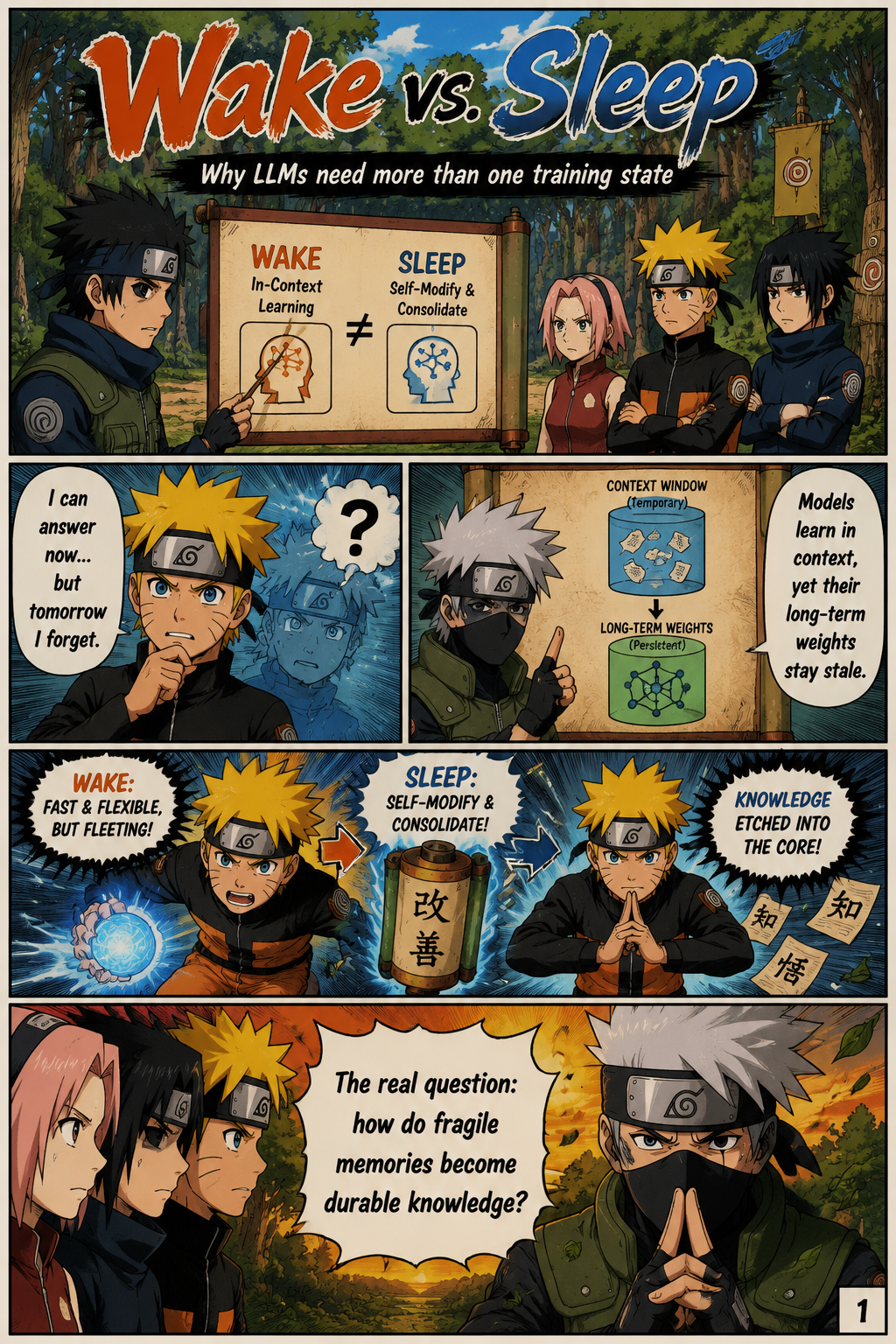
Wake vs. Sleep
The paper starts from the observation that large language models are strong at instant prediction and in-context learning, yet their long-term knowledge remains largely fixed after training. This creates a mismatch between temporary adaptation inside a context window and persistent learning in the model’s parameters. The authors frame this as a continual learning problem: a model may appear to learn from recent interaction, but that memory is fragile unless it can be consolidated. The proposed “Sleep” paradigm is motivated by the need to transfer temporal in-context knowledge into stable long-term knowledge. By asking how short-term memories become durable, the paper positions self-modification as a missing capability for deployed LLMs.
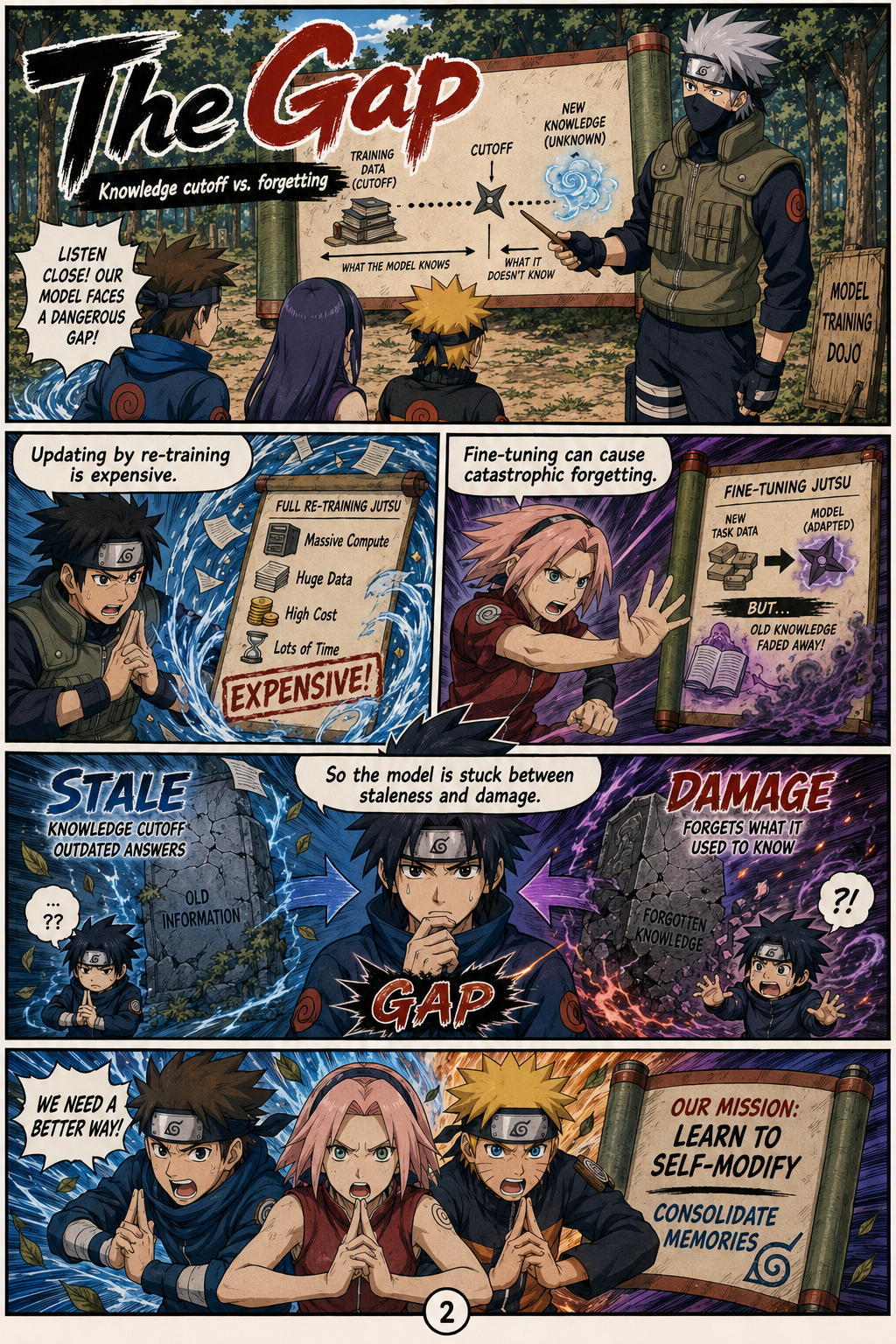
The Gap
The paper identifies an important dilemma for updating language models after deployment: leaving a model unchanged makes it stale, while updating it directly can be costly or harmful. Re-pretraining on expanded data is expensive, and continual fine-tuning can cause catastrophic forgetting that degrades performance on earlier tasks. This makes ordinary parameter updating an imperfect solution for lifelong learning in LLMs. The authors therefore treat memory consolidation as more than simple retraining; it must preserve prior knowledge while incorporating new information. The motivation for Sleep is to avoid forcing models to choose between knowledge cutoff limitations and destructive adaptation.
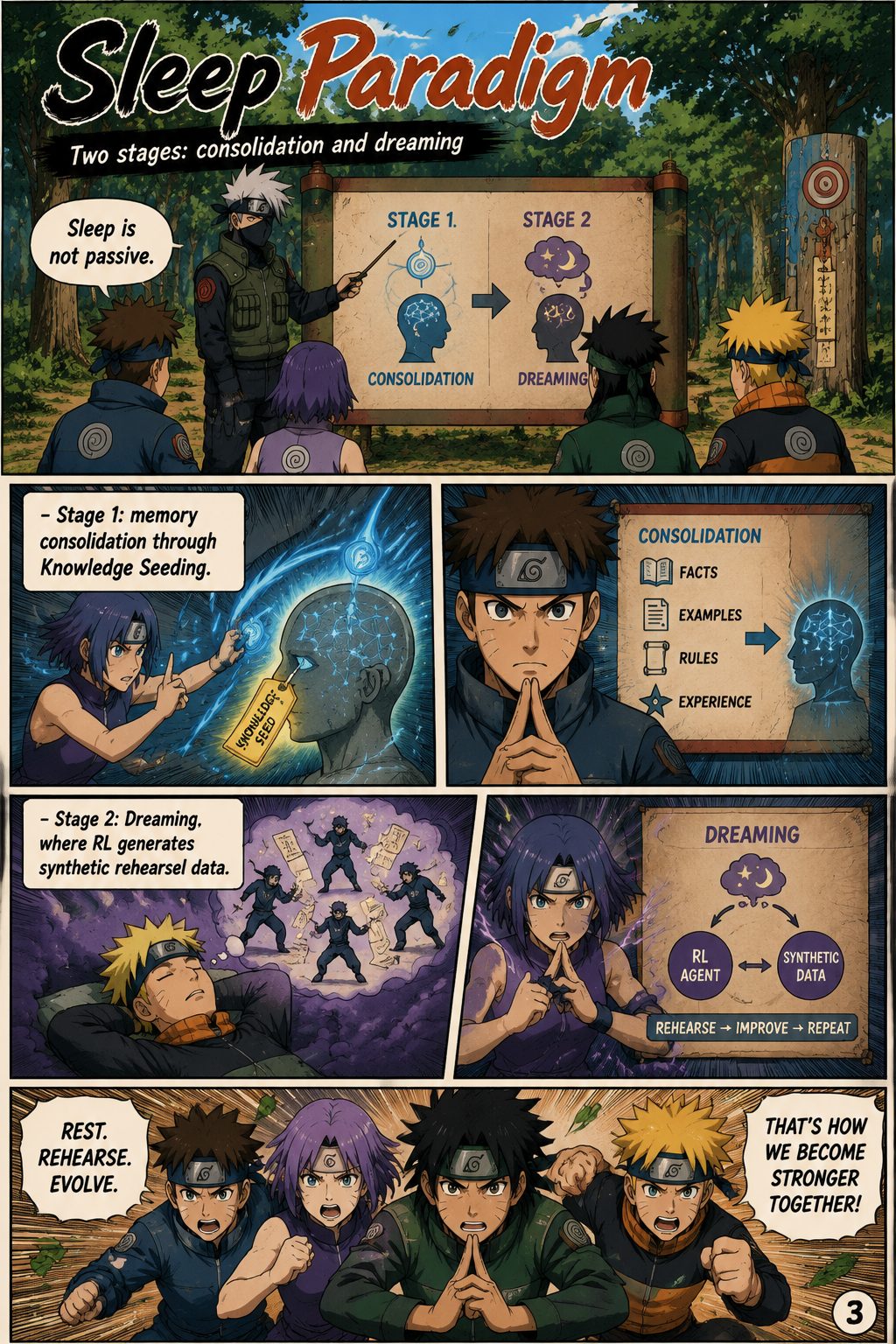
Sleep Paradigm
The core method in the paper is a two-stage Sleep paradigm designed to make continual learning more stable. The first stage is Memory Consolidation through Knowledge Seeding, described as upward distillation from a smaller-self into a larger network. This stage aims to move fragile, recent knowledge into more durable long-term parameters rather than leaving it only in context. The second stage is Dreaming, a self-improvement process in which reinforcement learning generates a curriculum of synthetic rehearsal data. Through this generated rehearsal, the model can revisit new knowledge and refine capabilities without relying solely on additional human-provided data.
Why Sleep Helps
The paper’s analogy to human learning is used to justify why offline consolidation should matter for language models. Human memory formation is described as involving both rapid online consolidation and offline consolidation during sleep or quiet rest, where replay helps stabilize and reorganize recent experience. The authors borrow this logic for LLMs by treating replay and distillation as mechanisms for converting recent patterns into stronger long-term knowledge. This framing distinguishes Sleep from approaches that focus only on online adaptation at the moment new information arrives. The implication is that an LLM learning system may need an offline phase that deliberately rehearses, reorganizes, and stabilizes knowledge before it becomes reliable.

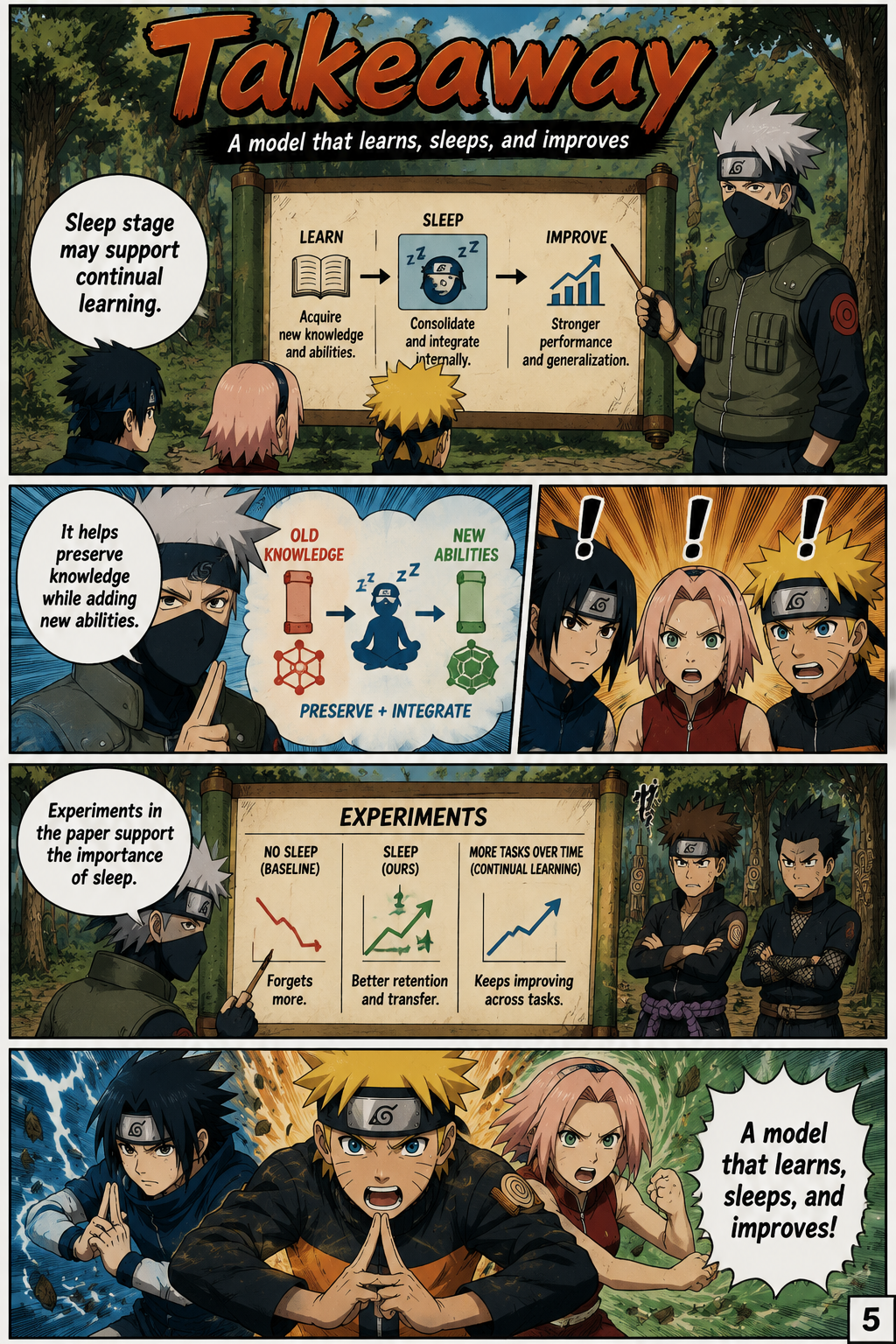
Takeaway
The paper reports experiments in the areas of long-horizon continual learning, knowledge incorporation, and few-shot generalization to evaluate the importance of the Sleep stage. These experiments are presented as evidence that consolidation and Dreaming can support models that continue learning rather than merely responding with temporary in-context behavior. The results section, as summarized by the paper, supports the claim that Sleep helps preserve knowledge while adding new capabilities. The broader implication is that LLMs may become more adaptive if they can self-modify through structured consolidation rather than ad hoc fine-tuning. The paper concludes that learning, sleeping, and recursively improving form a promising direction for models that must remain useful as information and tasks change over time.