ReadPaper Blog
Infinite Worlds with Versatile Interactions
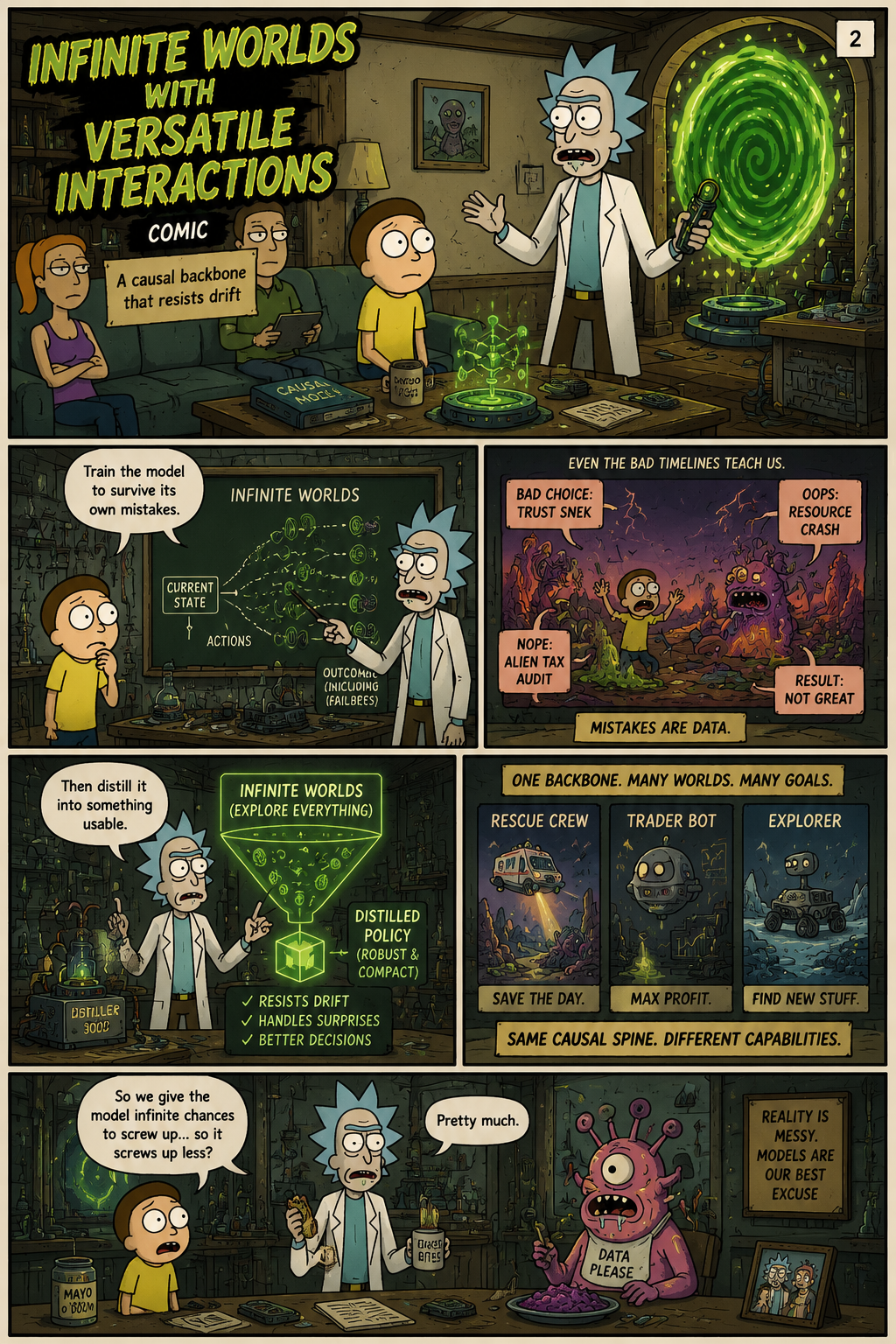
The paper introduces LingBot-World 2.0, also called LingBot-World-Infinity, an interactive causal world model designed to generate open-ended video environments that remain stable over long horizons. It addresses two core barriers in prior systems—error accumulation during frame-by-frame generation and the difficulty of real-time high-fidelity interactivity—by combining a drift-resistant causal backbone, a distilled real-time model, a richer action space, and an agentic harness.
Source: Infinite Worlds with Versatile Interactions
Open the World
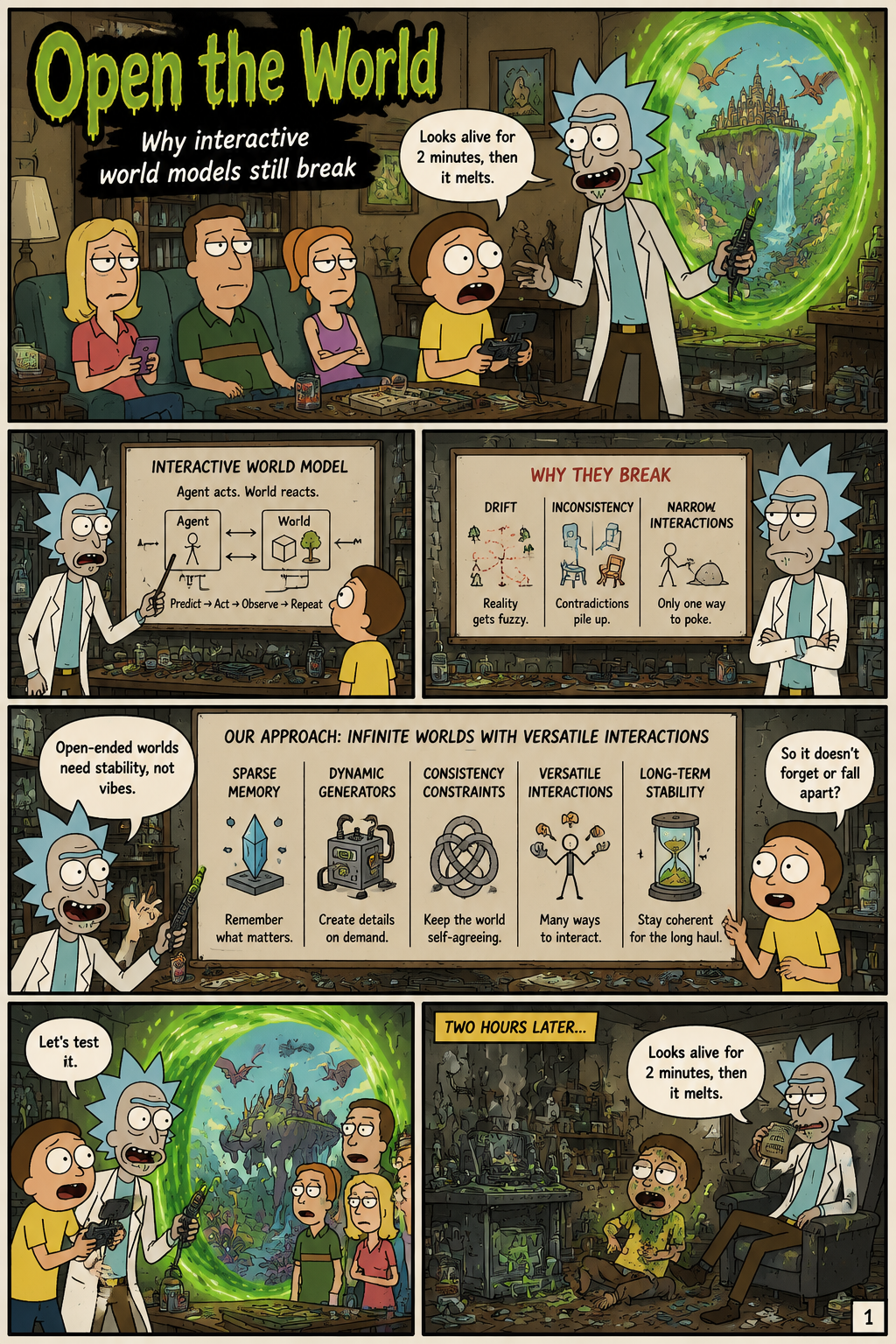
The paper frames interactive world modeling as a promising route toward generated games and embodied simulation, but argues that current systems fail when they must persist over time. Because causal video generators condition each new frame on previously generated frames, small visual errors can feed back into later predictions and gradually produce smeared textures, warped geometry, and implausible scene drift. The authors identify long-horizon stability as a central missing capability for worlds that are meant to be explored rather than merely previewed. They also emphasize that interactivity at high visual fidelity remains expensive, since responsive control, detailed rendering, and smooth video all compete for computation. LingBot-World 2.0 is positioned as a direct response to these limits, aiming for worlds that can continue indefinitely while reacting meaningfully to actions.
What They Built
The paper’s main technical starting point is a causal video generation backbone trained to resist the error accumulation that typically undermines autoregressive world models. Instead of treating short clips as sufficient evidence of quality, the authors make durability a defining criterion for the model, so the generated environment remains coherent as its own outputs become future inputs. This backbone also serves as a teacher for distillation, allowing the system to transfer stability into a more practical student model. The paper presents this teacher-student structure as the bridge between a capable research model and an interactive system that can be deployed under real-time constraints. By pairing a primary 14B model with a lightweight 1.3B counterpart, the work aims to make persistent world generation both high-quality and accessible on more modest hardware.
Fast Enough to Play
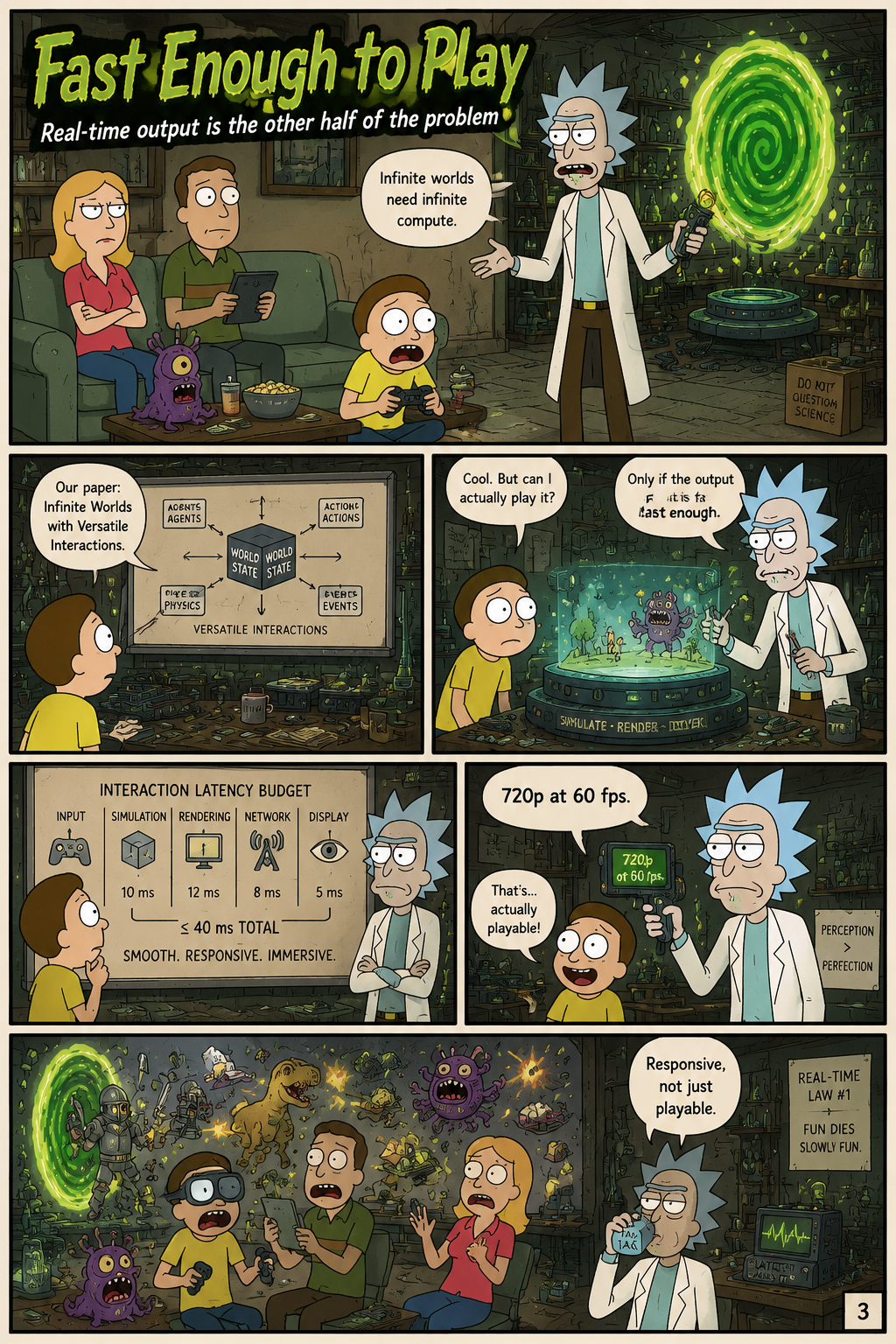
Real-time performance is treated as essential rather than incidental, because an interactive world model must respond quickly enough for continuous control to feel usable. The paper reports that the distilled variant can drive 720p video streams at 60 frames per second, which directly targets the resolution and latency expectations of live interactive environments. The authors connect this speed to the distillation process, where the base model’s stability becomes a foundation for a faster model rather than being discarded in pursuit of efficiency. They also cite an hour-long uninterrupted generation session without visible quality decay as evidence that the system’s robustness is not limited to short demonstrations. The implication is that a world model can be evaluated not only by per-frame visual quality, but also by whether it can sustain coherent generation at playable temporal scales.
More Than Walking Around
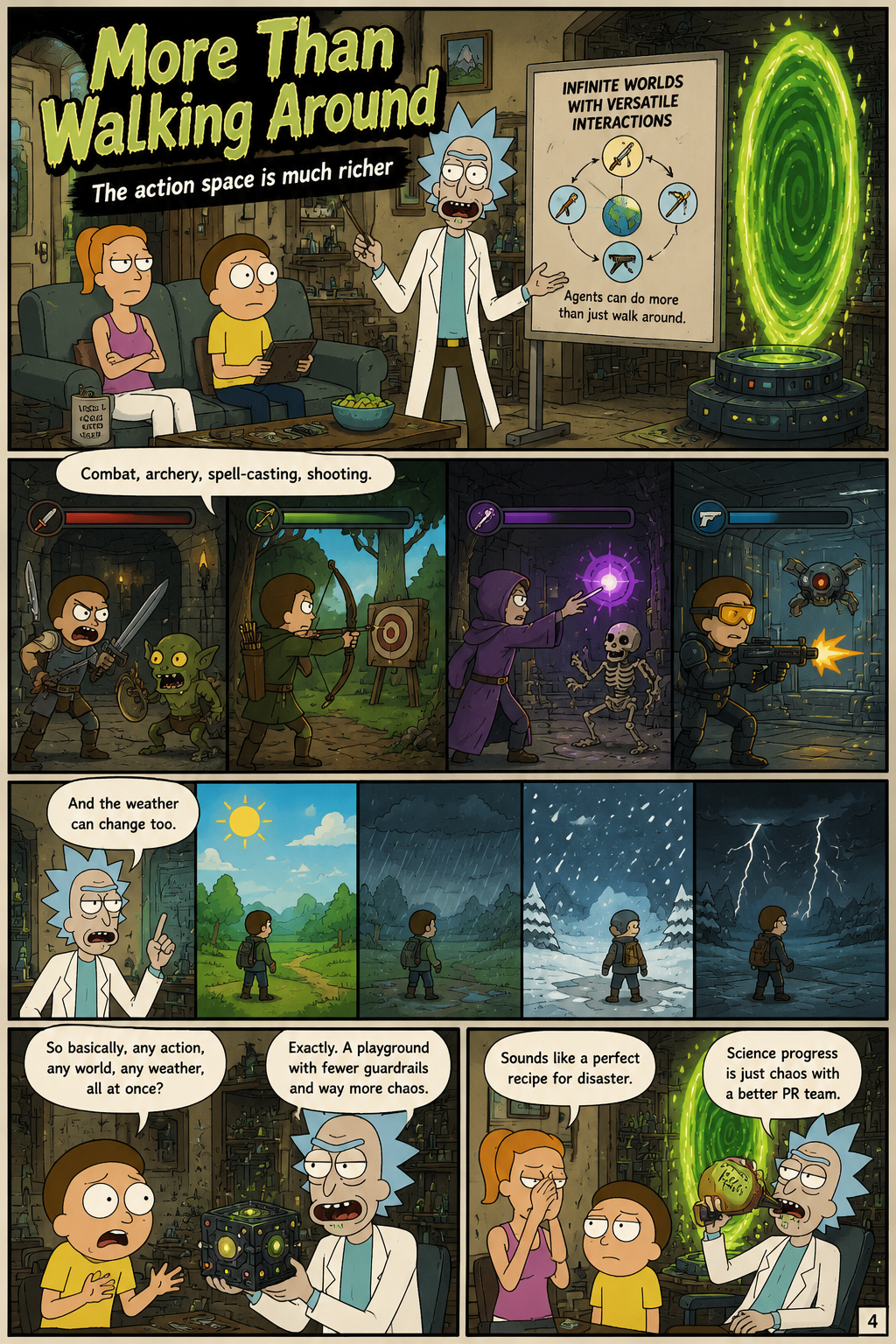
The paper expands the definition of interaction beyond navigation through a static generated scene. LingBot-World 2.0 introduces a broader action space that includes attacking, archery, spell-casting, and shooting, giving the model a richer set of causes to which future frames must respond. The authors also describe text-driven events that can alter the environment on demand, including weather changes such as snow or rain. This matters because world models intended for games or embodied simulation must represent consequences, not just scenery, and must maintain coherence while actions perturb the visual state. By combining character actions with environmental transformations, the paper argues for a more versatile simulator in which generated worlds are shaped by ongoing input rather than passively traversed.
Two Agents, One World
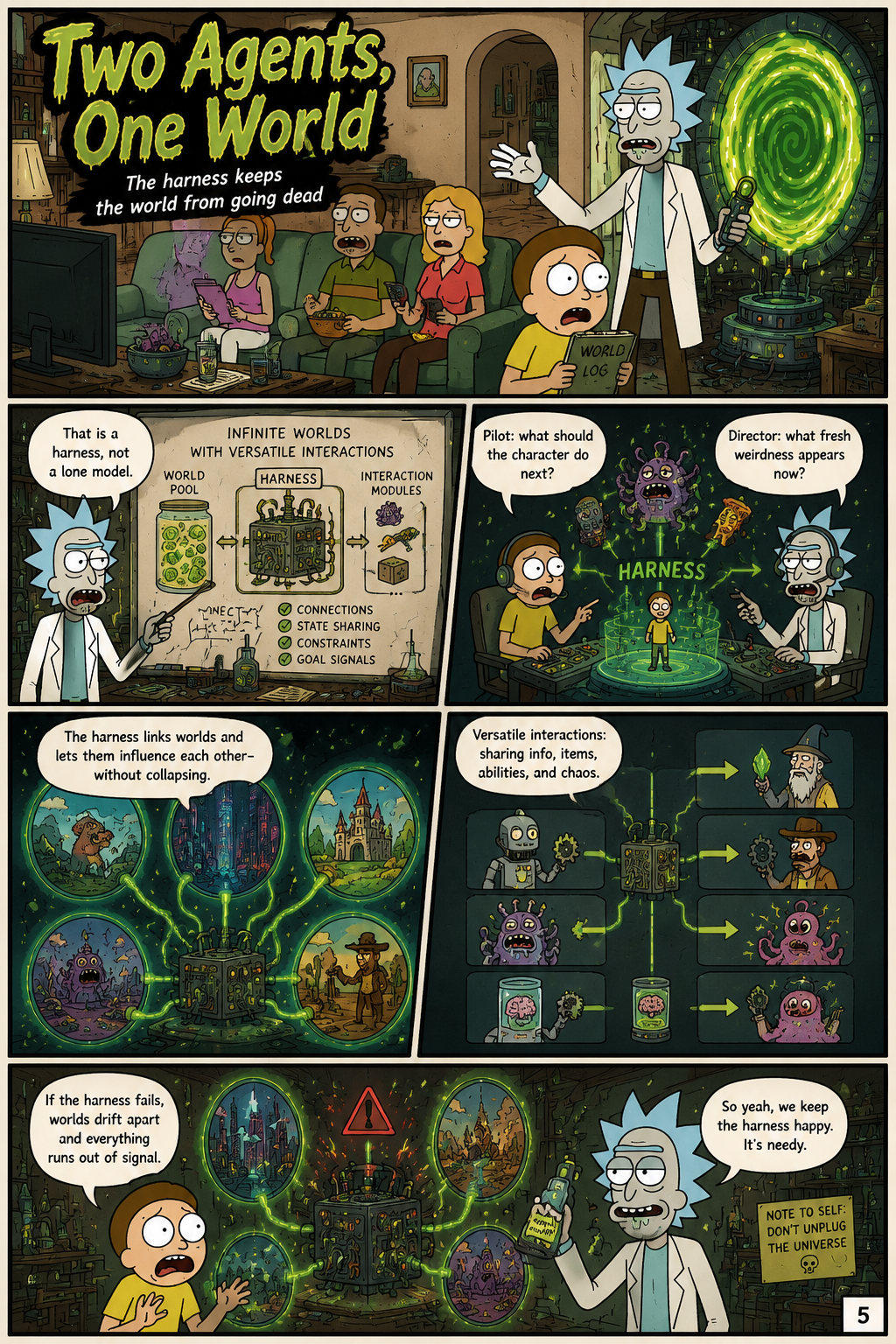
A distinctive contribution of the paper is its agentic harness, which surrounds the generative world model with planning and content-generation roles. The pilot agent reads the current scene and decides what the controllable character should do next, such as moving, attacking, or interacting with nearby objects. The director agent is responsible for keeping the environment from becoming empty or repetitive by synthesizing new elements, props, and events as exploration proceeds. The paper explicitly compares this scaffolded setup to the way language models become more useful when placed inside systems that let them inspect state, act, and pursue goals across multiple steps. This architecture reframes LingBot-World 2.0 as more than a frame predictor: it becomes a self-sustaining interactive environment with open-ended behavior, shared multi-player access, and fewer requirements for manually scripted moments.