ReadPaper Blog
Flow-ERD: Agent-Type Aware Flow Matching with Entropy-Regularized Distillation for Diverse Traffic Simulation
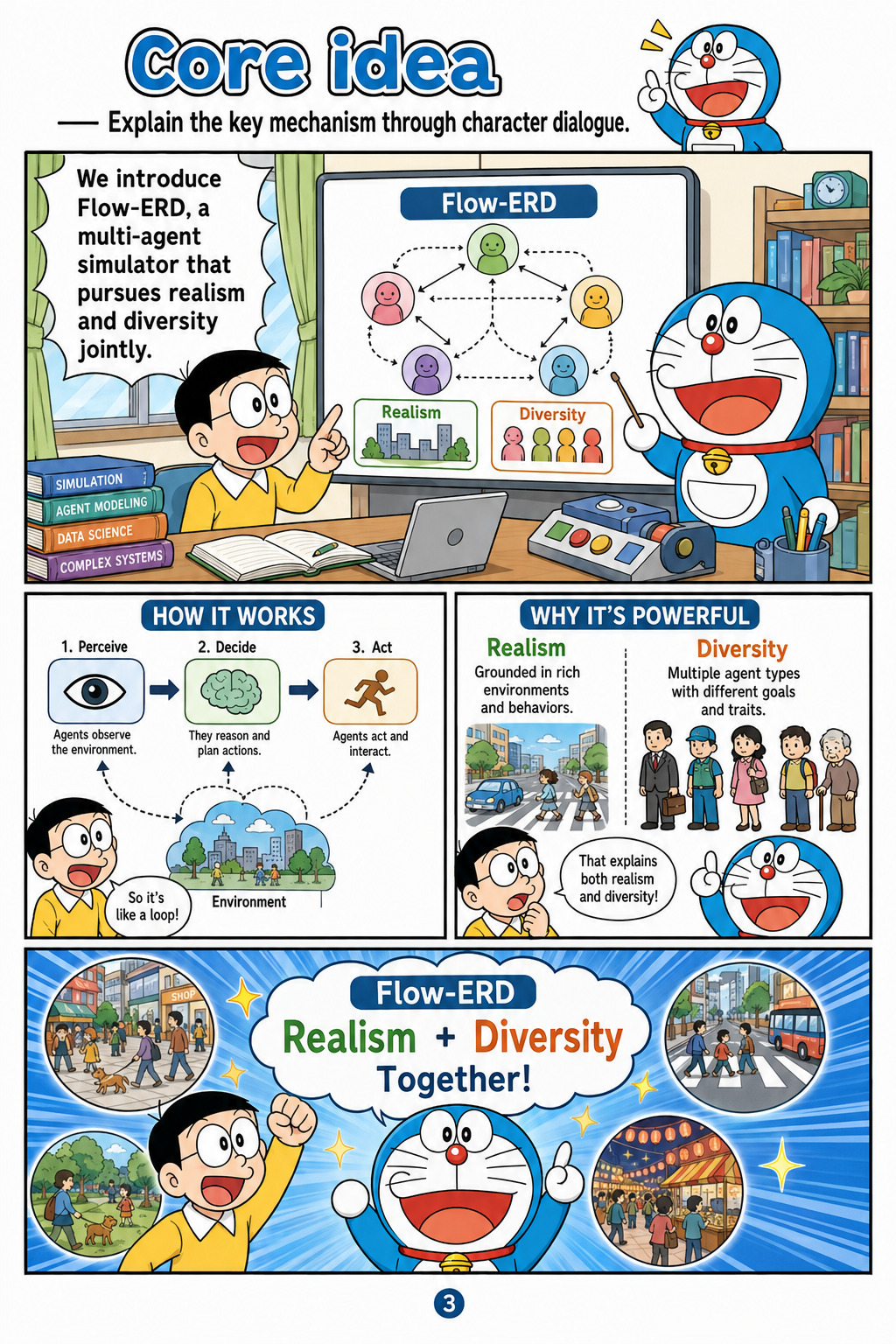
The paper introduces Flow-ERD, a multi-agent traffic simulator for autonomous-driving research that aims to make closed-loop rollouts both realistic and diverse. It addresses the tendency of existing benchmarks and methods to optimize mainly for realism by combining Agent-Type Aware Flow Matching with Entropy-Regularized Distillation, and reports state-of-the-art performance on the WOSAC benchmark while improving the realism–diversity trade-off.
Source: (none provided)
Research question
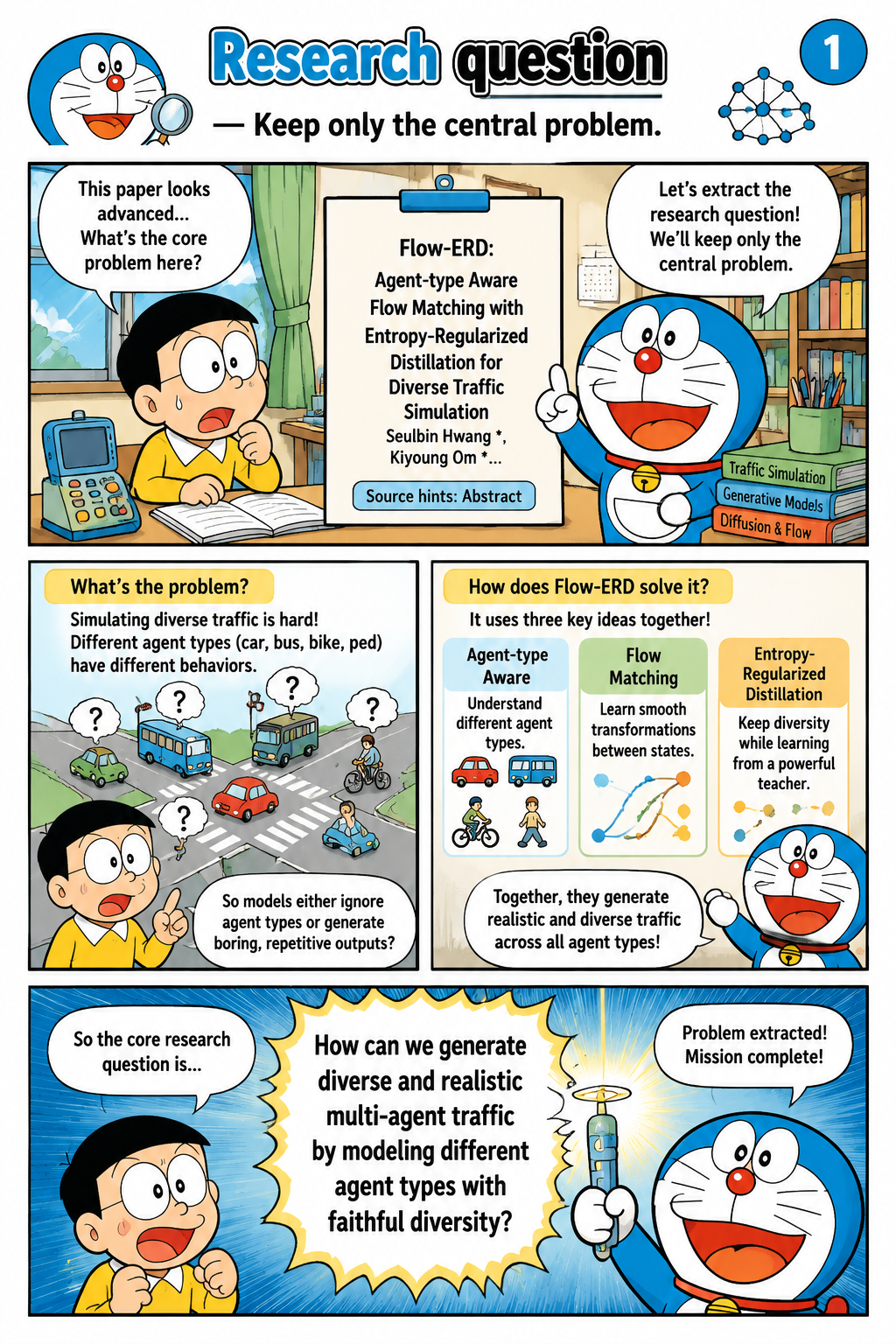
Flow-ERD studies a central problem in autonomous-driving simulation: how to generate traffic agents that behave realistically while still covering many plausible futures of the same scene. The paper argues that simulation is useful for validation and policy development only if surrounding vehicles, cyclists, and pedestrians react in a closed loop and do not collapse to a single logged trajectory. Its proposed simulator models a scenario with a road map, multiple typed agents, historical scene context, and a rollout horizon in which each generated state becomes the condition for the next prediction. The key contribution is a two-stage design in which Agent-Type Aware Flow Matching provides expressive continuous action generation, while Entropy-Regularized Distillation fine-tunes the resulting closed-loop rollout distribution. The paper’s motivation is therefore not merely higher benchmark realism, but a simulator that can expose an autonomous-vehicle policy to varied yet physically plausible traffic behavior.
Why old methods fall short
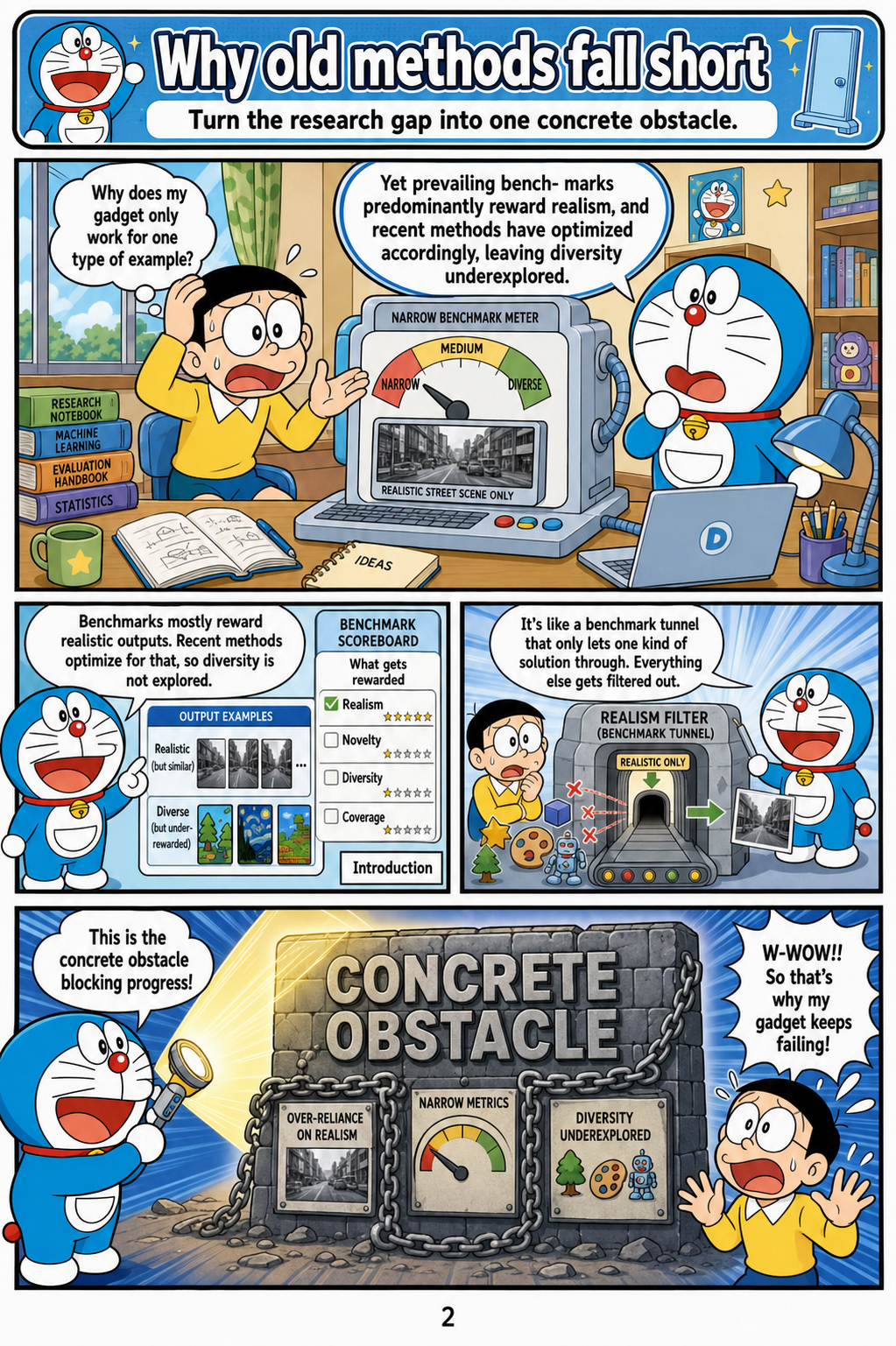
The paper identifies a mismatch between what traffic simulation needs and what many evaluation pipelines reward. Benchmarks such as the Waymo Open Sim Agents Challenge use a realism meta metric that compares rollouts against a single logged future, so a model can score well by concentrating around the recorded behavior rather than representing multiple plausible alternatives. Existing next-token-prediction simulators benefit from discrete, data-derived action vocabularies that encode realistic and type-compatible motion, but those same vocabularies limit fine-grained diversity because unseen motions must be approximated by available tokens. Continuous and diffusion-family methods remove this fixed-vocabulary bottleneck, yet the paper notes that unconstrained continuous outputs can produce type-incompatible motion, such as invalid lateral slip for wheeled agents. The paper also emphasizes closed-loop covariate shift: behavior cloning is trained under teacher forcing on logged histories, but deployment conditions on the model’s own generated states, allowing small errors to compound over the rollout.
Core idea
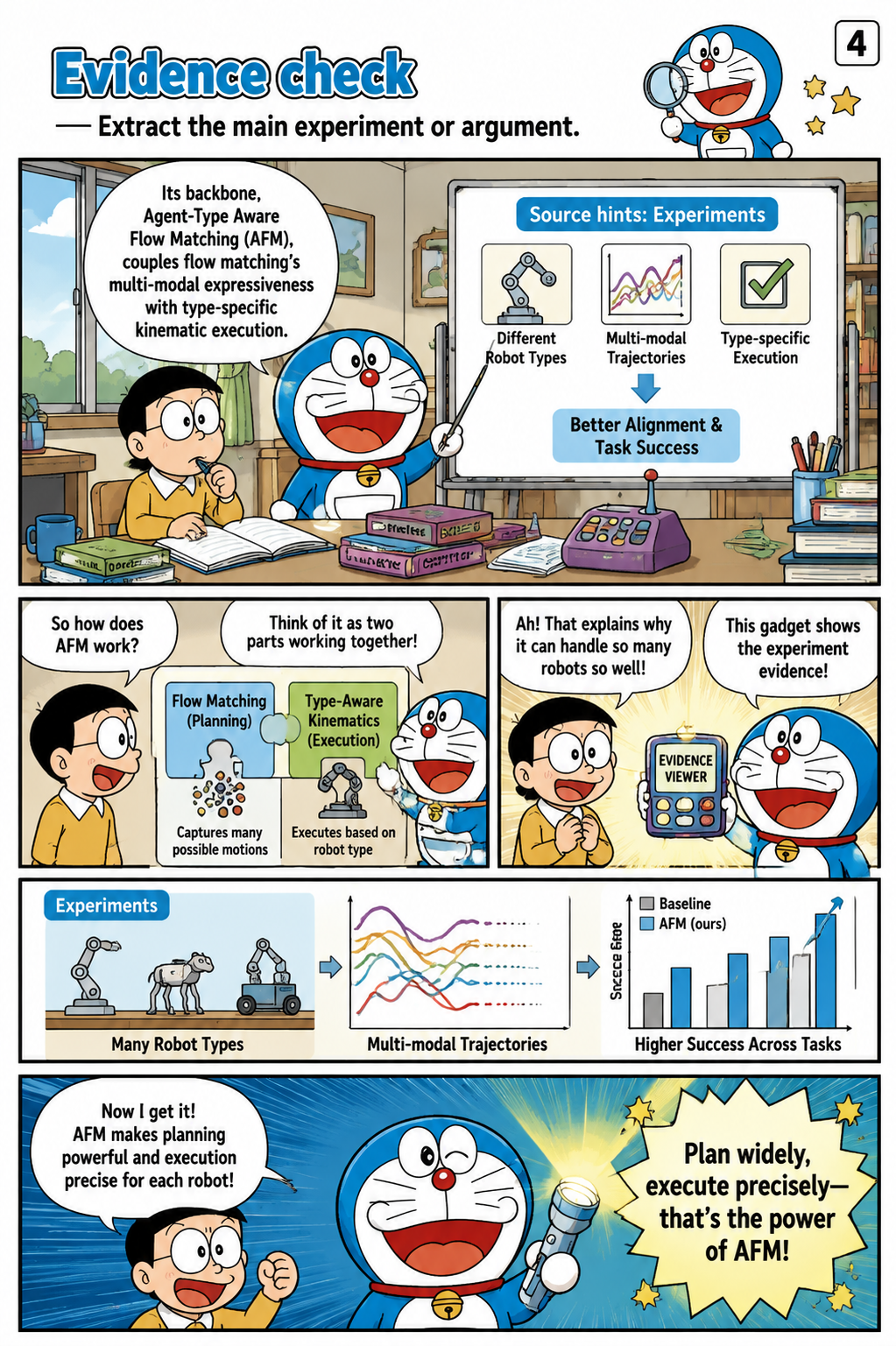
Flow-ERD’s core mechanism is Agent-Type Aware Flow Matching, a backbone that keeps the multimodal advantages of flow matching while grounding generated actions in agent-specific kinematics. The flow-matching component learns a velocity field along an affine optimal-transport path from Gaussian noise to data, enabling continuous sampling without a fixed number of tokens, anchors, or mixture components. Instead of directly trusting arbitrary continuous state changes, the method samples kinematic actions and executes them through transitions matched to agent type. Pedestrians are modeled with holonomic planar motion using longitudinal and lateral displacement, whereas vehicles and cyclists use bicycle-style non-holonomic motion that suppresses independent lateral displacement and accounts for heading change through a no-slip offset. This design lets the model represent fine-grained multimodal futures while preserving the motion constraints that make traffic rollouts plausible for each class of participant.
Evidence check
The second stage, Entropy-Regularized Distillation, addresses the paper’s training-side concern that open-loop behavior cloning does not guarantee stable closed-loop simulation. The paper frames closed-loop alignment as matching the model-induced rollout distribution to the data distribution, but notes that a plain reverse-KL objective is mode-seeking and can concentrate probability on only a few high-density behaviors. ERD therefore adds entropy regularization to the reverse-KL fine-tuning objective, encouraging rollouts that move toward realistic data-supported regions without collapsing the simulator’s multimodal distribution. For evaluation, the paper uses the standard WOSAC Realism Meta Metric alongside Cross-Pair Diversity, a log-free metric designed to measure the spread among multiple sampled rollouts rather than distance to a single logged future. This experimental setup directly tests the paper’s main claim that realism and diversity should be evaluated jointly rather than treated as separate or implicitly traded-off properties.
One thing to remember
The paper reports that Flow-ERD ranks first on the WOSAC test benchmark and that its AFM backbone achieves a state-of-the-art kinematic score, supporting the claim that type-aware execution improves realism rather than merely adding sampling variability. On the validation split, the paper states that AFM and Flow-ERD obtain the highest rollout diversity among reproducible baselines and dominate the realism–diversity Pareto front. The implication is that diversity in traffic simulation should not be left to temperature tuning, qualitative inspection, or a discrete token vocabulary with bounded coverage. By combining continuous flow-based generation, type-specific kinematic transitions, and entropy-regularized closed-loop distillation, the paper presents a simulator architecture aimed at maintaining plausible vehicle, cyclist, and pedestrian behavior across many possible futures. The main takeaway is that realistic autonomous-driving simulation requires distributional coverage as well as accuracy against logs, and Flow-ERD offers a concrete method and metric framework for pursuing both.