ReadPaper Blog
Flow-DPPO: Divergence Proximal Policy Optimization for Flow Matching Models
Flow-DPPO addresses a trust-region problem in reinforcement learning fine-tuning for flow matching image and video generators: PPO-style ratio clipping relies on noisy single-sample probability ratios that poorly approximate true policy divergence in high-dimensional continuous latents. The paper proposes replacing ratio clipping with an exact KL-divergence proximal constraint made possible by the Gaussian per-step policies induced by Flow-SDE and CPS samplers, improving reward optimization while better preserving the pretrained model.
Source: Flow-DPPO: Divergence Proximal Policy Optimization for Flow Matching Models
The Trust-Region Trouble
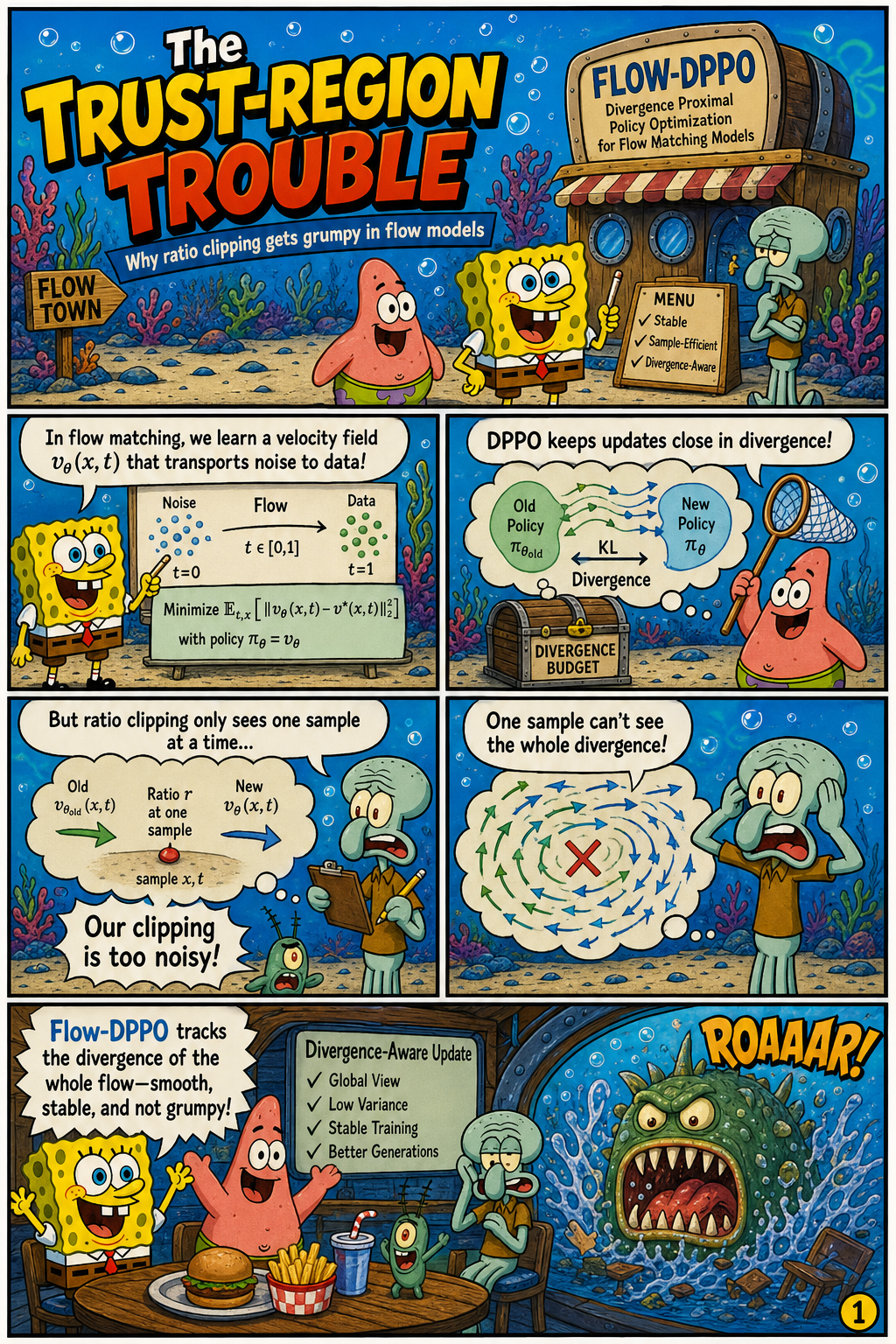
The paper argues that recent RL fine-tuning methods for flow matching models, including Flow-GRPO and CPS-based variants, inherit a problematic approximation from PPO: they use per-sample importance-ratio clipping as a stand-in for a trust-region divergence constraint. In flow models, the denoising or sampling trajectory is cast as a finite-horizon Markov Decision Process, where each action is the next latent sample and the reward arrives after generation. The authors claim that a single sampled probability ratio is a noisy Monte Carlo proxy for the true divergence between the old and new policies, and that this noise is amplified in continuous, high-dimensional latent spaces. This can over-constrain some parts of the trajectory while under-constraining others, weakening the intended policy-improvement guarantee. The paper further notes an intrinsic bias in Gaussian-policy ratios: the ratio distribution can shift left, making the usual PPO clipping interval effectively asymmetric in an undesirable way. This motivates a trust-region mechanism that controls the actual divergence rather than a noisy scalar sample from it.
The Hidden Advantage of Flow Models
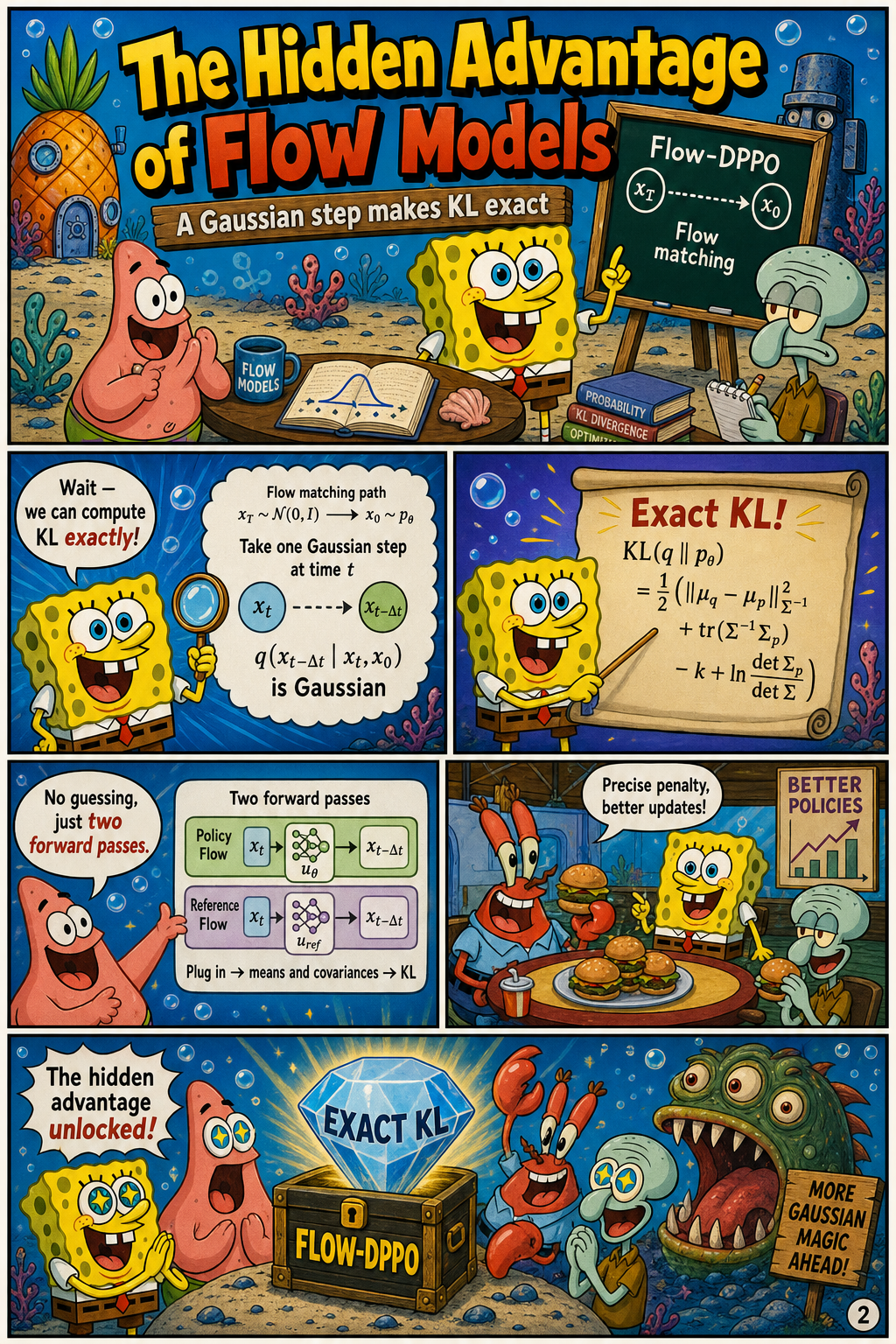
The key structural observation in Flow-DPPO is that flow matching samplers induce Gaussian per-step policies, making the relevant KL divergence exact and cheap to compute. The paper describes Flow-SDE and Coefficients-Preserving Sampling as stochastic versions of the otherwise deterministic flow sampling process, both expressible as Gaussian policies over the next latent state with mean μθ and schedule-dependent variance σ²(t). Because the old and new per-step policies share this Gaussian form, their KL divergence reduces to a closed-form squared distance between their means, scaled by the variance. The authors emphasize that this computation requires only the old and new policy means, which are already obtained through forward passes during training. This differs from language-model DPPO settings, where divergence over large vocabularies may require approximation. For flow models, the paper’s central claim is that the exact KL can replace the noisy ratio as the proximal signal without adding meaningful computational burden.
Flow-DPPO's Core Trick
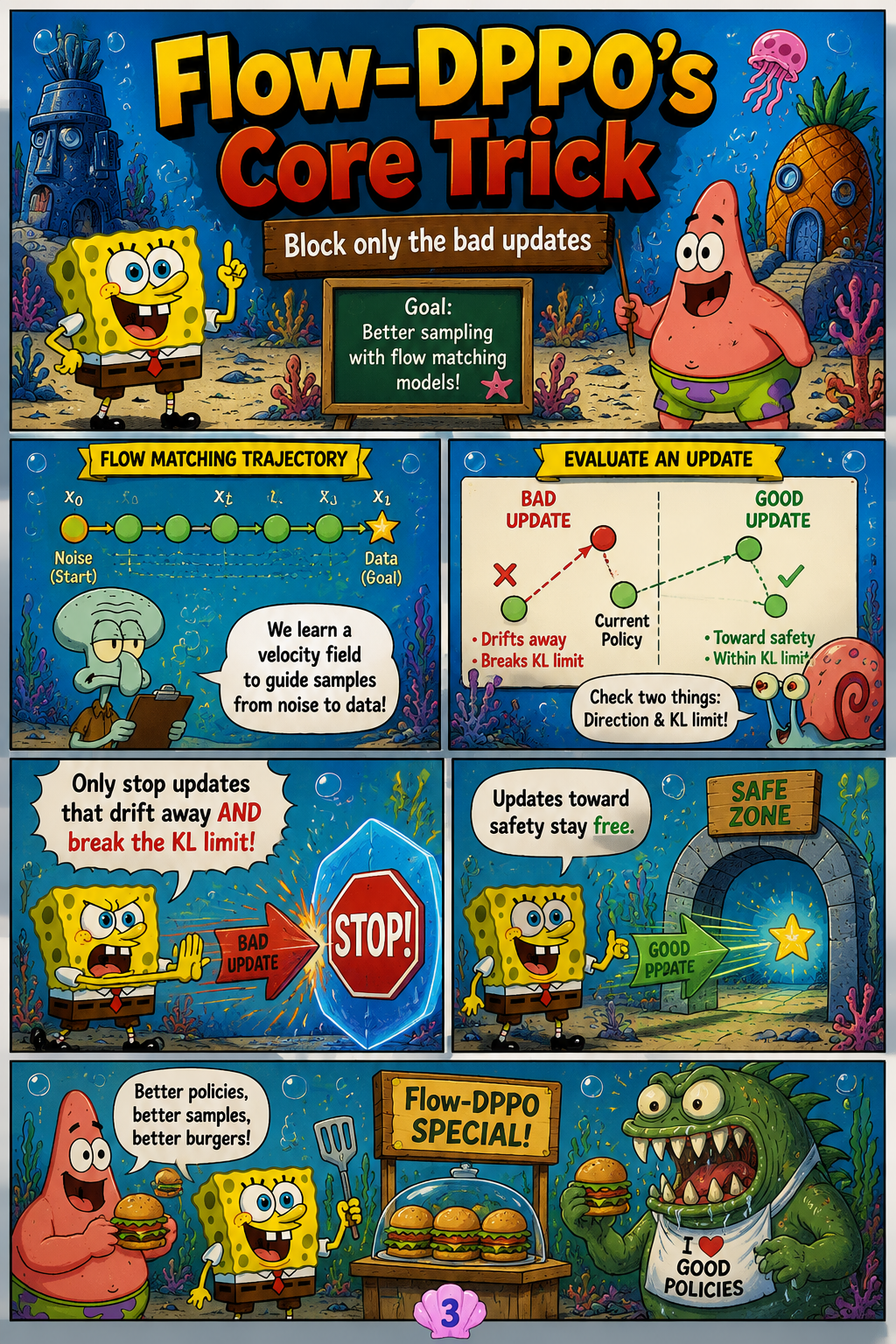
Flow-DPPO replaces PPO-style ratio clipping with an asymmetric divergence mask designed to enforce a direct KL trust region while preserving useful policy movement. The method blocks a gradient update only when two conditions hold at once: the update is moving the policy away from the old policy in the direction indicated by the advantage and ratio, and the exact KL divergence has exceeded a chosen threshold. Updates that move the policy back toward the old policy are not blocked, even if the current divergence is large, because they help recover from overshooting rather than worsen it. This design is grounded in the paper’s adaptation of trust-region policy optimization to the finite-horizon flow-model MDP, where terminal rewards define trajectory-level advantages. The resulting objective aims to keep the practical benefits of PPO’s asymmetric surrogate while replacing its noisy clipping trigger with a deterministic divergence test. In the authors’ framing, Flow-DPPO is therefore a divergence-proximal policy optimization algorithm tailored to the Gaussian policy structure of flow matching models.
What the Experiments Say
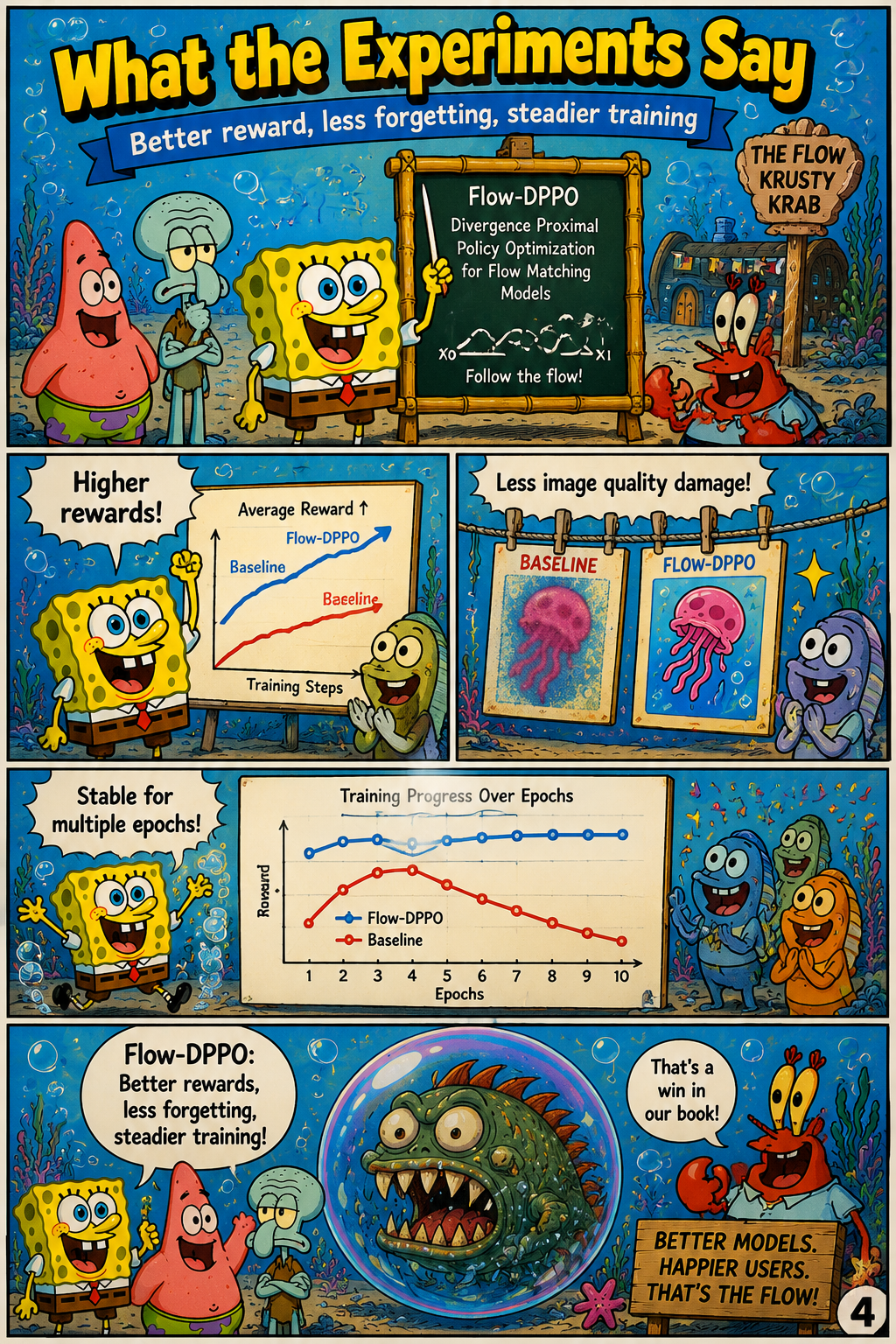
The experiments reported in the paper evaluate whether exact divergence control improves RL alignment of flow matching generators compared with ratio-clipping approaches such as Flow-GRPO, Flow-CPS, and GRPO-Guard. The abstract and introduction report that Flow-DPPO achieves higher rewards with better KL-proximal efficiency, meaning it obtains more reward improvement for a given amount of policy drift from the trusted model. The paper also claims that the method alleviates catastrophic forgetting, a central concern when reward optimization damages capabilities learned during pretraining. In qualitative comparisons using FLUX.1-dev with GenEval prompts, the authors state that Flow-DPPO maintains competitive compositional accuracy while producing less image-quality degradation than the compared methods. The reported results also emphasize more balanced multi-objective optimization, suggesting that direct KL control can reduce reward hacking when multiple goals compete. A further practical finding is that Flow-DPPO remains stable under multi-epoch training, whereas ratio clipping can degrade as policy staleness accumulates across repeated updates.
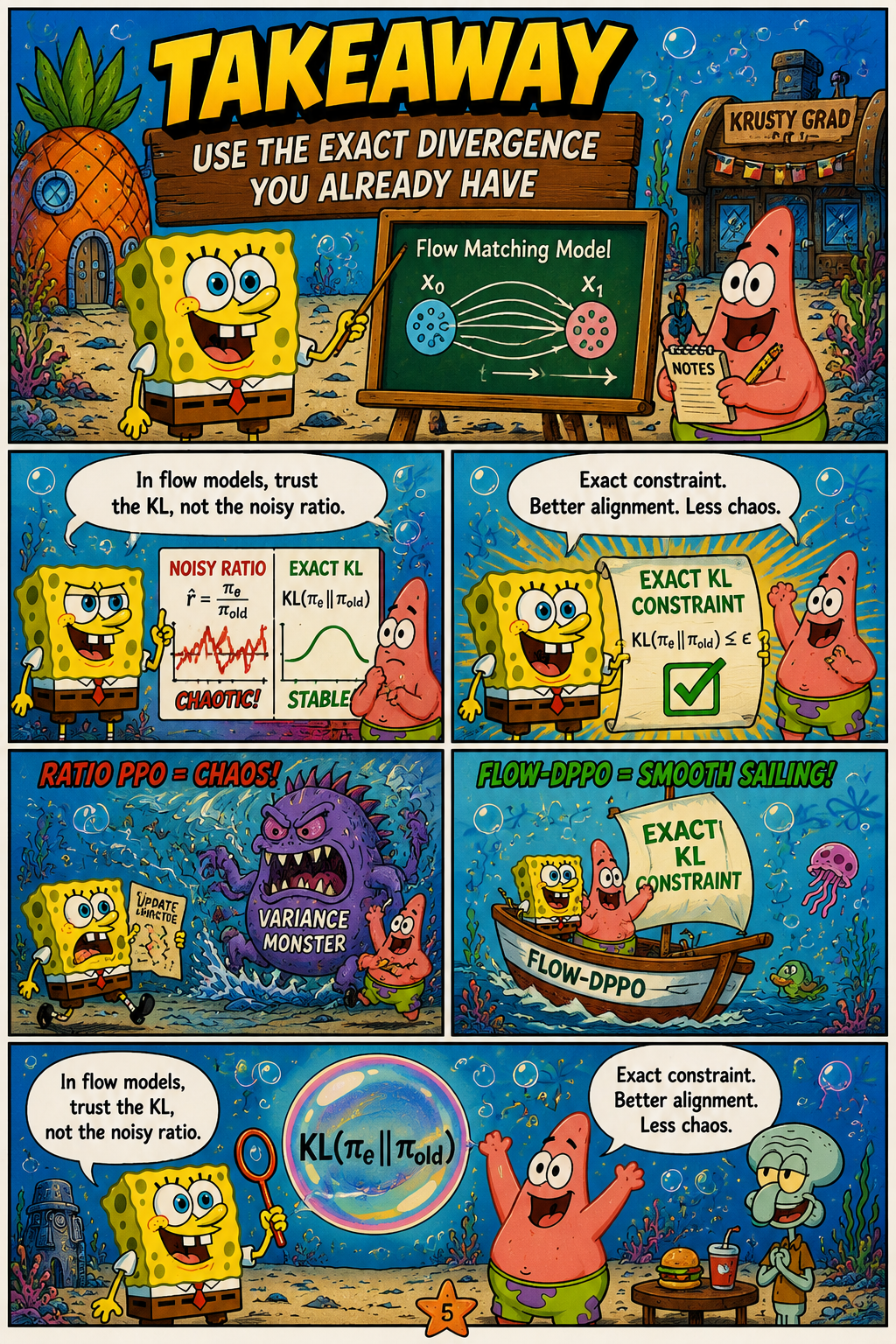
Takeaway
The main implication of the paper is that flow matching models should use the exact divergence available from their Gaussian sampler-induced policies rather than rely on PPO’s noisy probability-ratio clipping. This reframes trust-region RL fine-tuning for image and video generation as a setting where the mathematically intended constraint is not merely approximable but directly computable. By tying the proximal mechanism to KL divergence between old and new per-step policies, Flow-DPPO more closely follows the motivation of TRPO-style policy improvement while remaining compatible with first-order optimization. The method is especially relevant for text-conditioned flow generators, where RL rewards can target compositional accuracy, human preference, or other downstream objectives but may also destabilize visual quality. The paper’s broader message is that algorithmic designs imported from language-model or generic PPO settings should be re-examined when flow models provide stronger structure. Flow-DPPO uses that structure to offer a more stable and efficient route for online RL alignment of flow matching generative models.