ReadPaper Blog
FlashMemory-DeepSeek-V4: Lightning Index for Ultra-Long Context via Lookahead Sparse Attention
The paper addresses the GPU memory bottleneck in ultra-long-context LLM serving, where the KV cache grows linearly with sequence length even when sparse attention reduces compute. It proposes FlashMemory-DeepSeek-V4, an inference approach built around Lookahead Sparse Attention and a Neural Memory Indexer that predicts which historical KV chunks will matter and keeps only those query-critical chunks in GPU memory. The reported result is a large reduction in physical KV cache footprint while maintaining, and slightly improving on average, accuracy across long-context benchmarks.
Source: FlashMemory-DeepSeek-V4: Lightning Index for Ultra-Long Context via Lookahead Sparse Attention
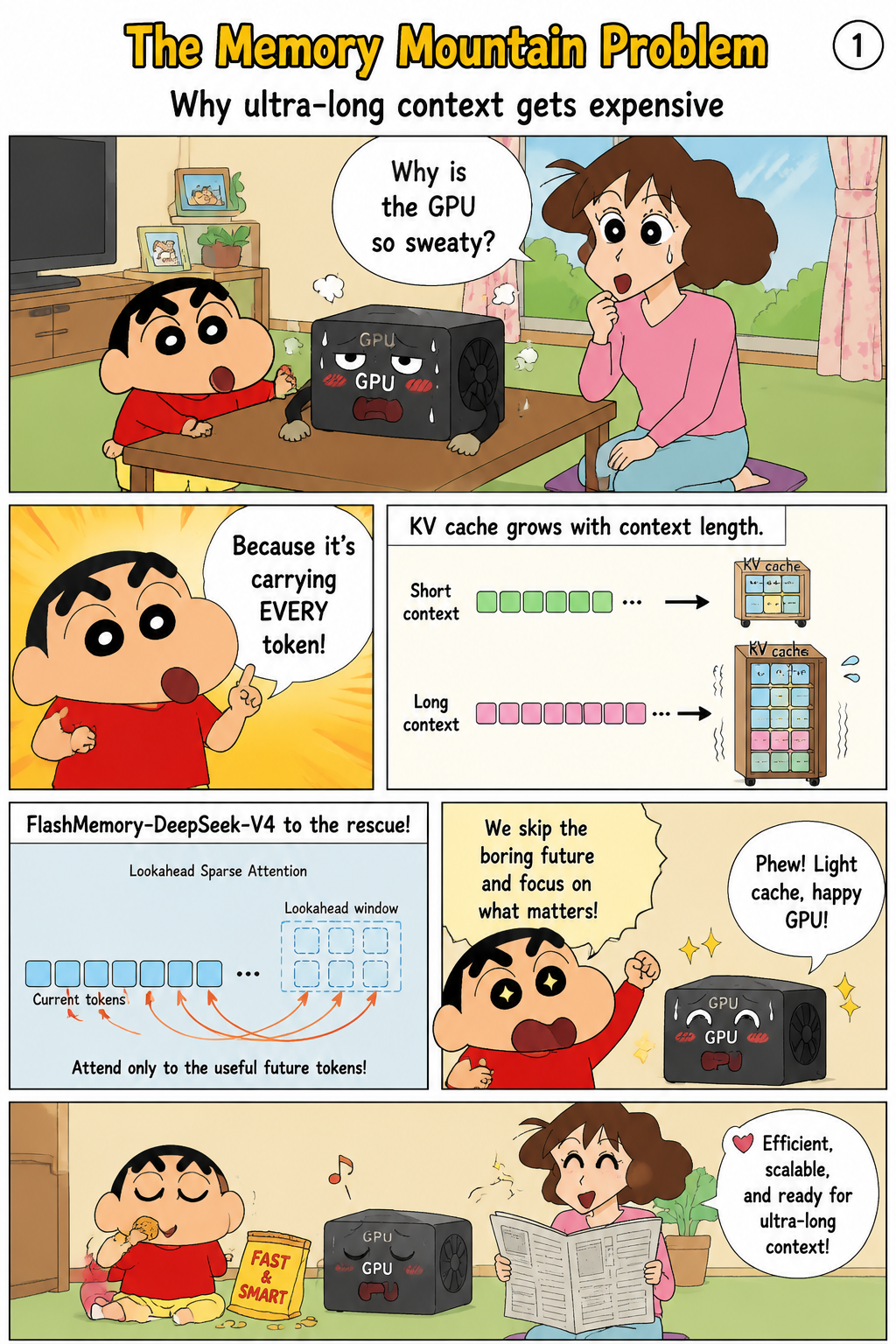
The Memory Mountain Problem
The paper begins from a practical bottleneck in long-context decoding: conventional large language models keep the full Key-Value cache resident in GPU memory as generation proceeds. This memory footprint scales linearly with sequence length, so extending context windows toward hundreds of thousands of tokens becomes constrained by capacity even when modern sparse attention mechanisms reduce per-step FLOPs. The authors position DeepSeek-V4 and Qwen3.5-style compressed or hybrid attention as partial mitigations, because these architectures still retain low-compression or full-attention pathways for fine-grained factual recall. FlashMemory-DeepSeek-V4 targets this remaining memory wall rather than only the arithmetic cost of attention. Its central motivation is that ultra-long-context serving should preserve global reasoning capability without paying the full GPU memory tax at every decoding step.
The Wasteful Habit
A key empirical observation in the report is that much of the retained historical context is inactive for many real inference requests. The authors state that their analysis of real-world inference logs found that over 90% of user requests with contexts longer than 64K tokens could be accurately resolved using only the last 8K tokens. This motivates the claim that loading every historical KV entry into GPU memory is often wasteful, because the current prediction may depend mainly on recent context. At the same time, the paper rejects a simple sliding-window solution as insufficient, since some tasks still require global synthesis over distant information. The resulting problem is a selective-memory problem: the system must distinguish routine local generation from cases where remote context is genuinely query-critical.

Lookahead Sparse Attention
Lookahead Sparse Attention is the paper’s proposed mechanism for making that selective-memory decision before the model needs the information. Instead of passively attending to all historical tokens, LSA periodically evaluates current hidden states and proactively fetches only critical CSA chunks into GPU memory at a fixed decoding interval, denoted τ, with τ = 64 given as an example. The method is built on the DeepSeek-V4 framework and is designed to preserve its existing capabilities by minimizing architectural disruption. It retains highly condensed HCA chunks at a 128:1 compression ratio for broad global awareness, while upgrading the conventional Compressed Sparse Attention pathway into a predictive retrieval mechanism. In this formulation, the Neural Memory Indexer functions as a lightweight controller that selects query-relevant KV chunks, allowing the backbone to access fine-grained history only when the predicted decoding trajectory requires it.

Train the Indexer Separately
The training contribution is the paper’s backbone-free decoupled strategy for optimizing the Neural Memory Indexer. Rather than jointly fine-tuning the massive host LLM or distilling through full-model execution, the authors formulate the indexer as a standalone dual-encoder trained on pre-computed hidden states and labels. This lets the indexer use standard retrieval-training frameworks while physically isolating its optimization from the DeepSeek-V4 backbone. The report emphasizes that this design avoids loading the massive backbone into GPU memory during indexer training, which is essential for making the approach practical. The authors further claim the production indexer can be optimized in a single H20 GPU hour, presenting the indexer as a small retrieval module rather than a second large model.

What It Achieves
The reported evaluations cover LongBench-v2, LongMemEval, and RULER, which the paper uses to test whether memory reduction harms long-context accuracy. Across these suites, FlashMemory-DeepSeek-V4 is reported to reduce the average physical KV cache footprint to 13.5% of the full-context baseline while preserving or slightly improving downstream accuracy. The paper states an average absolute accuracy gain of +0.6% over the standard DeepSeek-V4-Flash setting, framing LSA not only as a memory-saving mechanism but also as an attention denoiser for long-term memory tasks. At extreme 500K-token scales, the report claims FlashMemory suppresses physical KV cache overhead by more than 90% without destabilizing the backbone’s core reasoning capacities. The authors also note that the project was suspended after organizational changes, so the report presents preliminary breakthroughs and verified checkpoints rather than a fully completed production release.