ReadPaper Blog
Complexity-Balanced Diffusion Splitting
Complexity-Balanced Diffusion Splitting proposes a principled way to divide the denoising timeline of continuous-time diffusion and flow-matching generative models among multiple specialized sub-networks. The paper addresses the inefficiency of using one large monolithic model at every timestep, and it uses function approximation theory, de Boor’s equidistribution principle, Dirichlet energy, and trajectory acceleration to place temporal boundaries where modeling difficulty warrants them. Its experiments report improved synthesis quality across SiT, JiT, and UNet without increasing per-step inference cost.
Source: Complexity-Balanced Diffusion Splitting

Why one giant model feels wasteful
The paper begins from the observation that standard continuous-time generative models ask a single neural network to model very different regimes along one denoising trajectory. In the interpolant view shared by diffusion models and flow matching, the model learns a velocity field vθ(xt, t) that carries samples from a Gaussian noise prior toward the data distribution. Early timesteps are dominated by near-isotropic noise and coarse structure formation, while later timesteps require increasingly detailed modeling near the data manifold. The authors argue that scaling one monolithic architecture is inefficient because the full parameter budget is deployed uniformly even when no single regime needs all of it. This motivates temporal capacity allocation: using multiple specialized networks so that only the relevant sub-network is evaluated at a given timestep.
The gap: splitting exists, but the split is often guessed
The paper identifies the central unsolved issue in temporal specialization as the placement of the boundaries between sub-networks. Prior approaches can distribute denoising work across several models, but they often choose splits heuristically or run expensive searches over candidate partition points. Such searches may require training multiple large-scale alternatives, most of which are discarded after evaluation. The authors frame this as a lack of a principled criterion for deciding where the diffusion timeline should be cut. The gap matters because a poor split can leave one sub-network responsible for a disproportionately complex part of the flow, while another spends capacity on an easier interval.

The main idea: Complexity-Balanced Splitting
Complexity-Balanced Splitting, or CBS, addresses this boundary-selection problem by treating denoising as a function approximation problem over time. The paper draws on domain decomposition and de Boor’s equidistribution principle, which says that approximation domains should be partitioned so each interval bears equal estimated error or complexity. Rather than splitting the interval [0, 1] into equal lengths, CBS chooses knots 0 = t0 < t1 < … < tN = 1 so that the integral of a monitor function m(t) is equal across all segments. This objective assigns narrower temporal intervals to regions where the target velocity field is harder to approximate and wider intervals to smoother regions. The implication is a more balanced learning problem for equal-capacity sub-networks and a reduction in the maximum local modeling error that can perturb the ODE sampling path.

How CBS estimates difficulty
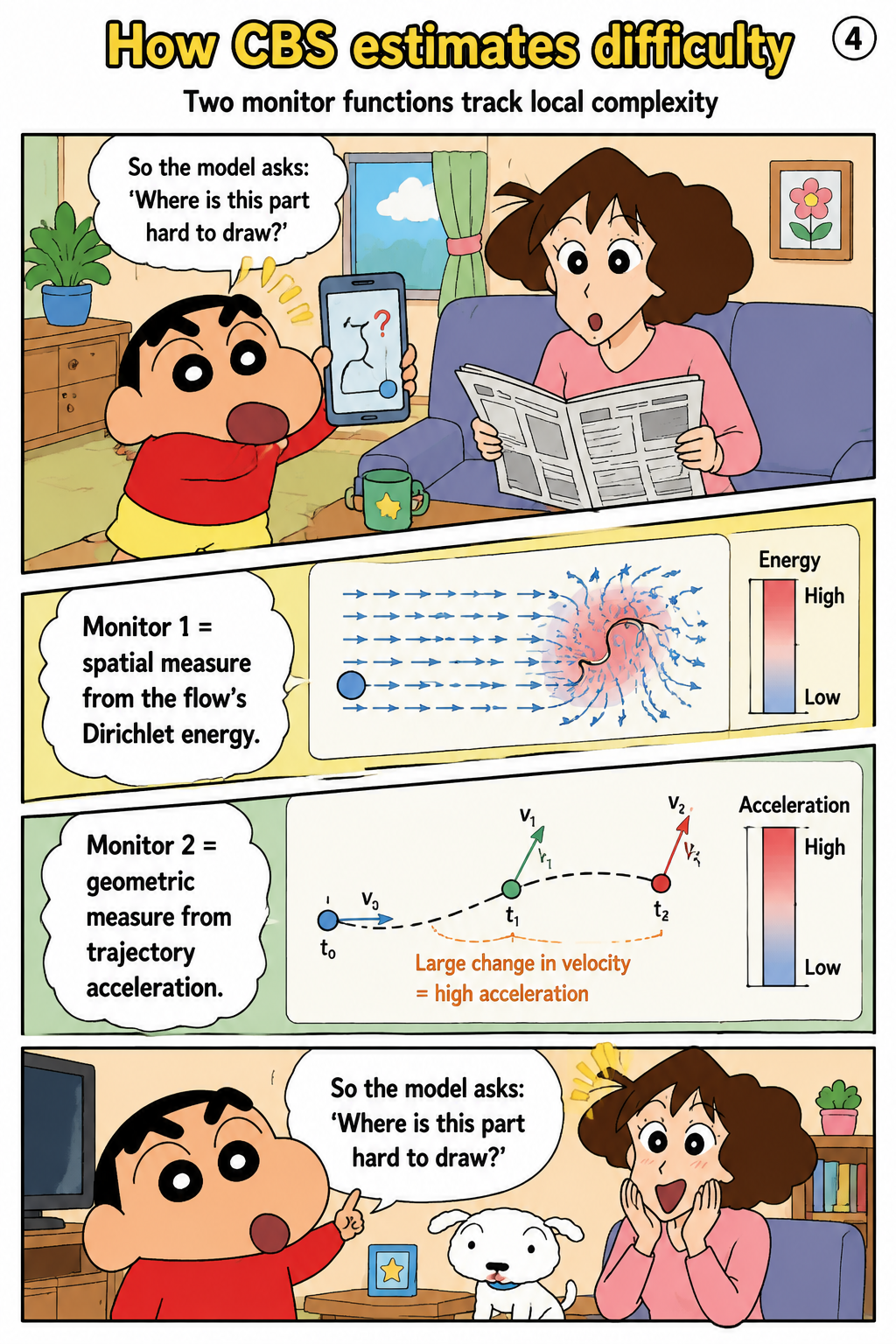
To estimate where the diffusion dynamics are difficult, the paper proposes two tractable monitor functions. The first monitor is based on the Dirichlet energy of the flow field, which measures spatial variation through the squared norm of ∇x vt(x) and serves as a computable proxy for spectral complexity in Barron-style approximation bounds. The authors connect this spatial roughness to expected approximation error by using Parseval’s identity and a Cauchy-Schwarz bound over an effective frequency bandwidth. The second monitor measures geometric complexity through the acceleration of sampling trajectories, using the second-order time derivative of the generated paths as an indicator of how hard the flow is to follow. A lightweight auxiliary model estimates these complexity profiles, allowing CBS to avoid both hand-tuned splits and exhaustive large-model boundary searches.
What the experiments say
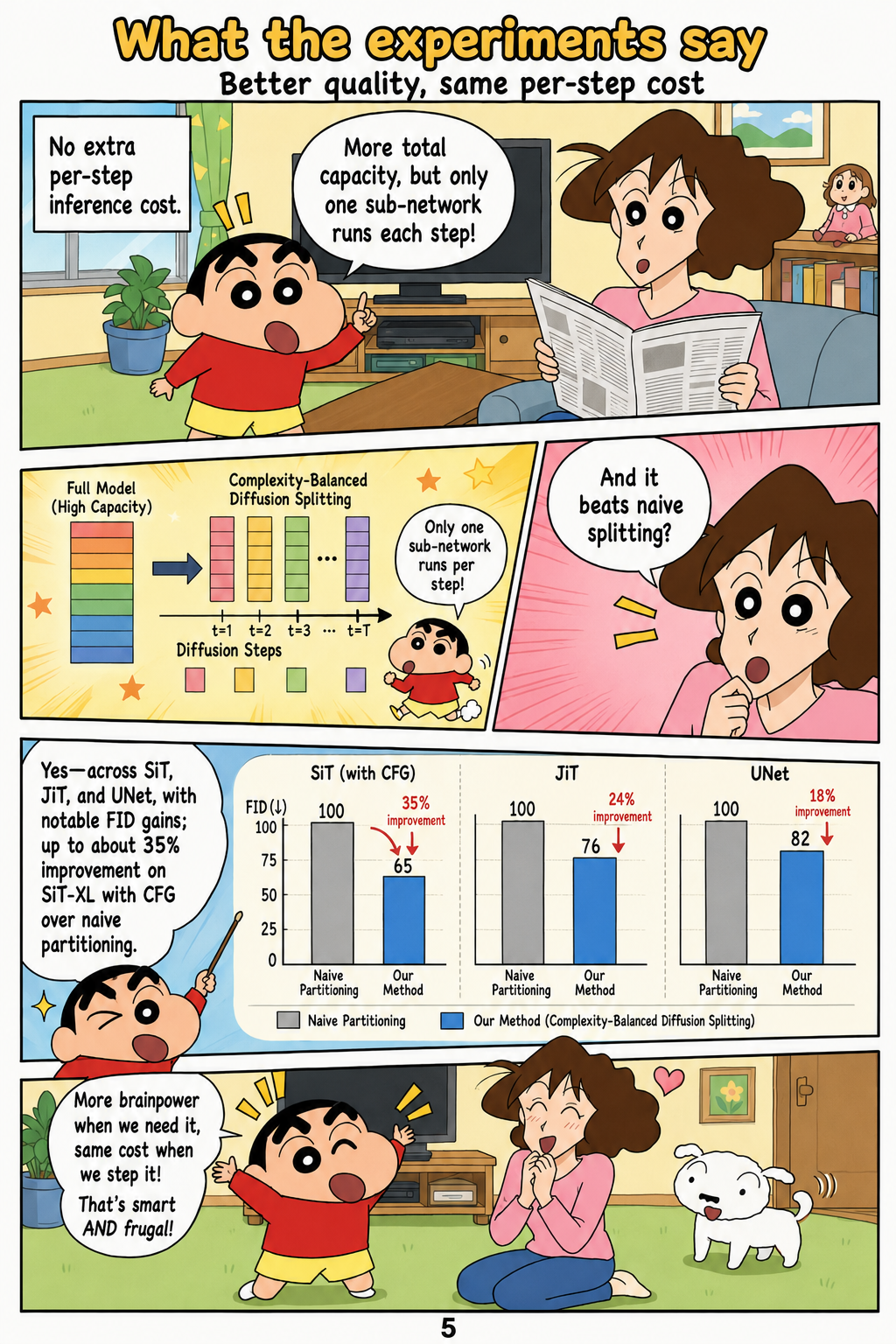
The paper evaluates CBS across multiple architectures, including SiT, JiT, and UNet, and reports consistent improvements in synthesis quality without increasing per-step inference cost. The cost property comes from the temporal-splitting design: total parameters can increase across specialized sub-networks, but only one sub-network is executed at each timestep. In the reported SiT-XL results, CBS improves FID by about 15% without classifier-free guidance and by about 35% with CFG compared with naive temporal partitioning. The authors also report that complexity-based partitions approach or exceed the quality of more expensive search-based alternatives. Ablations support the paper’s main claim that aligning temporal boundaries with local flow or trajectory complexity produces more balanced learning and more robust sample generation.