ReadPaper Blog
Beyond Uniform Token-Level Trust Region in LLM Reinforcement Learning
The paper studies why PPO- and GRPO-style trust regions can be miscalibrated for reinforcement learning with verifiable rewards in autoregressive large language models. It proposes CPPO, Cumulative Prefix-divergence Policy Optimization, which replaces a uniform token-level constraint with position-weighted divergence limits and a cumulative prefix budget, improving stability and reasoning accuracy in reported RLVR experiments.
Source: Beyond Uniform Token-Level Trust Region in LLM Reinforcement Learning
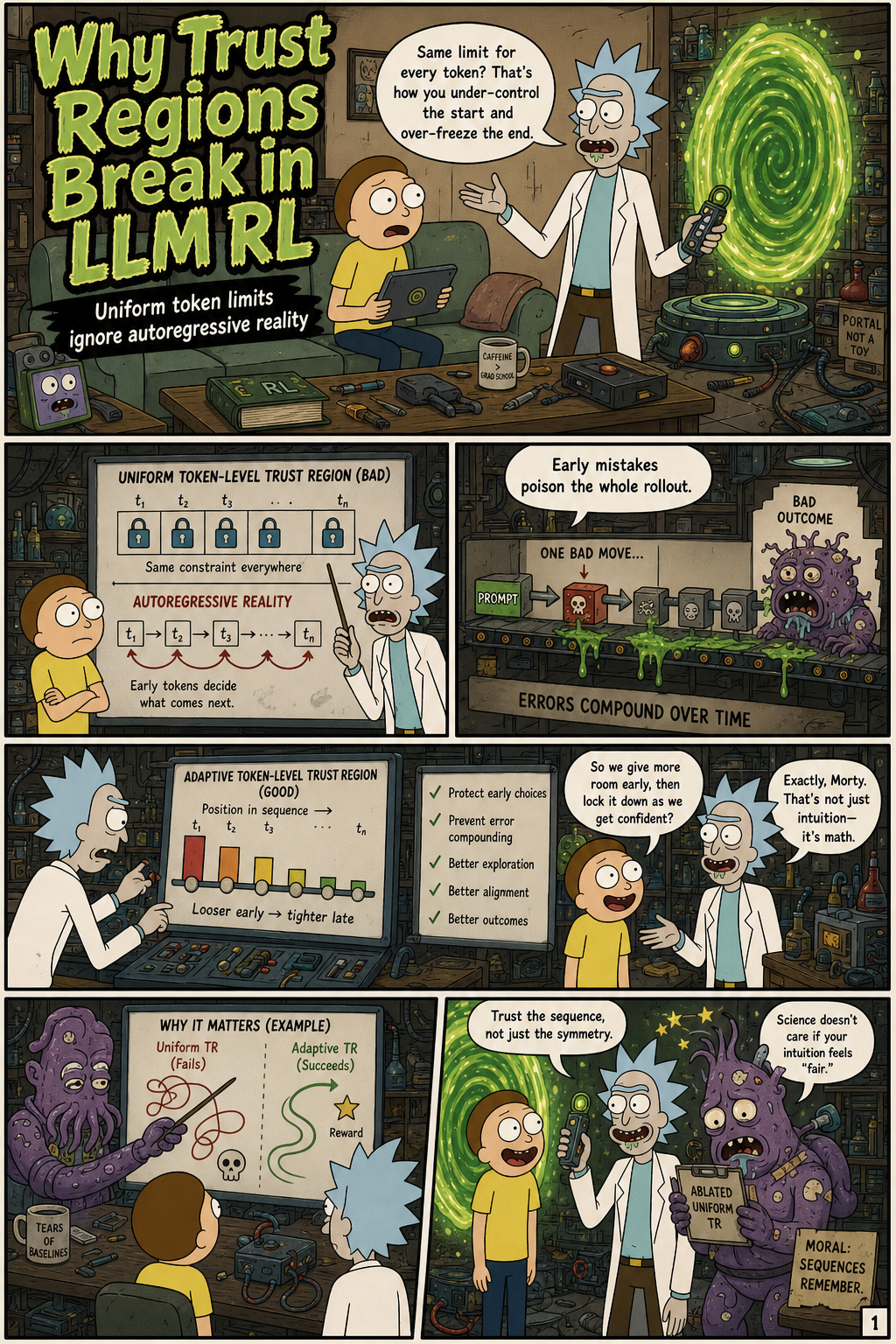
Why Trust Regions Break in LLM RL
The paper argues that current trust-region mechanisms in LLM reinforcement learning are structurally mismatched to autoregressive generation because they apply the same token-level constraint at every position. In RLVR, a policy samples a full response, a verifier assigns a scalar reward, and PPO- or GRPO-style objectives update the model using token-level likelihood ratios from data generated by a fixed rollout policy. This off-policy reuse makes divergence control necessary, but uniform clipping treats an early token and a late token as equally consequential. The paper’s key motivation is that early deviations change the conditioning prefix for all subsequent tokens, so they can create larger sequence-level distribution shift than identical deviations near the end of a response. This means static token thresholds can under-regulate early drift while unnecessarily limiting late-stage exploration, directly undermining stable reasoning optimization.
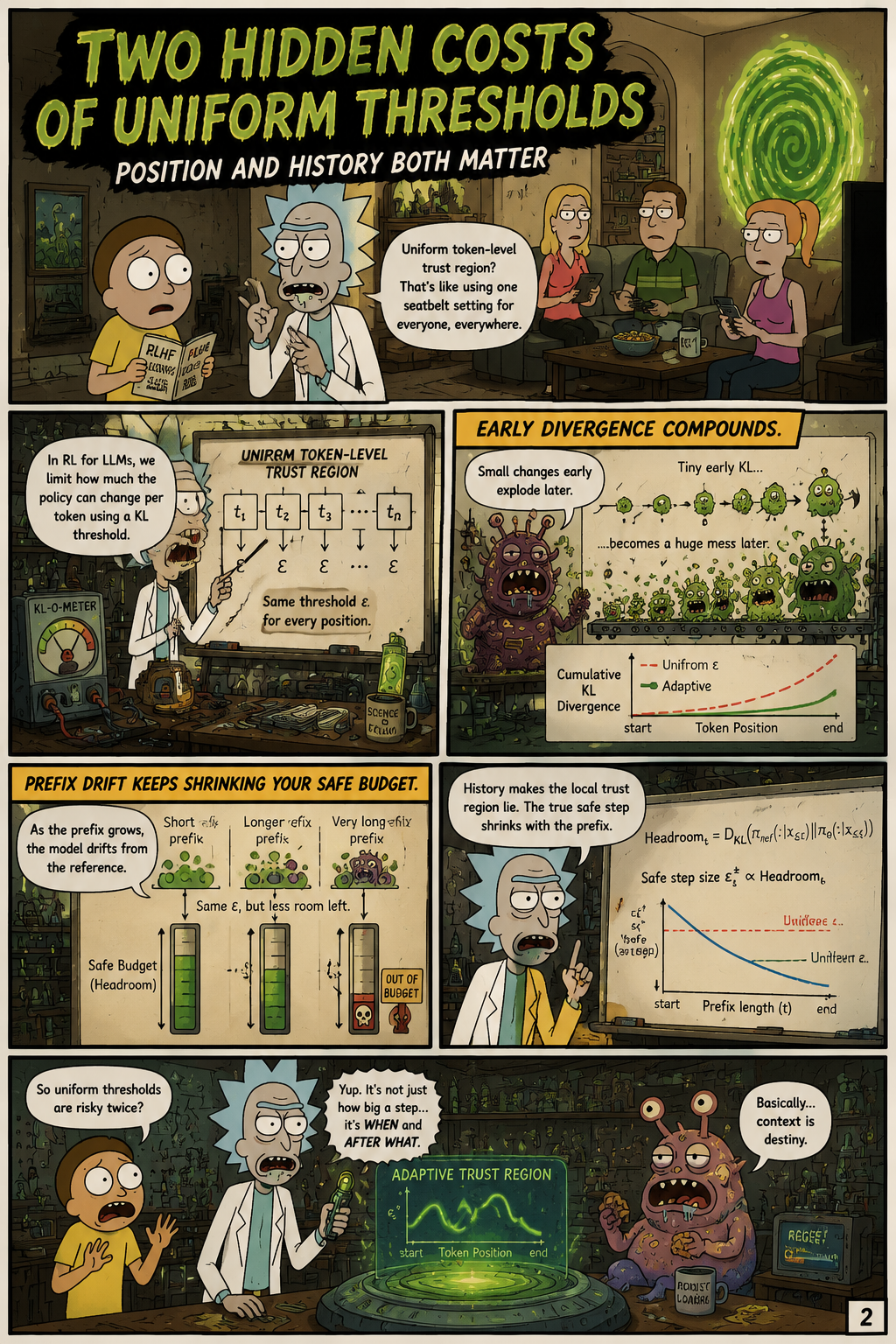
Two Hidden Costs of Uniform Thresholds
The paper identifies two hidden costs of uniform token-level thresholds: autoregressive asymmetry and cumulative prefix drift. Autoregressive asymmetry means that a policy change at position t affects the suffix generated after t, so the same next-token divergence has different sequence-level impact depending on where it occurs. Cumulative prefix drift means that the state st = (x, y<t) may already be far from the rollout policy’s trajectory before the current token is updated. Existing token-level rules such as PPO clipping and DPPO-style divergence tests evaluate each token largely in isolation, giving the same allowance even when the prefix has already accumulated substantial off-policy deviation. The paper frames this as a failure to allocate a finite trust-region budget across a generated trajectory rather than across independent token decisions.
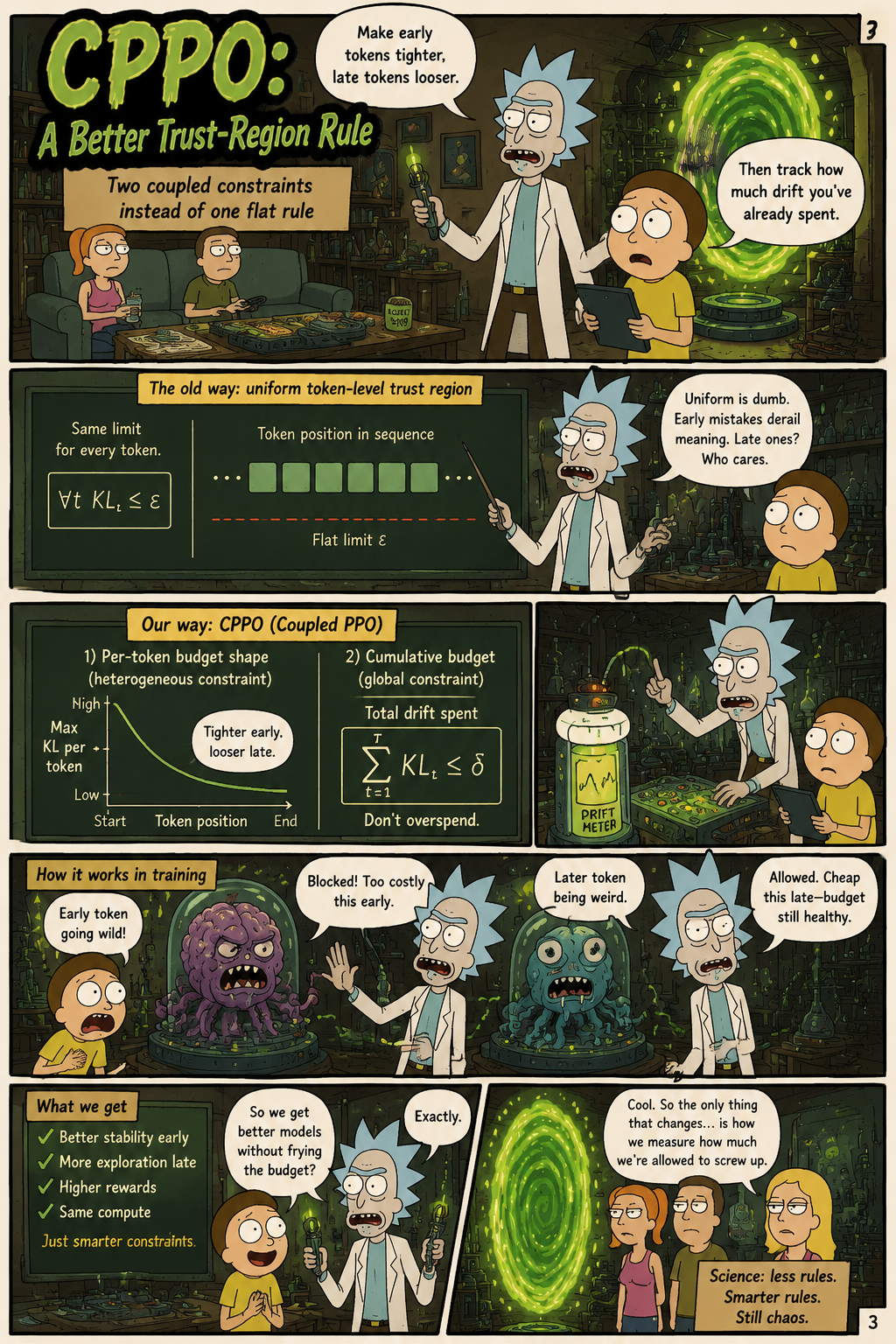
CPPO: A Better Trust-Region Rule
To address this gap, the paper proposes CPPO, or Cumulative Prefix-divergence Policy Optimization, as a drop-in token mask for RLVR training. CPPO uses the token-level divergence Dt = D(π(·|st), μ(·|st)) between the target policy and rollout policy, following the DPPO idea of measuring distributional change rather than relying only on a sampled likelihood ratio ρt. Its first mechanism is a position-weighted threshold, written in the excerpt as a condition involving wtDt ≤ δ, which imposes tighter effective limits on early positions and relaxes them later in the sequence. Its second mechanism is a cumulative prefix budget, expressed as a weighted average of prior divergences along the prefix, which blocks further deviation once the trajectory has already spent too much of its trust-region allowance. Together, these constraints make CPPO focus not only on how much a token distribution changes, but also on where the change occurs and how much divergence has already accumulated.
What the Theory Claims
The theoretical basis of the paper comes from a finite-horizon view of LLM generation as a sequential decision process. The authors use an exact performance-difference identity in which the policy improvement J(π) − J(μ) is decomposed into a token-level surrogate L′μ(π) and an approximation error Δ(μ, π). This error term contains the dropped suffix likelihood-ratio correction ρt+1:T, which formally captures how a token-level change propagates through future tokens. The paper argues that trust-region constraints should therefore reflect prefix-to-suffix error propagation, rather than imposing a position-agnostic bound at every step. CPPO’s weighted token constraint and cumulative prefix budget are designed to align with this finite-horizon policy-improvement bound, yielding a tighter guarantee than uniform thresholding in the paper’s analysis.

What the Paper Reports
Empirically, the paper evaluates CPPO under matched RLVR settings against trust-region baselines including PPO-style clipping, DPPO, TRM variants, CISPO, MinPRO, and GRPO. The excerpt reports that all token-level trust-region methods use the same Top-K reduced-TV approximation for token divergence, with K = 20, so that comparisons isolate the masking rule rather than the divergence estimator. The paper reports improved training stability and reasoning accuracy across various model scales, with CPPO obtaining the best AIME24/25/26 average scores in the described evaluations. A representative result is shown for Qwen3-30B-A3B-Base validation, where CPPO is reported to outperform the listed methods on the AIME average. The implication is that better allocation of a divergence budget across token positions and prefixes can improve RLVR post-training without changing the broader PPO-style optimization framework.