ReadPaper Blog
AnchorWorld: Embodied Egocentric World Simulation with View-based Evolution Customization
AnchorWorld addresses the problem of controllable first-person world simulation for virtual reality and embodied AI, where a model must respond to human body motion while preserving and evolving specified local scene states. The paper proposes a flow-matching DiT video-generation framework conditioned on SMPL-X full-body actions, egocentric camera pose, and pose-associated anchor views containing an RGB image, 6-DoF pose, and evolution prompt. Its importance lies in showing that egocentric simulators can be made more action-aware, spatially grounded, and locally customizable than systems driven only by text, camera trajectories, or implicit scene context.
Source: AnchorWorld: Embodied Egocentric World Simulation with View-based Evolution Customization
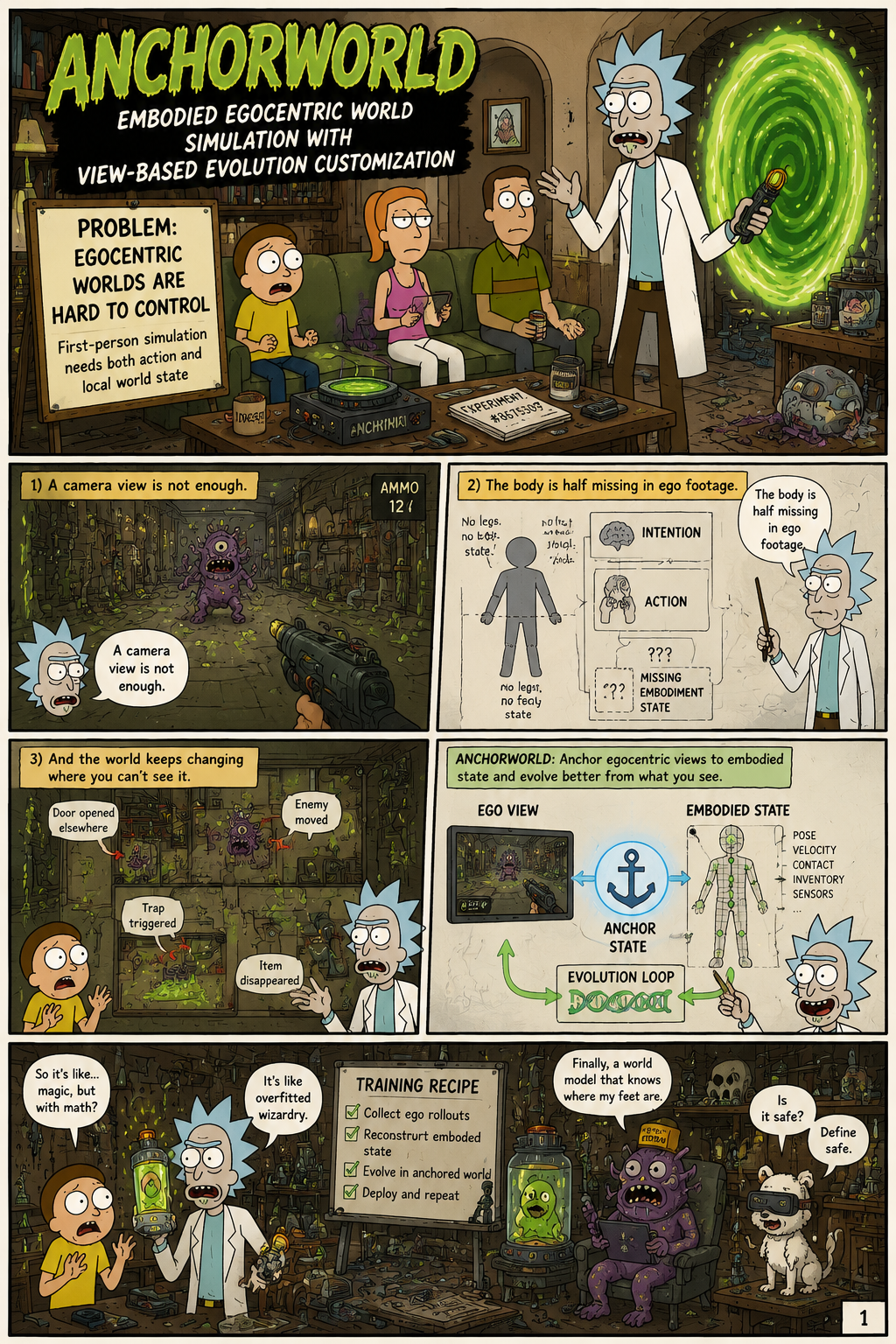
Problem: Egocentric worlds are hard to control
The paper frames embodied egocentric world simulation as a control problem that requires more than plausible video continuation from an initial camera view. For first-person applications such as virtual reality and embodied AI, the simulator must account for head motion, body motion, navigation, and interactions with nearby objects. The authors argue that egocentric video makes this difficult because much of the human body is out of view or truncated, so the visual evidence for full-body motion is sparse and indirect. They also identify a second limitation: existing world models often define the environment only through an initial frame, a global prompt, or history, leaving newly observed and out-of-sight regions weakly constrained. AnchorWorld is motivated by the need to combine embodied action control with localized world-state customization in a single egocentric simulation framework.
Gap: Existing methods only solve part of the job
The related-work discussion positions AnchorWorld against interactive world models that use keyboard inputs, mouse operations, camera trajectories, or text prompts as convenient but limited control signals. Such inputs can steer viewpoint changes or trigger events, but the paper argues that they do not faithfully represent how humans act from a first-person perspective. More recent egocentric approaches introduce hand poses or full-body motion, including methods such as DWM, PlayerOne, and PEVA, but the paper emphasizes that learning full-body action control from first-person footage remains under-supervised because the body is mostly absent from the target view. The authors also compare against scene-consistent video generation methods such as ReCamMaster, CineScene, SWM, and Context-as-Memory, which improve view consistency but typically lack explicit local world-state editing tied to 3D locations. This gap leads the paper to define world-customizable embodied egocentric simulation as a task requiring both human-motion-driven exploration and pose-grounded local scene control.

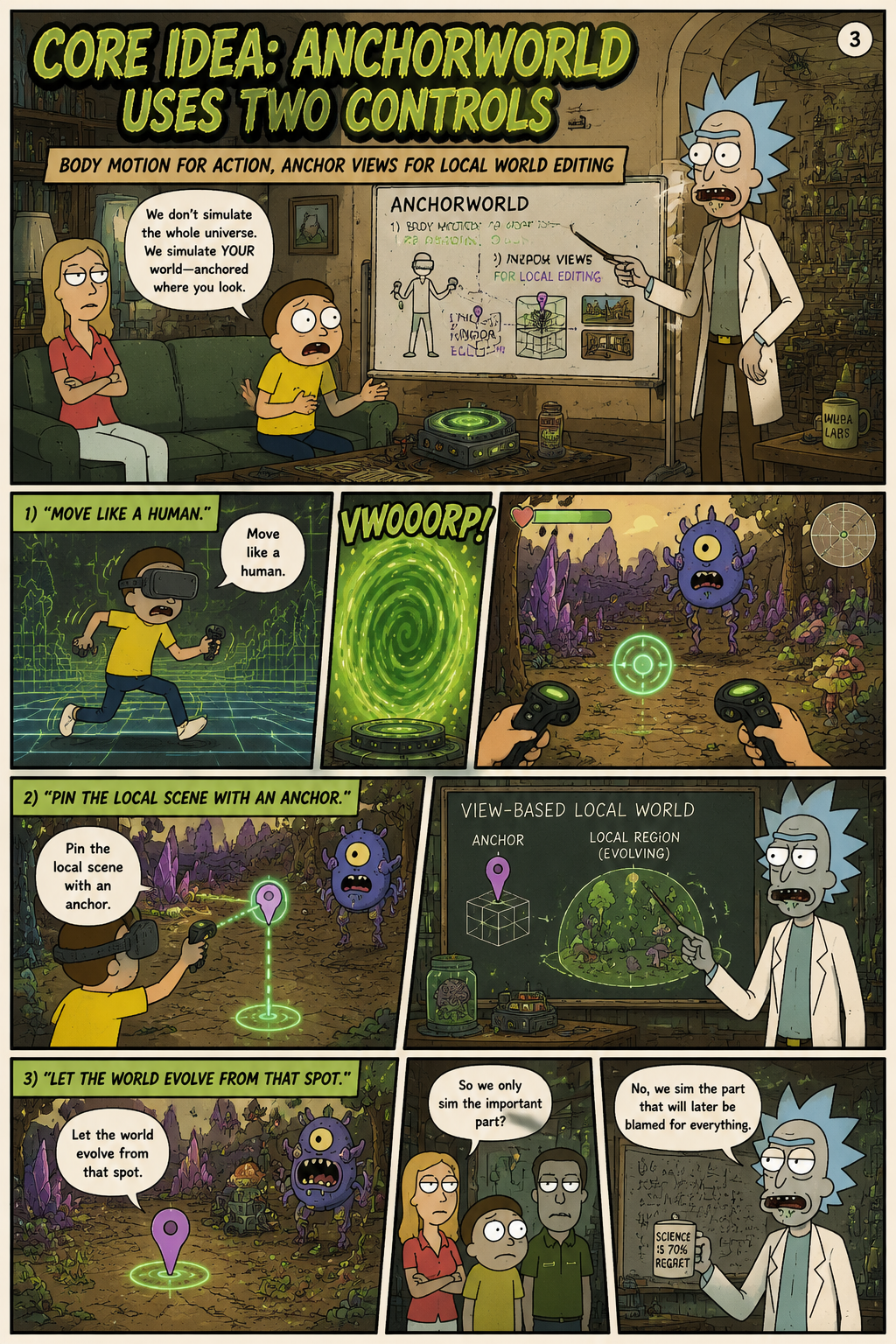
Core idea: AnchorWorld uses two controls
AnchorWorld’s core method uses two complementary inputs: embodied human motion for action control and pose-associated anchor views for world customization. The human action signal is derived from the SMPL-X parametric body model as a sequence of joint positions and axis-angle rotations, while the egocentric world is initialized from an initial first-person frame. Each anchor view is defined as an RGB image, a 6-DoF camera pose, and an evolution prompt describing how the local scene should change over time. By grounding anchors in a unified world coordinate system, the model can specify local appearance, preserve scene states across viewpoint changes, and guide dynamic evolution even for regions that are not initially visible. The framework is instantiated on Wan, a flow-matching-based DiT video generation model, so video synthesis is conditioned jointly on body action, camera pose, anchor imagery, and textual evolution descriptions.
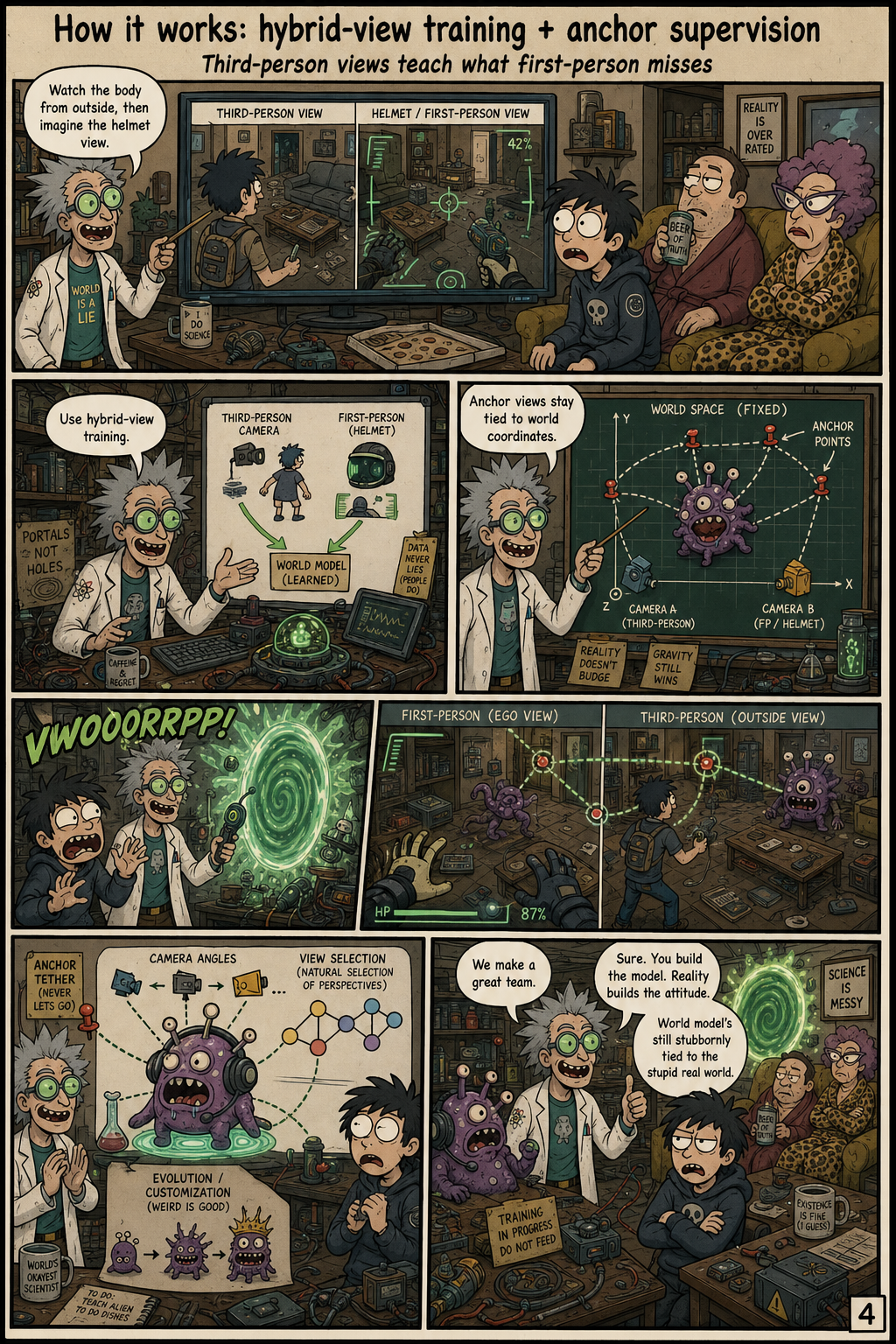
How it works: hybrid-view training + anchor supervision
The paper’s key training idea is hybrid-view human action control, which uses third-person videos as auxiliary supervision for information that first-person video hides. AnchorWorld represents action conditioning in a projection-based way by combining full-body motion with a camera trajectory, so the same motion can be associated with either an external observation view or a head-mounted egocentric view. The model is first pretrained on diverse third-person videos to learn projection knowledge and human-scene interaction priors, then adapted to egocentric simulation by aligning the camera parameters with the human head perspective. The architecture injects motion and camera conditions through spatial pose attention: encoded video tokens are concatenated with motion tokens and camera-pose tokens, processed by spatial self-attention, and then truncated back to updated video features. For customization, anchor views remain tied to 3D poses, and evolution prompts are incorporated through cross-attention so local scene changes are conditioned by both spatial grounding and text-described dynamics.
Evidence: It works better and stays consistent
The experiments reported in the paper evaluate AnchorWorld across egocentric, synthetic Unreal Engine, and captured real-world scenarios. The authors state that AnchorWorld outperforms adapted baselines on action accuracy, scene consistency, and dynamic evolution, and they use ablation studies to validate the contribution of the main design choices. The results emphasize that hybrid-view supervision improves egocentric human-action control and spatial pose awareness, while anchor-view customization strengthens local consistency under viewpoint changes. The paper highlights promising spatio-temporal geometric consistency and strict adherence to prescribed evolution prompts, including cases involving out-of-sight scene evolution. Its broader implication is that first-person world models can move from implicit, weakly constrained visual continuation toward controllable embodied simulation in which human motion and localized world states are both explicit conditioning variables.