ReadPaper Blog
AlayaWorld: Long-Horizon and Playable Video World Generation
AlayaWorld addresses the problem that interactive virtual worlds are costly to hand-build, difficult to customize, and hard to extend after deployment. The paper proposes a full-stack open-source framework that uses autoregressive video world models conditioned on world state and user interaction to synthesize playable environments online, aiming to make long-horizon, real-time generative worlds practical for games and embodied intelligence.
Source: AlayaWorld: Long-Horizon and Playable Video World Generation
Research question
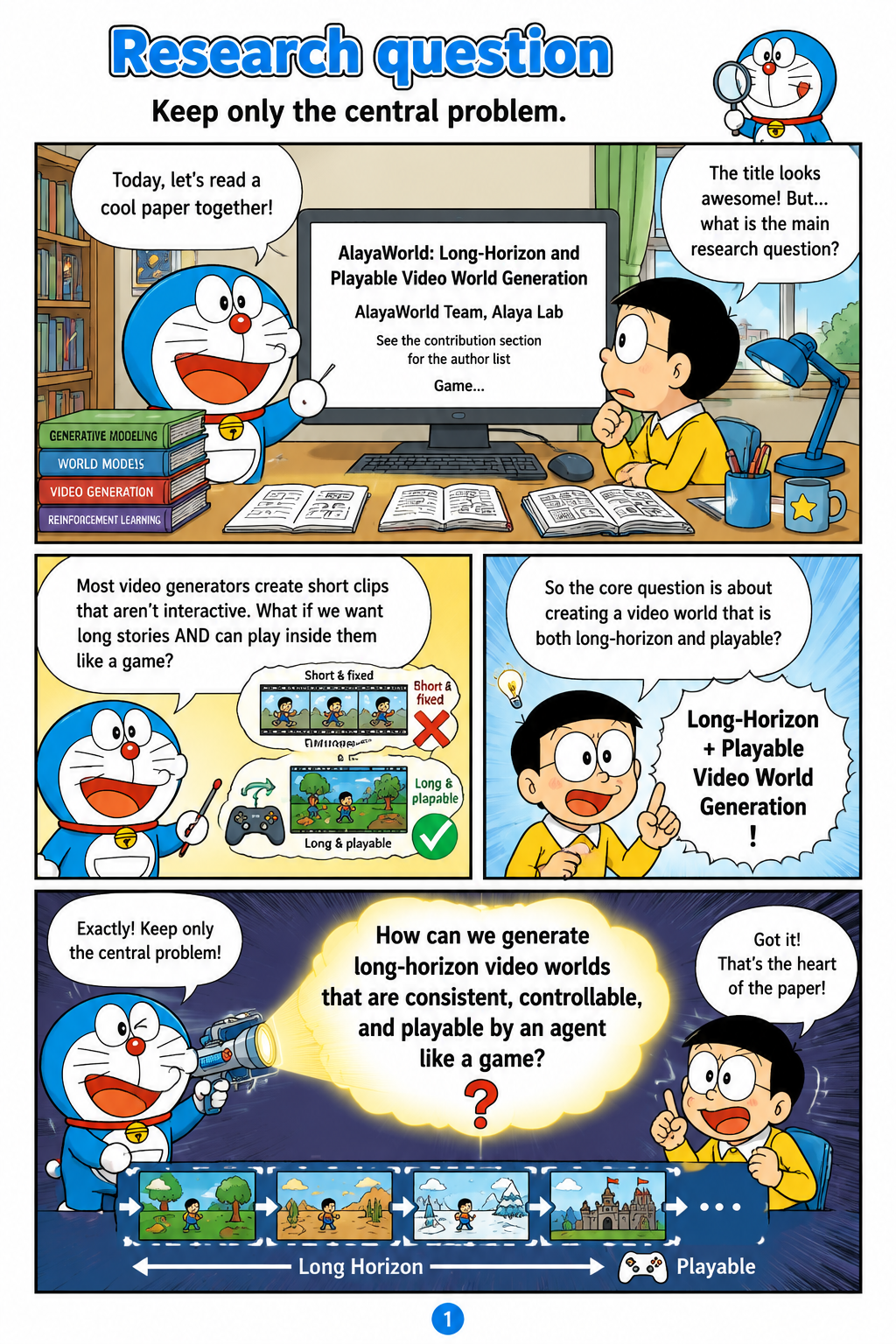
The paper frames interactive virtual-world creation as a core challenge for artificial intelligence because useful worlds must be visually rich, responsive to user actions, and persistent over time. Conventional game-production pipelines require explicit specification of objects, animations, interaction rules, and gameplay logic, which makes new content expensive to create and difficult to modify after release. AlayaWorld asks whether a learned video world model can replace much of this manual authoring by predicting future observations from the current state and user inputs. This formulation matters because it treats world generation, behavior modeling, and rendering as learned functions rather than separately engineered subsystems. The paper positions this shift as relevant not only to games but also to embodied agents, robotics simulation, and controllable environments for studying decision-making.
Why old methods fall short
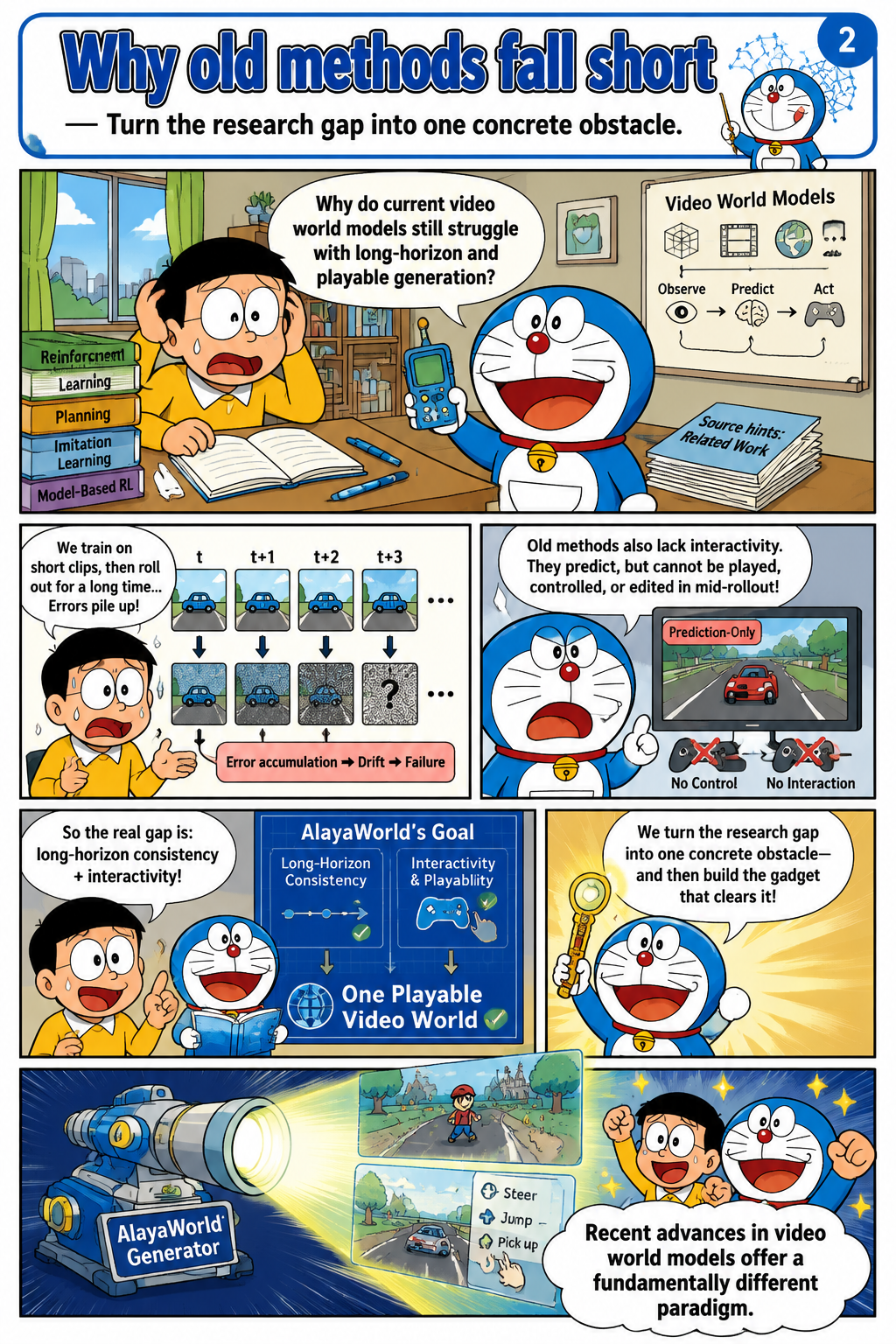
The related-work discussion argues that recent video generation systems provide strong backbones but do not by themselves solve playable world generation. Text- and image-to-video models such as Sora, Open-Sora, CogVideoX, Wan, LTX-Video, Veo, Kling, Gen-3, and MovieGen can synthesize coherent video, yet they usually follow predetermined trajectories rather than responding continuously to user control. Interactive systems such as Genie, Genie 2, GameNGen, DIAMOND, Oasis, GameGen-X, Yume, Matrix-Game, Hunyuan-GameCraft, MineWorld, WHAM, and WHAMM show that action-conditioned generation is feasible, but the paper highlights remaining gaps in generalization, controllability, consistency, long-horizon stability, and real-time latency. AlayaWorld therefore treats existing work as evidence that video models can become world simulators while also identifying the engineering and modeling barriers that prevent them from serving as open-ended, deployable worlds. The research gap is not simply higher visual fidelity, but the combination of control, consistency, stability, and runtime in a usable framework.
Core idea
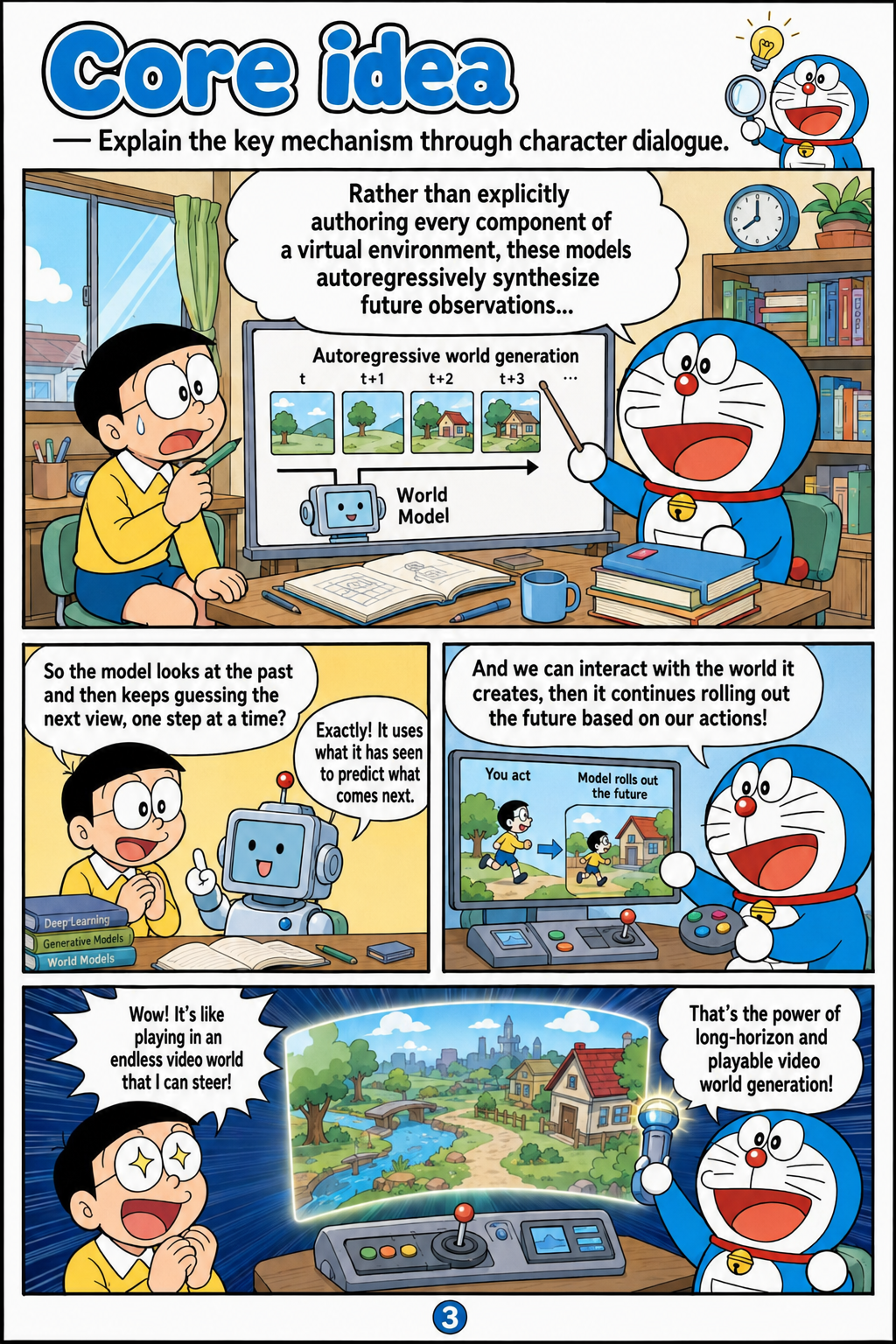
AlayaWorld’s central method is an autoregressive video world model that synthesizes future observations conditioned on interaction history and current world state. The framework is fine-tuned from LTX-2.3 and augmented with modules intended to address the main obstacles identified in the introduction: a prompt-switching mechanism, an AdaLN-style camera-control module, a 3D cache, history compression, an error bank, and few-step distillation. The paper distinguishes two interaction modes, navigation and prompt-driven action, so the generated world can respond both to camera movement and to higher-level actions such as combat, spell casting, and monster summoning. Its camera-control discussion connects AlayaWorld to three technical strategies in the field: treating camera motion as a conditioning signal, injecting camera geometry as an architectural bias, and using explicit rendered evidence such as a 3D cache. This design implies that playable generation requires more than a video backbone; it needs control pathways, memory mechanisms, and inference acceleration arranged as a coherent system.
Evidence check
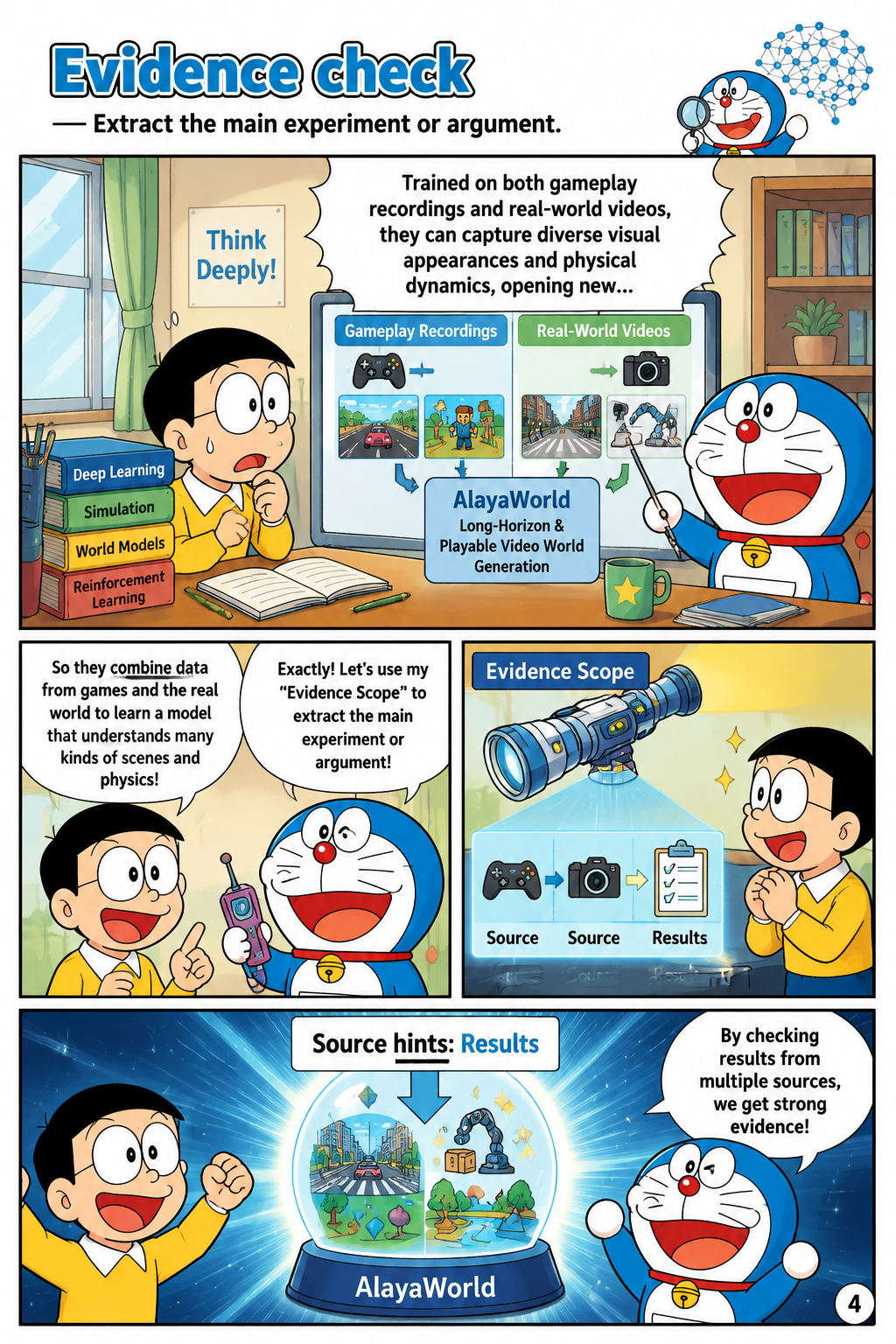
The paper’s evidence is presented mainly through the described capabilities, system components, project materials, and the promise of released evaluation tools rather than through detailed quantitative results in the provided excerpt. It states that AlayaWorld synthesizes explorable worlds spanning first-person and third-person viewpoints, real-world, game, and synthetic domains, as well as indoor and outdoor environments. It also emphasizes training on both gameplay recordings and real-world videos, which is meant to broaden the model’s visual appearances and physical dynamics beyond a single game domain. The framework release is described as including reproducible pipelines, reference implementations, evaluation tools, and comprehensive documentation, indicating that the contribution is both a model architecture and an experimental platform. The paper says complete technical details, experimental results, and the full codebase are scheduled for release, so the current evidentiary weight rests on the system description and stated demonstrations rather than independently inspectable benchmark numbers in the excerpt.
One thing to remember
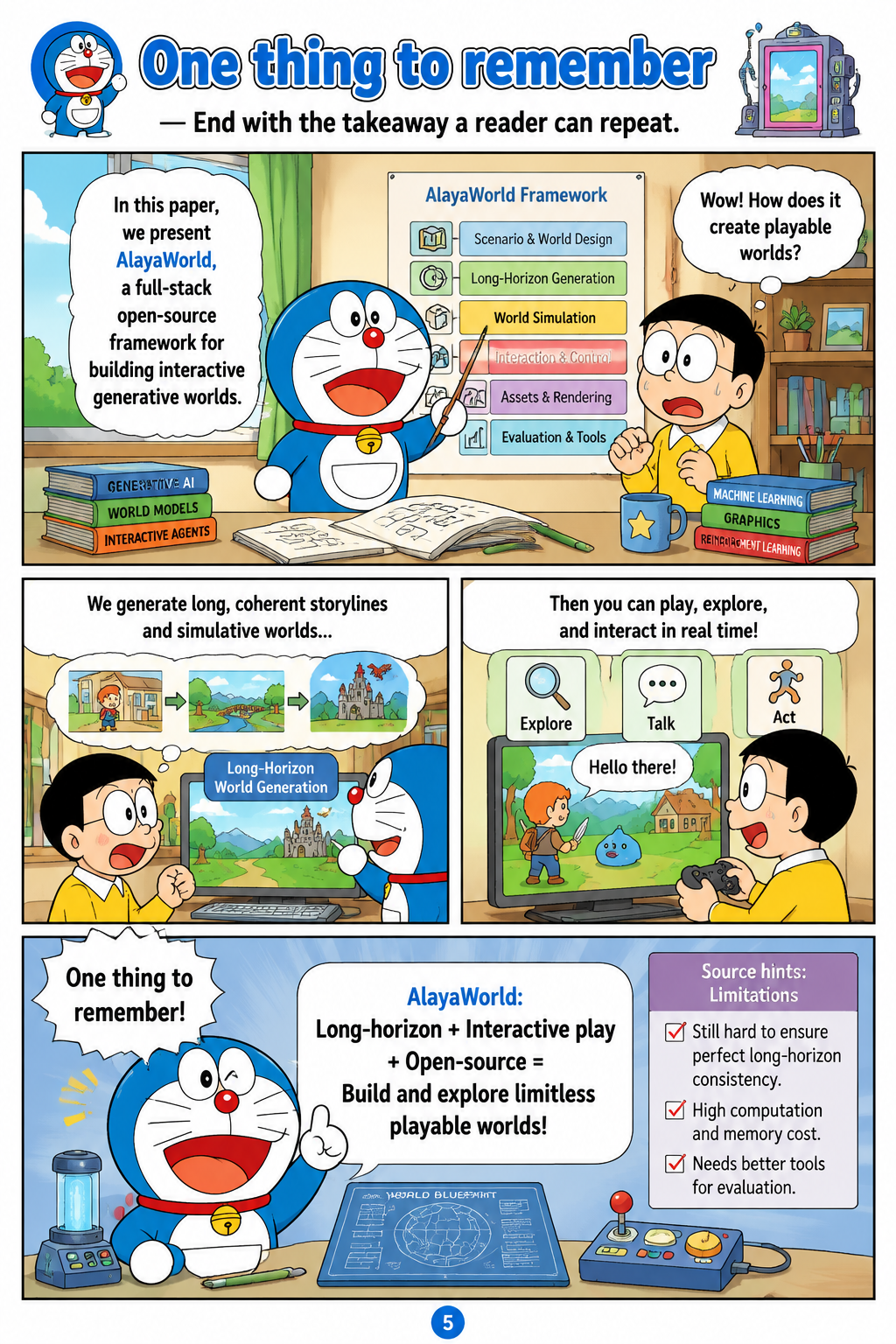
The main takeaway is that AlayaWorld presents playable video world generation as a full-stack systems problem rather than a single-model generation problem. Its contribution is to unify data preparation, model architecture, training, inference acceleration, and deployment within a modular open-source framework for long-horizon interactive worlds. The paper’s limitations are implicit in the four challenges it foregrounds: user control must remain open-ended, generated environments must preserve spatial and temporal consistency, long runs must avoid visual drift, and runtime must support low-latency interaction. By making these constraints explicit, AlayaWorld gives future research a concrete agenda for turning video generators into usable world simulators. If the released implementation matches the described design, the framework could help researchers compare methods for camera control, history modeling, 3D caching, distillation, and real-time deployment in a shared setting.