ReadPaper Blog
Agentic Environment Engineering for Large Language Models: A Survey of Environment Modeling, Synthesis, Evaluation, and Application
This survey explains why large language model agents need engineered interactive environments: direct real-world interaction is often costly, unsafe, private, and irreproducible, while simulated environments can provide scalable feedback, reward signals, and trajectory data. It organizes the field around the lifecycle of agentic environment engineering, covering environment modeling, synthesis, evaluation, and application, and argues that agent capability growth increasingly depends on closed-loop co-evolution between agents and their environments.
Source: Agentic Environment Engineering for Large Language Models: A Survey
Why invent an environment at all?
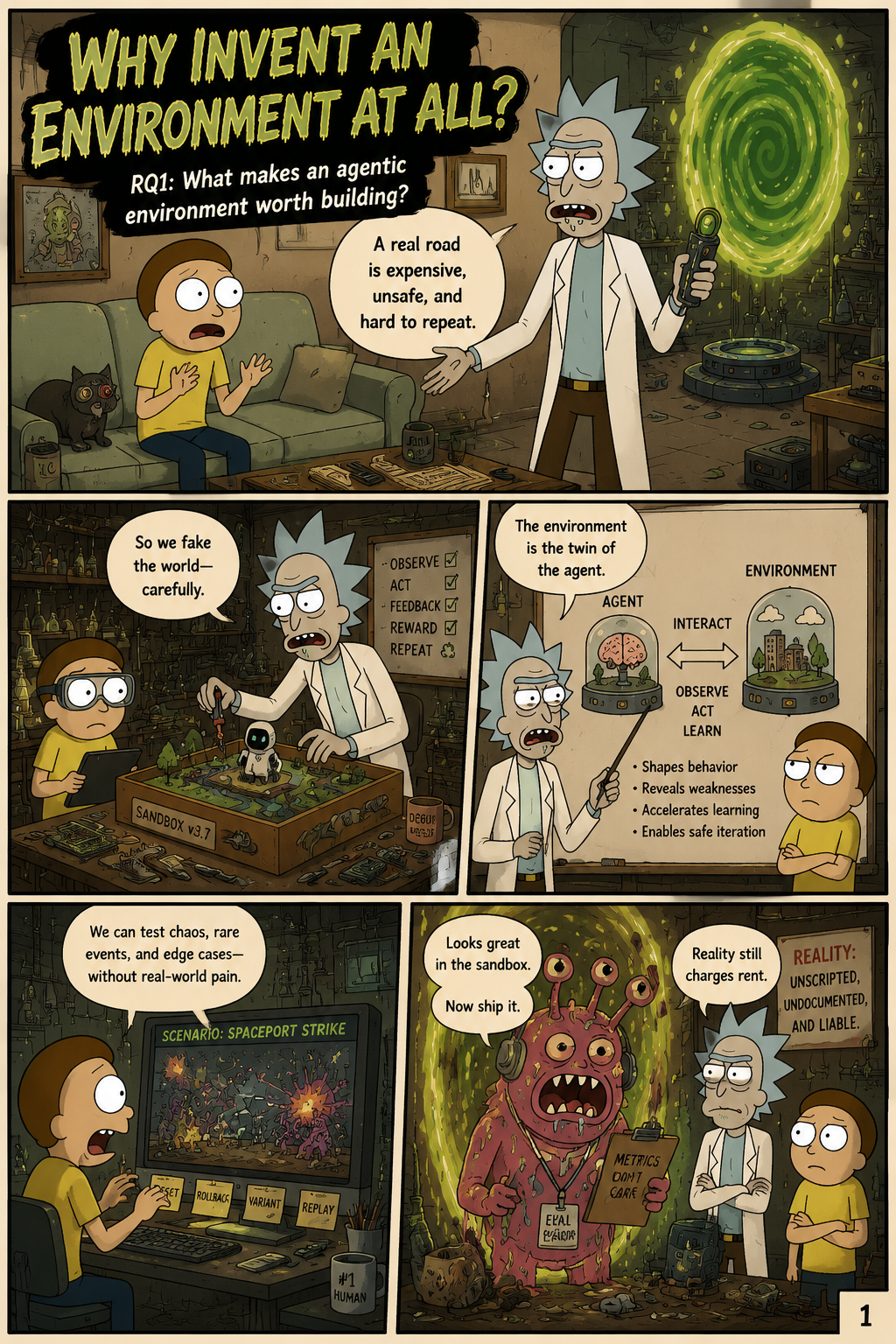
The paper defines an agentic environment as a dynamic system that simulates a real-world scenario in which an LLM-based agent can act, observe outcomes, and receive feedback. Its motivation is that real-world interaction is often infeasible for agent development because it can be expensive, unsafe, privacy-sensitive, and hard to reproduce after failures. The survey uses examples such as autonomous driving to illustrate why direct deployment can be inefficient and risky, while simulated alternatives can approximate real conditions with tools and reward signals. These environments are presented as an inseparable twin of the agent across capability evaluation, inference-time reasoning enhancement, and reinforcement learning training. The central claim is that environment engineering is becoming a necessary foundation for continual agent evolution because it enables large-scale trajectory generation under controlled and repeatable conditions.
What kinds of environments exist?
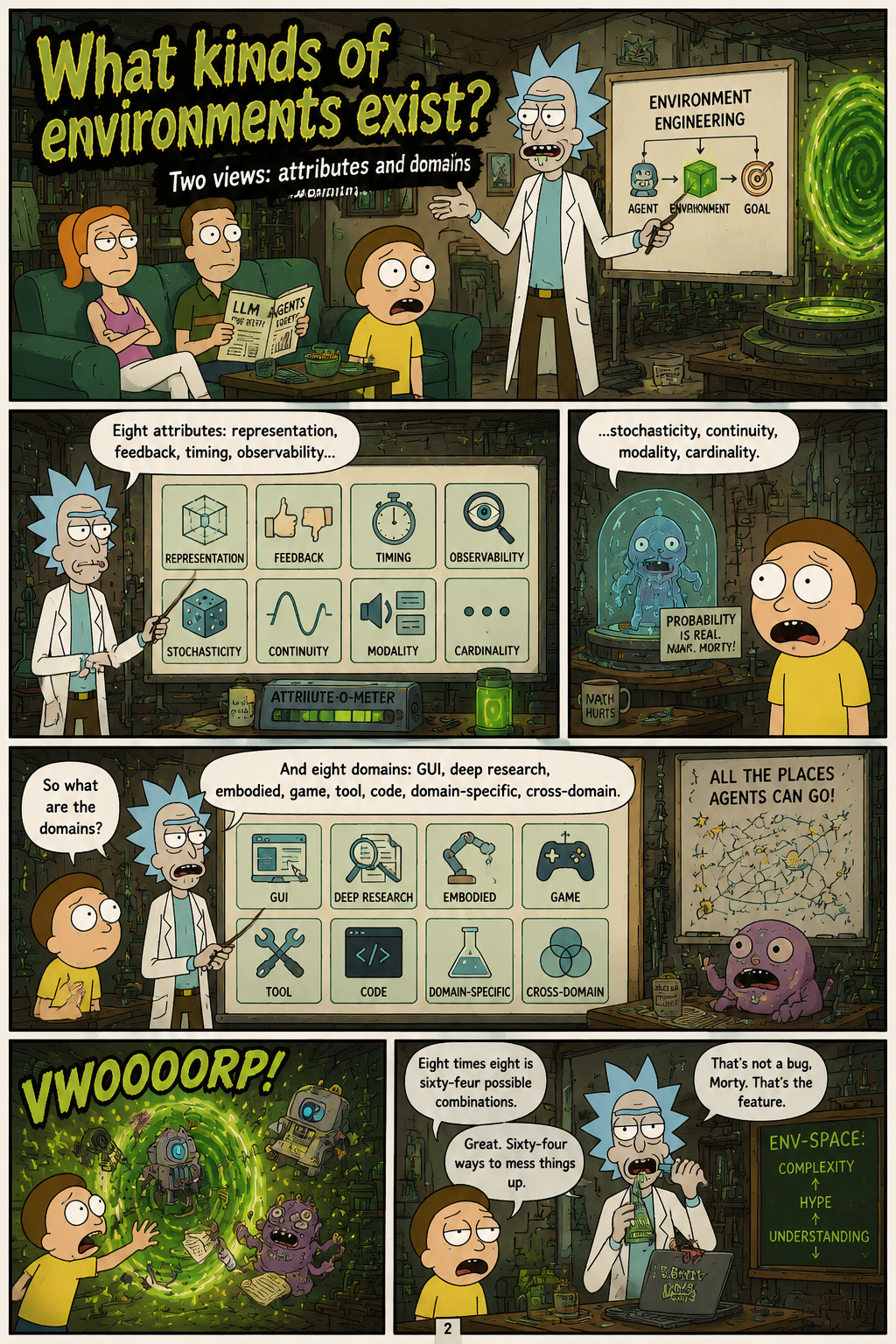
To answer what kinds of agentic environments are worth building, the survey categorizes existing work through eight environment attributes: representation, feedback, timing, observability, stochasticity, continuity, modality, and cardinality. This attribute-based view clarifies how environments differ in what they expose to agents, how they respond to actions, whether their dynamics are deterministic or stochastic, and whether they support single-agent or multi-agent interaction. The paper also classifies environments by eight representative domains: GUI, Deep Research, Embodied, Game, Tool, Code, Domain-Specific, and Cross-Domain. By comparing development paths and core capabilities across these domains, the survey shows that agentic environments are not merely benchmarks but structured interaction systems for testing planning, tool use, reasoning, coding, embodied control, and domain-specific problem solving. A key implication is that current environments remain limited for multi-agent settings and still struggle to balance the engineering reliability of symbolic systems with the generative scalability of neural models.
How do people synthesize environments?
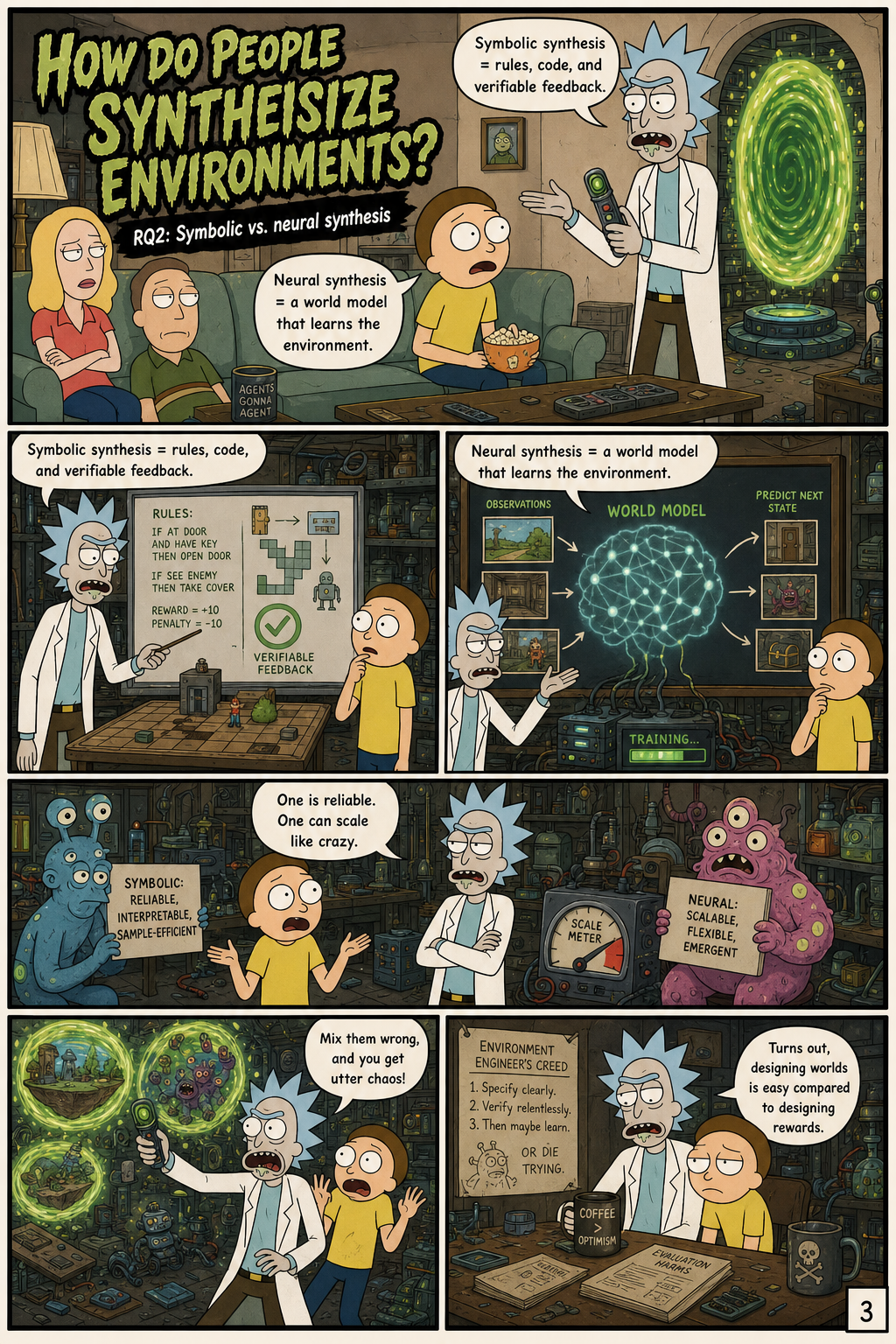
For environment construction, the survey separates automated environment synthesis into symbolic synthesis and neural synthesis. Symbolic synthesis builds environments from explicit rules, code, or other symbolic structures, and it emphasizes verifiable rubrics that can provide reliable environmental feedback. The paper describes an evolution within symbolic synthesis from task-driven approaches to real-world-driven synthesis and then toward de novo synthesis, reflecting a push toward broader and more flexible environment spaces. Neural synthesis instead parameterizes the environment with a neural network, especially a world model, so that interactions are generated through learned mappings rather than hand-specified rules. The survey further distinguishes pixel-level, word-level, and latent-level neural modeling, indicating that learned environments may represent interaction at different levels of abstraction. The broader methodological tension identified by the paper is that symbolic approaches tend to offer stronger correctness guarantees, while neural approaches promise greater scalability and open-ended generation.
How do we judge environment quality?
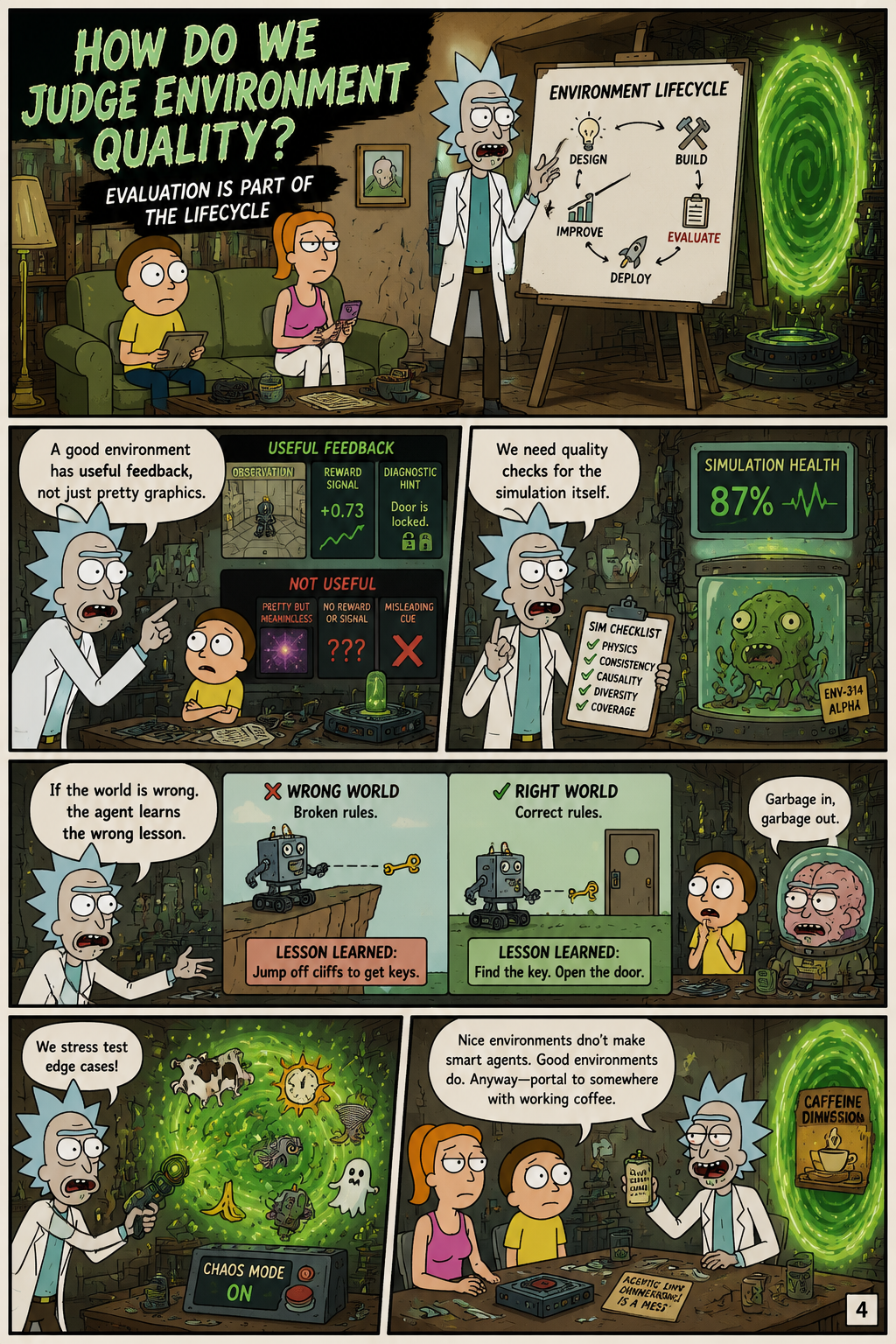
The survey treats environment evaluation as a core part of the engineering lifecycle because agent learning depends directly on the quality of environmental feedback and trajectories. It organizes quality control around correctness, diversity, complexity, and fidelity, which together assess whether an environment behaves reliably, covers varied scenarios, challenges agents appropriately, and matches the target real or simulated task setting. The paper notes that correctness has received comparatively more attention and is supported by several evaluation frameworks, while diversity, complexity, and fidelity remain under-researched. This gap matters because an environment that is formally correct but narrow or unrealistic may fail to train agents for robust generalization across tasks. The survey therefore frames environment evaluation not as a secondary benchmark concern, but as a prerequisite for reliable agent evolution in reinforcement learning, inference-time reasoning, and long-horizon task execution.
Why does any of this matter for agents?
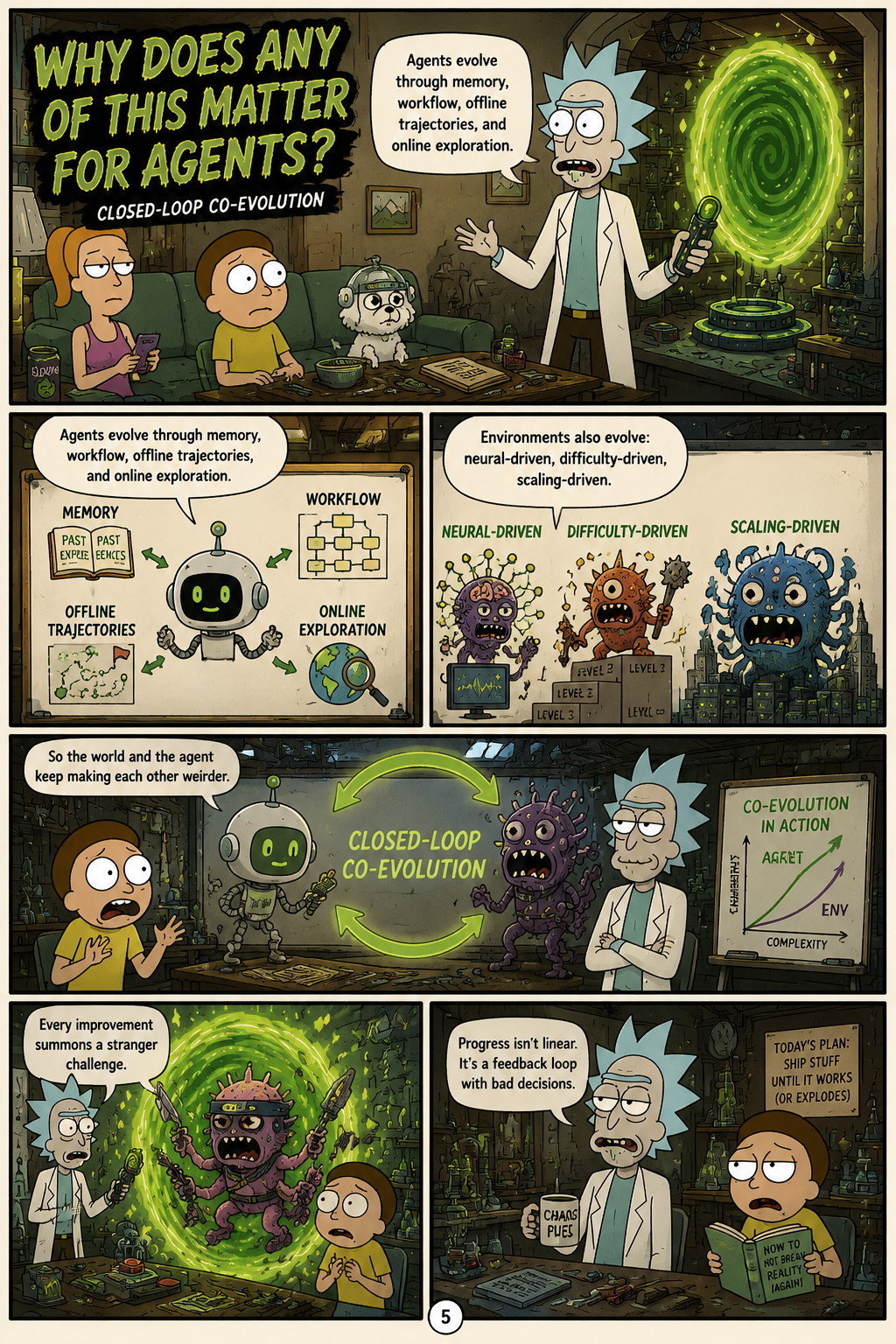
The paper’s application perspective centers on closed-loop agent–environment co-evolution, in which agents improve through interaction while environments also adapt to support further capability growth. For agent evolution, the survey identifies four pathways: memory-centric experience evolution, orchestration-centric workflow evolution, trajectory-centric offline evolution, and exploration-centric online evolution. These pathways cover how agents reuse past interactions, coordinate task sequences or multi-agent workflows, refine behavior from high-quality trajectories, and adapt through reinforcement learning in dynamic environments. For environment evolution, the survey identifies neural-driven, difficulty-driven, and scaling-driven paradigms, corresponding to changing internal parameters, curriculum-like task difficulty, and expansion of scenario diversity or structure. The paper concludes that future progress will likely require Environment-as-a-Service, Multi-agent Environments, Neural-Symbolic Environments, sim-to-real alignment, and a more scientific account of environment scaling laws and environment–capability relationships.